


Who is Marine Le Pen: Macron's far-right rival now banned from office
US President Donald Trump and Elon Musk backed the French leader, drawing parallels between Marine Le Pen and Trump's legal troubles
 "Marine Le Pen")
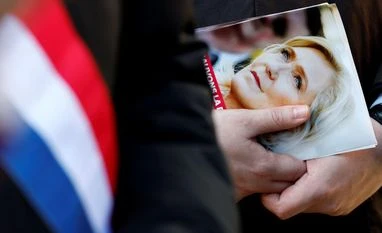
A local elected official from the French far-right Rassemblement National (National Rally - RN) political party, distributes leaflets in support of French far-right leader Marine Le Pen at a market, a day after she was found guilty of embezzlement of
Listen to This Article
Marine Le Pen, leader of France’s far-right National Rally party, has been convicted of embezzling European Union funds and sentenced to four years in prison, with two years suspended. The court also barred her from contesting public office for five years—a decision that could significantly affect the 2027 presidential elections. Le Pen, a three-time presidential candidate and one of President Emmanuel Macron’s key political opponents, has vowed to appeal the ruling.
The verdict has shaken France’s political establishment and is likely to influence European politics as well. Here’s a closer look at who Marine Le Pen is and why the verdict matters.
Who is Marine Le Pen?
Marine Le Pen, 56, is the daughter of Jean-Marie Le Pen, founder of the National Front, which was later renamed the National Rally (Rassemblement National, RN). A populist figure known for her anti-immigration stance, Le Pen has tried to moderate the party’s image since taking over leadership in 2011.
Under her watch, the party moved away from its more openly extremist rhetoric, changed its name, and aimed to appeal to a broader electorate. Despite this rebranding, her platform remains staunchly nationalist and socially conservative. She has campaigned for increasing police forces, banning the Muslim headscarf in public spaces, and curbing immigration.

 "Marine Le Pen")
 "Marine Le Pen")
 "Market, BSE, NSE, NIfty, Stock Market, investment, Loss, Lost")
 "Ranveer Allahbadia")
 "Measles outbreak 2025")
Le Pen’s popularity has grown in recent years. Her party emerged as the largest bloc in the National Assembly following the 2024 snap elections called by President Macron.
What does the National Rally party stand for?
Founded in 1972 by Jean-Marie Le Pen, the National Front—now the National Rally—has historically aligned with far-right ideals, including Euroscepticism and anti-immigration. While under Marine Le Pen’s leadership the party has softened its tone and abandoned its push for France to leave the EU, it remains committed to limiting Brussels’ influence.
Its electoral campaigns have focused on immigration control, cost-of-living issues, crime, and national sovereignty—key concerns among a growing segment of French voters.
What was the embezzlement case against Le Pen?
Le Pen and 23 senior party figures were accused of misusing European Parliament funds between 2004 and 2016. The funds were meant for paying parliamentary assistants but were allegedly diverted to pay staff working for the party in France, including a bodyguard and a private secretary.
The scheme is estimated to have cost European taxpayers around €4 million. During her trial, Le Pen denied wrongdoing, stating she committed “no irregularity.” However, the court concluded she was central to an organised effort to divert EU funds.
Presiding judge Bénédicte de Perthuis said the severity of the fraud and Le Pen’s refusal to acknowledge the misconduct justified both the financial penalty and the political disqualification.
What is Marine Le Pen’s sentence?
Following a three-hour court hearing, Le Pen was sentenced to two years under house arrest, enforced with an electronic monitoring device, and received an additional two-year suspended sentence. She was also fined €100,000.
The National Rally was fined €2 million, half of which is suspended.
Although Le Pen remains a sitting member of the National Assembly, she is barred from standing for public office until at least 2029 unless her appeal succeeds. With the 2027 presidential race approaching, the ruling could dramatically alter France’s political landscape.
‘A political witch hunt’: Le Pen’s response
Le Pen walked out of the courtroom before the sentence was delivered in full and convened an emergency meeting at party headquarters in Paris. Later, she spoke to reporters, calling the ruling a “political decision” intended to eliminate her from public life.
“I will not allow myself to be taken out like this,” she told TF1, promising to appeal “as soon as possible.”
She alleged the ruling was timed to weaken her party’s momentum and likened the situation to authoritarian regimes. “Millions of French people are outraged,” she said.
Impact on French politics
Le Pen’s conviction and disqualification could trigger a major shift in the political balance. Her National Rally has been the most formidable opposition to Macron’s centrist government. If she is unable to run in 2027, it could leave the far right without a unifying figure.
One possible successor is Jordan Bardella, 29, the current National Rally president. Bardella has been touted as a strong contender for European and national leadership roles.
The appeal process could stretch over months or even years, leaving Le Pen’s future—and the opposition’s leadership—uncertain. The verdict comes as the party enjoys record-high polling numbers, making the timing particularly consequential.
Is this Le Pen’s ‘Trump mugshot’ moment?
The sentencing has drawn comparisons to former US President Donald Trump’s legal battles. Some European commentators have described this as Le Pen’s “Trump mugshot” moment, suggesting it could galvanise her support base or position her as a political martyr.
Although Le Pen had previously distanced herself from Trump—particularly after his tariff measures targeting Europe—both Trump and Elon Musk have publicly backed her.
Musk criticised the verdict on social media, claiming it “will backfire, like the legal attacks against President Trump.” Trump added, “That’s a big deal… sounds very much like this country,” drawing parallels with his own ongoing legal woes.
More From This Section
 "Israel strike")
 "Fire, Fire accident")
 "earthquake, Myanmar")
 "Iran's Supreme Leader Ayatollah Ali Khamenei, Donald Trump")
 "John F Kennedy")
Topics : Marine Le Pen France France elections Emmanuel Macron right wing BS Web Reports European Union Explained Decoded
Don't miss the most important news and views of the day. Get them on our Telegram channel
First Published: Apr 01 2025 | 3:39 PM IST