


Nasa uncovers clues about gold's cosmic origin: All you need to know
The mystery of where the precious metal gold came from in the Universe may finally have been solved as Nasa finally has some clues
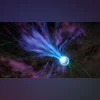 "Magnetar")
Nasa uncovers clues about gold’s cosmic origin (Image source: science.nasa.gov)
Listen to This Article
The origin of metal heavier than iron, such as gold, has always been a mystery. But not anymore. Nasa finally has an answer to how the previous metal has been created and distributed throughout the universe.
A new study led by Columbia University doctoral student Anirudh Patel and published in The Astrophysical Journal Letters suggests that magnetars (highly magnetised neutron stars) could have helped forge and spread elements heavier than iron, like gold, across the universe.
The research also suggests that the magnetar flares may have played a far bigger role than expected.
Patel’s team uses 20-year-old data
Patel and his team used 20-year-old data from ESA and Nasa telescopes to help their study, which found that huge magnetar flares could account for up to 10% of the galaxy’s heavy elements. Magnetars were formed early, and they have created some of the universe's first gold.
Eric Burns from Louisiana State University, who co-authored the study, said it was like solving a century-old riddle using forgotten observations.
Also Read

 "space station, ISS, satellite, international space station")
 "Axiom-4 mission crew members")
 "Don Pettit")
 "ISRO")
 "Nasa astronaut Don Pettit")
“It’s answering one of the questions of the century and solving a mystery using archival data that had been nearly forgotten,” said Eric Burns.
According to the study, these flares came from magnetars. A magnetar is a type of neutron star with an extremely strong magnetic field. One teaspoon of neutron star material could weigh billions of tonnes on Earth.
On rare occasions, the magnetars release huge amounts of high-energy radiation when they undergo 'starquakes'. Starquakes are powerful bursts of radiation called magnetar giant flares, which can even affect the atmosphere of Earth. As of now, only three magnetar giant flares have been observed in the Milky Way and the nearby Large Magellanic Cloud and seven outside.
Searching for clues from the past
When atoms gather too many neutrons, they can decay and gain protons. It pushes them up the periodic table and this process can transform lighter elements into heavier ones like gold, mercury, or even uranium. It needs a neutron-rich setting, which is found during magnetar flares.
In 2017, scientists observed the collision of two neutron stars producing heavy elements. However, such collisions happen too late to explain early gold. Recent work by co-authors Jakub Cehula, Todd Thompson and Metzger suggested that magnetar flares might instead be the missing source.
Initially, Metzger's team thinks that the visible and ultraviolet light is the clue, but then Burns asks if gamma rays might leave a clearer trail. He then revisited data from the 2004 magnetar flare and discovered a mysterious gamma-ray signal recorded by ESA’s now-retired INTEGRAL satellite.
The signal matches the prediction by the team. While recalling his excitement, Patel said, “I wasn’t thinking about anything else for the next week."
Close eye on future flares
The discovery has opened a new door in astrophysics. NASA’s upcoming COSI mission, set to launch in 2027, could confirm these results. This wide-field gamma-ray telescope will look closely at cosmic explosions like magnetar flares, potentially identifying specific elements created during the chaos.
The latest discovery has been a groundbreaking one, opening a new door in astrophysics. Nasa's future mission, scheduled to take place in 2027, could confirm these results. This wide-field gamma-ray telescope will closely observe cosmic events such as magnetar flares, which are expected to identify specific elements created during the chaos.
Reflecting on the journey from cosmic explosions to modern technology, Patel said, “It’s very cool to think about how some of the stuff in my phone or my laptop was forged in this extreme explosion.”
More From This Section
 "artificial intelligence, Technology, algorithm")
 "Iran water crisis")
 "Mark Mobius")
 "ArcelorMittal Nippon Steel")
 "Iran, Iran flag")
Don't miss the most important news and views of the day. Get them on our Telegram channel
First Published: Apr 30 2025 | 6:09 PM IST