


'Was fighting lunatics like you': Trump hits back at reporter on tariffs
During a White House press briefing, US President Donald Trump defended his delayed action on tariffs, saying he 'was fighting lunatics like you' when pressed by a reporter on the issue
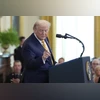 "Donald Trump, Trump")
President Donald Trump (Photo/PTI)


Listen to This Article
At a White House press briefing on Thursday, US President Donald Trump lashed out at a reporter who questioned the timing of his decision to use a decades-old law to impose wide-ranging tariffs. When pressed on why he waited until his second term to invoke the 1977 International Emergency Economic Powers Act (IEEPA), Trump called the journalist a “lunatic”.
The confrontation began after the reporter referred to an ongoing appellate court hearing that is reviewing Trump’s authority to use the IEEPA to impose tariffs. “As you know, a federal appellate court today heard oral arguments about whether or not you had the authority to unilaterally impose those tariffs,” the reporter said. He then continued, “Why didn’t you invoke this law in your first term? You could’ve collected billions upon billions of dollars back then.”
Trump just BODIED a fake news reporter ☠ REPORTER: "Why didn't you invoke this law in your first term?" PRESIDENT TRUMP: "Because in my first term, I was fighting lunatics like YOU!” pic.twitter.com/ZXJU35UcO5
— Libs of TikTok (@libsoftiktok) July 31, 2025
Trump responded, “In my first term, I was busy fighting lunatics like you who were trying to do things incorrectly and inappropriately to a duly elected president.”
Also Read

 "oil trade, Russia, Crude Oil, Vladimir Putin, US sanctions")
 "pharma, tariff")
 "White House ballroom")
 "Donald Trump, Trump")
 "Marco Rubio")
He defended his tariff actions in office, saying, “We took in hundreds of billions from China.” Trump stressed that the US had already collected “hundreds of billions of dollars in tariffs” during his first term. Before moving on, he added, “You people didn’t cover it very well.”
During his presidency, Trump imposed tariffs on Chinese goods starting in 2018, initially on $50 billion worth of imports, which expanded further in 2019.
US court scrutinises Trump’s tariff authority
Judges from a US appeals court on Thursday raised serious doubts about whether President Trump was legally allowed to use emergency powers to justify his tariff policies. The scrutiny came during a hearing where lawyers representing states and businesses argued that Trump had gone beyond his legal authority, news agency Reuters reported.
The US Court of Appeals for the Federal Circuit, based in Washington, DC, is reviewing the legality of tariffs introduced by Trump in April under a “reciprocal” trade framework. These duties were applied to a wide group of America’s trading partners. The court is also evaluating separate tariffs imposed earlier in February targeting China, Canada, and Mexico.
The judges heard arguments in two related lawsuits — one filed by five small US companies and another by a group of 12 US states governed by Democrats. Both suits challenge the President's use of IEEPA to justify imposing tariffs.
Judges quiz legal basis for tariffs
During the hearing, government attorney Brett Shumate was repeatedly asked to clarify how the 1977 IEEPA — which was mainly designed to let presidents freeze assets or impose sanctions on foreign enemies — could be used to set trade tariffs.
Shumate defended the move, saying the law grants the president “extraordinary” powers during a national emergency, including the ability to block imports entirely. According to him, that same power extends to setting tariffs, since the law allows the president to “regulate” imports in times of crisis.
However, Judge Jimmie Reyna expressed skepticism, pointing out that the law never directly refers to tariffs. “IEEPA doesn’t even say tariffs, doesn't even mention them,” Reyna said.
Tariffs on countries set to take effect
On Thursday (local time), Trump signed a new executive order imposing tariffs on 68 countries and the European Union. A 50 per cent duty will apply to Brazilian imports, citing Brazil’s economic policies and actions against former President Jair Bolsonaro. For India, the rate has been fixed at 25 per cent.
The tariffs, effective August 7, are part of Trump’s larger trade strategy ahead of upcoming negotiations. Countries not named in the order will face a 10 per cent baseline tariff.
More From This Section
 "china, china economy")
 "Harvard University")
 "Donald Trump, Trump")
 "Russia Ukraine conflict, Russia Ukraine")
Don't miss the most important news and views of the day. Get them on our Telegram channel
First Published: Aug 01 2025 | 11:00 AM IST