


Who's driving the US-Israel-Iran conflict and who holds power in Tehran now
US and Israeli strikes killed Iran's Supreme Leader Ayatollah Ali Khamenei and top commanders, reshaping Tehran's power structure as questions mount over who will lead next
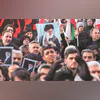 "Mourners at Enghelab Square in Tehran on Sunday after Iran's supreme leader Ayatollah Ali Khamenei was killed in joint Israeli-US strikes. (Photo: Reuters)")
Mourners at Enghelab Square in Tehran on Sunday after Iran’s supreme leader Ayatollah Ali Khamenei was killed in joint Israeli-US strikes. (Photo: Reuters)


Listen to This Article
On Saturday (February 28), the United States and Israel launched a coordinated aerial campaign of strikes across Iran, targeting the country’s leadership, military command infrastructure, missile systems and nuclear-related sites. Iranian state media and US and Israeli officials subsequently confirmed that Ayatollah Ali Khamenei, Iran’s Supreme Leader since 1989, was killed in the strikes on his Tehran compound, following which the Iranian authorities declared 40 days of mourning following his death.
Several senior Iranian military and security officials were also killed in the operation. Consequently, Tehran has responded with retaliatory missile and drone attacks on US assets and allied bases in the Gulf region as the conflict spread beyond Iranian airspace.
The strikes were framed by US and Israeli officials as necessary to degrade Iran’s nuclear ambitions and missile programmes and to neutralise what they described as imminent threats to American forces and regional partners.
President Donald Trump and Israeli Prime Minister Benjamin Netanyahu publicly framed the campaign as a major blow against what they described as existential threats to their countries and regional security. Trump described the situation as an “opportunity for change in Iran’s internal politics”, while Israeli officials emphasised self-defence against Iran’s military capabilities.
The main players at the centre of the Iran crisis
Ayatollah Ali Khamenei
Also Read

 "Trade, Ship")
 "Ozempic, Wegovy, Mounjaro, GLP-1 drugs, semaglutide, tirzepatide, weight loss drugs")
 "International flights")
 "heartbreak, mental health")
 "Kuwait fire")
Khamenei was the Supreme Leader of Iran from 1989 until his recent death, where he was the country’s highest authority, with ultimate control over political, military and security institutions.
His rule was marked by staunch anti-Western and anti-Israeli rhetoric, expansion of Iran’s regional influence through allied militia groups, and sustained development of Iran’s nuclear and ballistic missile capabilities. Early Sunday (March 1), Iran’s state news agency IRNA confirmed that Khamenei, 86, had been killed in the US-Israeli strikes, alongside his daughter, son-in-law and grandson, who were also reported killed.
Iran’s President condemned the killing as an “open declaration of war against Muslims”.
US President Donald Trump
The US president has long taken a confrontational approach to Iran. Even during his first term, Trump withdrew the United States from the 2018 nuclear agreement that had offered Tehran sanctions relief in exchange for limits on its atomic programme. He replaced it with what he called a “maximum pressure” campaign aimed at weakening Iran economically and diplomatically.
Last year, US forces joined Israel in striking Iranian nuclear sites during a previous phase of hostilities. In January, as protests shook Iran, Trump warned he would hit “very hard” if Iranian authorities “start killing people like they have in the past”.
Although he reopened negotiations with Tehran in February, the talks ran alongside continued threats. The latest strikes mark the sharpest escalation of his Iran policy.
Israel Prime Minister Benjamin Netanyahu
For decades, Netanyahu has described Iran’s nuclear ambitions, missile arsenal and support for armed groups as an existential threat to Israel.
His push for military action took shape during a 12-day war in June last year, after which he maintained Israel would act again if Iran rebuilt its attack capabilities.
In January this year, he addressed the Iranian public directly, saying he hoped “the Persian nation will soon be freed from the yoke of tyranny”. More recently, he warned that if Iran attacked Israel, it would face a response it “cannot even imagine”.
Netanyahu has repeatedly called on Iranians to overthrow their leaders and restore relations that existed before the 1979 Islamic Revolution.
Saudi crown prince Mohammed bin Salman
Saudi Arabia’s crown prince has long viewed Iran as a rival but also fears regional instability.
In 2017, he likened Khamenei to a “Middle East Hitler”, straining relations further. Yet in 2023, Riyadh and Tehran restored ties under a China-brokered deal.
When US action appeared likely earlier this year, Saudi Arabia and other Gulf states urged Washington to hold back. Prince Mohammed later pledged not to allow attacks on Iran from Saudi territory, despite hosting a US base.
Which key Iranian officials were killed in the US-Israeli strikes?
Several state media and international reports identified dozens of senior Iranian officials killed during the air campaign on Saturday-Sunday. Among the senior officials killed alongside Khamenei were:
- Ali Shamkhani, a longstanding adviser and national security figure involved in defence planning and negotiations with the US.
- Abdolrahim Mousavi, chief of staff of Iran’s armed forces, who had led ground forces and been elevated to the top military role in 2025.
- Aziz Nasirzadeh, Iran’s Minister of Defence, the former air force commander responsible for national defence planning.
Their deaths represent a near-simultaneous end to Iran’s senior military leadership.
In total, around 40 Iranian leaders and senior commanders were reported killed in the initial phase of what Israeli military officials described as an overwhelmingly precise set of strikes.
Who is in line to succeed Khamenei?
Upon Khamenei’s death, Iran’s constitution provides for an interim leadership council to exercise supreme authority until a new Supreme Leader is chosen by the Assembly of Experts, an elected body of clerics tasked with such appointments.
The interim council comprises President Masoud Pezeshkian, who holds executive authority and is part of the transitional leadership; Gholam-Hossein Mohseni-Ejei, the Chief Justice and senior cleric with judicial and state governance experience; and Ayatollah Alireza Arafi, who is a senior cleric on the Guardian Council and a deputy chief of the Assembly of Experts.
According to international analysts, the next Supreme Leader will be chosen by the Assembly of Experts, with several names surfacing as possible candidates, including:
- Gholam-Hossein Mohseni-Ejei
- Ayatollah Alireza Arafi
- Hojjat-ol-Eslam Mohsen Qomi, who was a close adviser to the late Khamenei
- Ayatollah Mohsen Araki, another senior cleric in the Assembly of Experts.
Although no official successor has been appointed yet, the process remains underway as Iran navigates both a leadership transition and an active military crisis.
More From This Section
 "Iran, US Israel attacks on Iran, Israel Iran conflict, US Iran, Israel Iran")
 "Israel strike")
 "US visa")
 "Ali Larijani")
 "PM Narendra Modi, Canada's Mark carney")
Topics : Benjamin Netanyahu BS Web Reports Israel Iran Conflict US-Iran tensions Iran economy Iran US President Donald Trump Ayatollah Ali Khamenei Mohammed bin Salman
Don't miss the most important news and views of the day. Get them on our Telegram channel
First Published: Mar 02 2026 | 12:59 PM IST