Yet, as Pallavi Raghavan shows in her fine scholarly survey of India-Pakistan relations, the two countries maintained an uninterrupted dialogue during these years in order to resolve —or at least contain and manage — the deep differences that marred their relations. Drawing on available archival material, Ms Raghavan sheds new light on India-Pakistan negotiations on the many contentious issues arising from the partition of British India. These included the management and disposal of evacuee properties, protection of religious minorities, sharing of the Indus Waters, regulation of trade and finance across a newly formed border and the drawn out, but ultimately unsuccessful, efforts to conclude a “No War” Pact.
These negotiations yielded no permanent solutions; yet, argues Ms Raghavan, a “series of ad hoc, interim measures that could be countenanced by both states were devised in the meantime to patch things over”. Regardless of the actual outcome of negotiations, dialogue itself served a very real purpose by helping to maintain a degree of stability in India-Pakistan relations.
The Nehru-Liaquat Pact, for example, was aimed at protecting minority rights in the context of a massive exodus of Hindu refugees from East Pakistan. The refugee influx had triggered calls in India for a military solution. The pact itself “had patchy degrees of success, though it did succeed in stabilizing the flow of migrants across the Bengal delta for the time being. The consequences of the Pact, moreover, went some way to avoid the breakout of a war between the two countries.”
Likewise, negotiations on sharing the Indus Waters came to naught. However, they did bring to light the technical possibility of allowing Pakistan to develop an irrigation system based on the waters of the western rivers, while reserving the eastern rivers for India. The scheme required investments on a scale that was unaffordable in 1953, but it provided the framework of an agreement in 1960, after the World Bank’s offer to provide the requisite financial support.
In early 1950, Jawaharlal Nehru and Liaquat Ali Khan began a correspondence on a “No War” Pact that continued almost till the end of the year. They failed to reach an agreement and Nehru’s initiative may appear to have been nothing more than an exercise in futility. Emphasising the importance of atmospherics, Ms Raghavan argues that the exercise did, in fact, serve an important purpose. The significant feature of the Nehru-Liaquat correspondence on a “No War” pact was that it was in the public domain; the “objective of having the correspondence was to be able to declare loudly that it had taken place.” The central concern, she contends, was image projection at a time when talks were in progress on many other deeply divisive issues. The impulse for dialogue and reconciliation was “not merely fleeting or whimsical, but drew on concrete imperatives which were in the political interests of both governments”.
The book under review is an important contribution to diplomatic history not only because it presents a thoroughly researched and balanced narrative of India-Pakistan relations in the early post-independence years, but also because it offers an alternative perspective. The first feature is captured in the title of the book; the second, in its sub-title. Ms Raghavan presents us with an “alternative history” of Indo-Pakistani relations. She suggests that the “relationship was not necessarily inevitably predisposed toward conflict”, demonstrating how the 1950s “saw a slew of highly constructive inter-governmental exchanges, including a number of major ministerial summits and conferences, frequent — indeed, sometimes almost daily — communication between the two prime ministers, numerous meetings between provincial delegations from either side of the border, and dense engagements between cabinet ministers, bureaucrats and diplomats...”
Surveying the past with an eye on the present, she suggests that “acts of engagement and co-operation are as integral to the interests of both countries as those that perpetuate hostility.”
The reviewer is a retired ambassador and the author of War and Diplomacy in Kashmir, 1947-48 


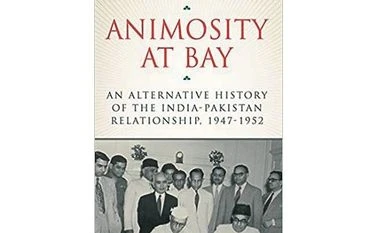 "Animosity at Bay")