


Mumbai's time capsules
The city's quaint elevators are an integral part of its history, Stepping into them is like stepping into another era
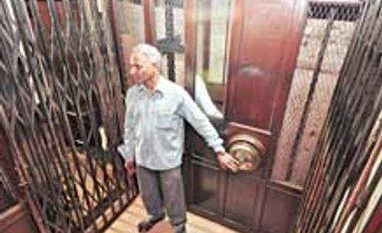 "The lift at Navsari Building is still operated by a hand lever")
The lift at Navsari Building is still operated by a hand lever
If the grim liftman at Navsari Building is to be believed, he has dropped off Shah Rukh Khan, Sachin Tendulkar and Bal Thackeray at the fourth floor for appointments with an eye specialist. But a most intriguing celebrity that this liftman fails to notice is his own workplace - the oldest functioning manual elevator in the city and perhaps the country. Governed by counterweight mechanism and operated by a hand lever, it routinely pulls discerning tourists to D N Road in Fort. Sometimes, tenants may whine if the lift fails but the owners have remained keen on caring for this piece of history. "We realise what we have is unique and we don't want to change it," says Sudhir Kotak of the industrialist family that bought the property from the Tatas in the late 1920s.
A number of such old-style elevators, time capsules in their own right, have survived the advent of technology and impatience and continue to toil in South Mumbai. Maintained painstakingly by owners, most are in Fort, Malabar Hill, Marine Drive or Ballard Estate. Elevators of that era seem to have been imagined not merely as machines, but also as objects of beauty. Their interiors have charming wooden panels that, at times, feature carvings or mirrors which assist visitors in preening. A few cage-style elevators can still be found in the city, including at the Mumbai Port Trust headquarters, where the lift sits inside an ornamental iron enclosure.
The lift at Navsari Building is still operated by a hand lever
An archetypal feature of Victorian buildings is tall ceilings, which makes scaling their levels doubly difficult. A three-storey building from that period is about as tall as a modern one with seven floors - one has to climb 32 steps to get to the first floor of the General Post Office (GPO). While lifts became a part of architecture plans in later years, some already completed buildings added them as an afterthought. The Port Trust office in Fort was finished in 1891 but a lift was built in the orifice of the stairs around 1925, according to Chairman Ravi Parmar. Kodak House, which also belonged to the Tatas before it was sold to Deutsche Bank, is 110 years old but its elevator is aged about 100.
The Taj Mahal Palace hotel has three lifts in its heritage wing, with filigree work and antique silk panelling that made a guest compare the ride to "being in a jewellery box". George Harrison travelled incognito in one to meet sitar maestro Ravi Shankar when he was recognised and drew a large crowd to the lobby. Previously, Mahatma Gandhi had refused to use the grand lifts and instead walked up the stairs. Ornate lifts are found also at The Ripon Club and The Royal Bombay Yacht Club which was recently restored.
The old lift manufacturers have either closed down or merged with bigger companies over the years. Navsari has a lift made by Spain's Stigler, which was taken over by Kone. There are Waygood lifts at GPO and the Port Trust. That company was later bought out by Otis. Spare parts are no doubt hard to find but resourceful maintenance firms like Alif Elevators insist they can fix "any type of old lift". They care for 150 to 200 elevators in the city, after seeking a safety review from the Public Works Department. If the ropes and wires are sturdy, heritage lifts can be maintained in the present condition, says conservation architect Vikas Dilawari. The older lifts are also more open and airy, he notes.
Stepping into one, it is easy to imagine the generations of awkward silences and sidelong glances these booths have witnessed, or the tunes they must have heard being hummed or drummed on their walls at the end of a day's work. The ageing lifts are not as slow as one might expect, but if one does get restless on the way, some of them feature benches. Liftmen are almost always present because it takes skill to operate the lifts and crowding has to be avoided for safety. When more people climb in, the lift stops short of the floor, observes Dayanand Gurav who mans the elevator at Navsari Building. Another lift operator at GPO, who has served there for 24 years, believes modern lifts are no competition. "You can't dent these wooden walls," he says, knocking on them.
Recently, another person was impressed by the quality of wood used in a quaint elevator. Liberty Cinema, the art deco theatre built in 1949, has two striking lifts customised with white Canadian cedar and dark Burma teak. A representative of the Canadian Council, who visited recently, took the help of a wood expert and discovered that Canada had since stopped exporting such a high grade of cedar. "The manufacturer is Schindler but the powder and lipstick is ours," chuckles owner Nazir Hoosein whose father meticulously worked on these details. Over time, the lifts' push-button panels have ruefully been replaced, but the old mirrors are intact and the ride remains noiseless. Some years ago, Hoosein presciently sourced spare motors from Chor Bazaar.
The rows of residential art deco buildings in South Mumbai also house these historical machines. Lawyer and historian Rajan Jayakar who lives in one such building, Court View, says, "Residents, chiefly Parsis, have been caring for these lifts for generations." Incidentally, some of these lifts even tend to behave like Parsi cafes, known for their quirky warnings. "This lift is not for going down," says one, while another warns, "Enter at your own risk."

Don't miss the most important news and views of the day. Get them on our Telegram channel
First Published: Nov 29 2014 | 12:27 AM IST