


Tarantino does it again
The magic of The Hateful Eight lies in its storytelling
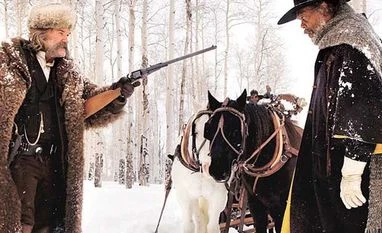 "The Hateful Eight")
In a desolate landscape covered with snow, where time and being seem to be of little consequence, a gnarled tree comes into view. Then you realise the tree trunk is not what it seems; it's a stone crucifix with Jesus. Deceptive appearances, thus, rightly set the tone for Quentin Tarantino's eighth film, The Hateful Eight.
Tarantino's latest thriller unfolds in blizzard-hit Wyoming, shortly after the American Civil War. And it is here, on a trail that is struggling against fresh snow, that we meet Major Marquis Warren (Samuel L Jackson). A former Union cavalry officer who claims to have a letter from Abraham Lincoln, Warren, now a bounty hunter, is taking three bodies to Red Rock - in The Hateful Eight, Red Rock is where all roads lead to.
A stagecoach soon comes along, and a substantial part of the six-chapter film is set in the six horse-drawn carriage. Here's where Warren meets the other two of Tarantino's "hateful" characters - tough bounty hunter John Ruth (Kurt Russell) and Daisy Domergue (Jennifer Jason Leigh), his black-eyed prisoner who has a wicked smile. Although he doesn't have to turn her in alive to claim the $10,000 bounty, punching-man Ruth has sworn to see spitting-woman Domergue hang.
The blizzard is a silent but weighty actor in the film. It's the reason why Warren seeks Ruth's help in getting to Red Rock; why rebel reprobate Chris Mannix (Walton Goggins) joins the two en route; and why they all have to stay confined in Minnie's Haberdashery, an inn that serves stew and coffee - regular and poisoned.
The inn's owners are conspicuous by their absence, but it's at Minnie's Haberdashery that the rest of the cast from the title comes together. There's the former Confederate general Sanford Smithers (Bruce Dern), who barely moves from his place by the fire, and cattle hand Joe Gage (Michael Madsen). The flamboyant English hangman, Oswaldo Mobray, is played by Tim Roth, while Bob, the inn's Mexican caretaker, is Demián Bichir. And all of the "hatefuls" have blood on their hands. There's a lot on their minds, too, except remorse.
It's hard to make an educated guess about a Tarantino project until you've seen it till the end, and The Hateful Eight is no exception. However, you can't shake off the feeling that all the characters, perceived to be strangers to one another, are somehow connected. Thus, they all simmer together till the lid is blown off with a rifle shot.
As is expected from Tarantino, there's a generous offering of blood splatter, cranial explosions, hard punches and pipe-smoke. Even more opulent are the dialogues. There's so much full-naming and talking in the film that older scenes slip away as you are pulled into newer ones, but that's also a hallmark of the film - that and the theatricality of it all. When different characters nail the same door shut at different times using two blocks of wood, the scenes are both comical and intense.
And, though the music - particularly Apple Blossom by The White Stripes - and Robert Richardson's cinematography are as smooth as the acting, what truly makes The Hateful Eight worth watching is Tarantino's storytelling. His voice, which pops up as an anonymous narrator's between the scenes, dots the cold and dark narrative.
As the "hateful eight" join Tarantino's own gallery of rogues - the Tarantino hall of fame that features unforgettable characters such as Kill Bill (2003) schoolgirl Gogo Yubari - you may need a break in the three-hour-long drama. But, maybe, keep it short.
Tarantino's latest thriller unfolds in blizzard-hit Wyoming, shortly after the American Civil War. And it is here, on a trail that is struggling against fresh snow, that we meet Major Marquis Warren (Samuel L Jackson). A former Union cavalry officer who claims to have a letter from Abraham Lincoln, Warren, now a bounty hunter, is taking three bodies to Red Rock - in The Hateful Eight, Red Rock is where all roads lead to.
A stagecoach soon comes along, and a substantial part of the six-chapter film is set in the six horse-drawn carriage. Here's where Warren meets the other two of Tarantino's "hateful" characters - tough bounty hunter John Ruth (Kurt Russell) and Daisy Domergue (Jennifer Jason Leigh), his black-eyed prisoner who has a wicked smile. Although he doesn't have to turn her in alive to claim the $10,000 bounty, punching-man Ruth has sworn to see spitting-woman Domergue hang.
The blizzard is a silent but weighty actor in the film. It's the reason why Warren seeks Ruth's help in getting to Red Rock; why rebel reprobate Chris Mannix (Walton Goggins) joins the two en route; and why they all have to stay confined in Minnie's Haberdashery, an inn that serves stew and coffee - regular and poisoned.
The inn's owners are conspicuous by their absence, but it's at Minnie's Haberdashery that the rest of the cast from the title comes together. There's the former Confederate general Sanford Smithers (Bruce Dern), who barely moves from his place by the fire, and cattle hand Joe Gage (Michael Madsen). The flamboyant English hangman, Oswaldo Mobray, is played by Tim Roth, while Bob, the inn's Mexican caretaker, is Demián Bichir. And all of the "hatefuls" have blood on their hands. There's a lot on their minds, too, except remorse.
It's hard to make an educated guess about a Tarantino project until you've seen it till the end, and The Hateful Eight is no exception. However, you can't shake off the feeling that all the characters, perceived to be strangers to one another, are somehow connected. Thus, they all simmer together till the lid is blown off with a rifle shot.
And, though the music - particularly Apple Blossom by The White Stripes - and Robert Richardson's cinematography are as smooth as the acting, what truly makes The Hateful Eight worth watching is Tarantino's storytelling. His voice, which pops up as an anonymous narrator's between the scenes, dots the cold and dark narrative.
As the "hateful eight" join Tarantino's own gallery of rogues - the Tarantino hall of fame that features unforgettable characters such as Kill Bill (2003) schoolgirl Gogo Yubari - you may need a break in the three-hour-long drama. But, maybe, keep it short.

Don't miss the most important news and views of the day. Get them on our Telegram channel
First Published: Jan 16 2016 | 12:17 AM IST