


Need for liquidity set to drive secondary deals in the Indian market
Secondary deals are driven by the need to create liquidity, so that fund managers can move onto the next fund
 "Need for liquidity set to drive secondary deals in Indian market")
premium
Last Updated : Oct 10 2018 | 11:47 PM IST
One of the best ways for venture capital (VC) firms to realise value is to take a company public. However, it often takes time for an investment to mature, while a VC fund has a fixed life of 10 years. By the end of which, it has to start returning capital to its investors, called LPs (Limited Partners).
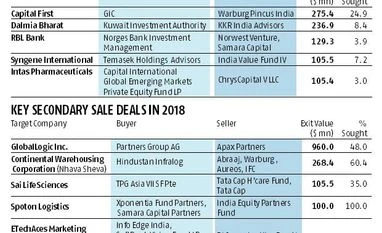
Another way to find an exit is to sell the firm to another VC or private equity (PE) investor. This PE to PE deal is called a secondary sale. As VCs which are close to their fund life look for liquidity, secondary deals are likely to gain ground in India, partly driven by secondary specialists.
Hong Kong-based secondary specialist New Quest Capital Partners is in talks to buy the India portfolio of New Enterprise Associates (NEA). The firm, backed by TPG Capital, is also in talks with IDG Ventures to buy four companies from its first fund. These are not the only deals.
In August 2018, Edelweiss’ alternate asset arm, Edelweiss Alternate Asset Advisors, acquired two real estate funds of Milestone Capital. US-based General Infrastructure Partners (GIP) bought PE firm IDFC Alternatives’ infrastructure fund. TRG Capital has bought JP Morgan’s Asia infrastructure fund, which includes its investments in India.
NewQuest has invested over $500 million
(Rs 37 billion) in India. ‘‘We expect the secondary opportunity to rise in India. As the PE and VC market in India matures, the secondary market opportunity will increase accordingly. India funds also have a long tail, best addressed through innovative secondary transactions,'' says Amit Gupta, founding partner of NewQuest Capital.
Secondary deals are driven by the need to create liquidity, so that fund managers can move onto the next fund. VC firms started in India in 2005 and the eco-system is in its teens.
‘‘Limited Partners (LPs, investors in PE firms) have a 10-year window on venture capital and they expect their money back,'' says Rahul Khanna, managing partner, Trifecta Capital. He was part of Canaan Partners in India, which sold its portfolio to its LP, JPMorgan. Most VC firms in India are on to their third or fourth funds, having deployed fund one, called fund two and investing from the third fund.
‘‘How are they going to continue to raise equity without making significant distribution? Liquidity events like Wal-Mart are fewer and GPs are taking a view that every three-four years, they need to take some money off the table,'' adds a GP or fund manager. A leading VC firm had put 8-10 firms in a portfolio (mixed bag) and partly exited it.
To be sure, exits through strategic sales and Initial Public Offers of equity are more popular. ‘‘There's no pattern around secondary deals but, as the fund cycle gets longer, and the pressure builds on, it needs to be relieved,'' says a fund manager. There are three types of secondary deals: at the company level (one PE sells to another), at the portfolio level or LP swaps, where one LP wants out and another wants in.
Sometimes, it is used as a way to create a new platform and existing fund managers continue to manage the portfolio. Lightbox Ventures acquired six firms from Kleiner Perkins and Sherpalo Ventures that its founding partner, Sandeep Murthy, had invested in. Similarly, existing fund managers at NEA could continue to manage the portfolio after New Quest acquires the portfolio. ‘‘A new sponsor could give more money to deploy. For a fund manager, it is easier to raise a fund if you have a portfolio,'' says Khanna.