


SBI likely to report 24% fall in Q2 net on bad loans, MTM losses
Notably, this will be the third quarter in a row wherein the net profit will fall on a year-on-year basis
)
State Bank of India is slated to announce its results for the quarter ended September on Wednesday. The net profit is pegged at Rs 2,795 crore, down 23.6 per cent as compared to the September 2012 quarter. The net interest income (NII) is seen at Rs 11,866 crore, up 8.1 per cent.
While loan growth is estimated at 20 per cent, in line with the bank's performance in recent quarters, higher provisions towards bad loans and mark-to-market (MTM, writing down assets in line with current valuations) losses could lead to a sharp fall in net profit.
Notably, this will be the third quarter in a row wherein the net profit will fall on a year-on-year basis. At Rs 2,795 crore, it would be the lowest over the past eight quarters. In the June 2011 quarter, the net profit was Rs 1,583 crore. Net interest margin, though, is expected to remain stable at 3.2 per cent.
"With a sharp rise in rates of commercial paper, demand for credit might have shifted to SBI, that has the lowest base rate (among banks) at 9.8 per cent. Hence, credit is estimated to grow at a strong pace of 20 per cent in the September quarter, which will also support NII growth", says Kajal Gandhi, banking analyst at ICICI Securities.
For the quarter gone by, when now-retired Chairman Pratip Chaudhary was at the helm, it had resorted to "taking over" large corporate accounts from competing banks by offering cheap lending rates. This strategy, though supported by loan growth, could hardly be income-accretive. The only benefit it has provided is growing the asset book and reducing the prospects of slippages, since these are investment grade accounts with strong collaterals.
The bank has a sizable restructuring pipeline, of about Rs 10,000 crore, over the next few quarters. It will continue to witness higher slippages in this one, believe analysts. While net slippages might improve sequentially, the asset quality woes are far from over.
"On a sequential basis, SBI's net slippages (on a high base) are expected to decline, with expectation of both lower gross slippages and higher recoveries and upgrades. We factor a net slippage ratio of 1.8 per cent and credit cost of 0.90 per cent," believes Alpesh Mehta, banking analyst at Motilal Oswal Securities.
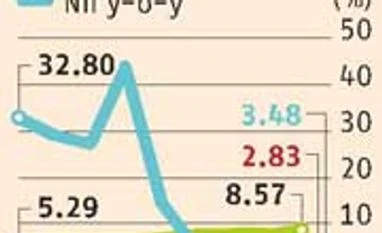
Notably, the gross non-performing assets (NPA) plus restructured assets ratio has increased from 5.3 per cent in the June 2011 quarter to 8.57 per cent in the June quarter (see chart). Its net NPA ratio has risen to 2.8 per cent from 1.6 per cent in the same period.
Also, the bank is estimated to report net investment losses of Rs 100-120 crore as against Rs 490 crore of investment gains in the September 2012 quarter, pulling down the net profit further. Management commentary on asset quality will be keenly watched, as will loan growth.
A senior SBI official says the operating environment remains under strain, due to the adverse effect of slow economic growth. But the slippages are unlikely to be on the same scale as the first quarter. This one would be challenging on asset quality. There has been emphasis on recoveries and early detection and action for potential NPA accounts. The new chairperson has emphasised this as a priority.
Analysts remain divided on the scrip. Of the 20 analysts polled by Bloomberg since October, nine have a 'Buy' rating, eight have a 'Sell' and the other three have a 'Neutral' view. Their average target price is Rs 1,717 a share, indicating the stock appears fairly valued.

Don't miss the most important news and views of the day. Get them on our Telegram channel
First Published: Nov 13 2013 | 12:24 AM IST