


Street may ignore Vedanta's Q2 profit miss
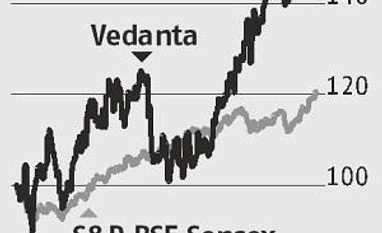
Rising volumes and robust realisations will drive growth in most segments
 "data")
premium
Last Updated : Nov 02 2017 | 11:13 PM IST
Vedanta’s performance in the September quarter (Q2) was supported by growing volumes in the zinc, copper and aluminium segments and rising base metal prices. But, the benefits were partially mitigated by lower oil and gas volumes, currency appreciation and an increase in the cost of production of aluminium.
While the mining major reported impressive sales, Ebitda (earnings before interest, tax, depreciation and amortisation) and net profit year-on-year (y-o-y) growth of 37 per cent, 24 per cent and 41 per cent, respectively, profitability was a tad lower than the estimates. Revenues at Rs 21,590 crore were three per cent higher than consensus estimates. But, Ebitda at Rs 5,776 crore and net profit at Rs 2,036 crore were lower than their respective Bloomberg consensus estimates of Rs 5,927 crore and Rs 2,242 crore.
While rising crude oil prices have lifted expectations as well as prospects of the oil and gas segment, a decline in production in Q2 caused the segment’s revenue and profitability (at Ebit, or earnings before interest and tax level) to decline 8 per cent and 25 per cent sequentially. But, this is seen as a temporary blip. Vedanta expects production to average at 191,000 barrels of oil equivalent (boe) per day in FY18, against 180,955 boe in Q2, as exploration projects continue.
Among base metals, Q2 witnessed record aluminium production at 401,000 tonnes and alumina at 269,000 tonnes. But, cost of producing aluminium at $1,857 per tonne was up sequentially ($1,727 during Q1) due to high power cost consequent to coal shortages and the ash dyke incident.
High prices of inputs (caustic and carbon) were offset by lower cost of imported alumina. Costs are likely to remain elevated in the December quarter (Q3) as well (company guidance of $1,850-1,900 per tonne), but are expected to decline sharply in the January quarter. The ramp-up of the 500,000-tonne Jharsuguda-I smelter by Q3 and that of the 1.25-million-tonne Jharsuguda-II smelter should boost volumes. Average aluminium prices, up 24 per cent y-o-y on the LME, are also expected to remain firm, with a clampdown on capacities (up to 30 per cent this winter) in China. These should help offset some of the cost pressures.
The copper segment saw record quarterly cathode production of 106,000 tonnes and also benefited from higher average prices (up 33 per cent) on the LME. The pricing outlook for copper is also firm, given the average global demand-supply deficit of 180,000-210,000 tonnes for 2017-19, analysts said. In the zinc business, Hindustan Zinc is driving volume growth, which at 230,000 tonnes was up 27 per cent y-o-y.
Vedanta’s international zinc business should see further benefits as its Gamsberg project starts production by mid-2018. Zinc’s mined output growth in China (40 per cent of global zinc mined output) is likely to remain muted, as supply shortfall is expected to persist through 2018, a Deutsche Bank report said.
The outlook appears strong, and the Street may ignore Q2’s miss on profitability.