


India tumbles 11 places on competitiveness index
A global competitiveness index by WEF puts India at 71st spot among 144 countries
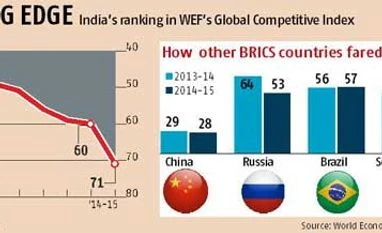)
There were 144 countries ranked in the Global Competitiveness Report 2014-15 released by the World Economic Forum (WEF) on Wednesday. “On a downward trend since 2007 and dropping by 11 more places this year India ranks 71st. The government faces the challenge of addressing the country’s competitiveness weaknesses and reviving the economy, which is currently growing at half the rate of 2010,” the report said.
The data came a few days after India’s economy grew at a two-year high of 5.7 per cent in the first quarter of the current financial year, bolstering spirits in the government as well as industry.
The country’s ranking in the global competitiveness index (GCI) was 48 in 2007-08 (three quarters of which fell in calendar year 2007) and it slipped to 50 a year later.
What could be an eye-opener for policymakers is the fact that Russia was at the 64th rank in 2013-14, four notches below India. However, it is 53rd in 2014-15, much ahead of India. At 28th, China stands some 40 places ahead of India.
The report said as the poorest economies among emerging Asian countries — India and Myanmar — were transitioning away from agriculture and developing a manufacturing base they would need to create a sound and stable institutional framework for local and foreign investors and improve connectivity.
Manufacturing push
“Manufacturing accounts for less than 15 per cent of India’s GDP. Agriculture represents 18 per cent of output and employs 47 per cent of the workforce. Low productivity in the sector means very low wages and a life of mere subsistence for many,” it said.
The country’s rankings on specific yardsticks were somewhat peculiar. While it ranked higher on more complex areas of competitiveness — innovation (49th) and business sophistication (57th), on the basic drivers of competitiveness such as health and primary education, its performance was poor.
India had its lowest rank in technological readiness (121st). Despite mobile telephony being almost ubiquitous, India is one of the world’s least digitally connected countries. The report said despite its immense potential and promise, by many accounts, India continued to suffer from poverty.
A third of India’s population still lives in extreme poverty — possibly the highest incidence outside sub-Saharan Africa — and many people still lack access to basic services and opportunities, such as sanitation, health care, and quality schooling.
“There are encouraging signs,” the report noted. “India has achieved spectacular progress on various measures of corruption and now ranks 65th. Red tape seems to be less of an issue than it had been, and government efficiency is equally improving.”
However, it said the overall business environment and market efficiency (95th, down 10 places) are undermined by protectionism, monopolies, and various distortionary measures, including subsidies and administrative barriers to entry and operation.
It quoted the World Bank’s data on ease of doing business to say that it took 12 procedures and almost a month to register a business in India. Besides, taxes for a typical registered firm amount, on average, to 63 per cent of profits.

Don't miss the most important news and views of the day. Get them on our Telegram channel
First Published: Sep 04 2014 | 12:48 AM IST