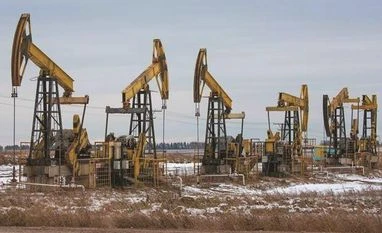
Brent crude oil prices are up nearly 20 per cent in the past month and hit a three-year high of $80 per barrel on Tuesday on the commodity exchanges.
This will raise the price of crude oil imported by India, forcing oil-marketing companies to raise fuel prices, leading to higher retail or consumer inflation. Higher crude oil prices will also translate into higher input prices for consumer goods companies. Analysts say an oil-induced rise in input price may also lead to decline in corporate margins.
"The sharp increase in global energy prices and the prospects of elevated prices may pose another source of risk to global and domestic inflation. Markets have been sanguine about inflation being transitory. However, ongoing supply-led disruptions across commodities may result in higher-than-expected entrenched inflation," write analysts at Kotak Institutional Equities.
Historically, there has been a positive correlation between Brent crude oil prices and overall inflation in India as captured by the price deflator for India's gross domestic product (GDP). The GDP price deflator takes both wholesale price index (WPI)-based inflation and consumer price index (CPI)-based inflation into account.
According to the data from BP, Brent crude oil price doubled between 2005 and 2011. In the same period, overall inflation in India jumped from 4.6 per cent in 2005-06 to nearly 10 per cent in 2010-11. Similarly, a sharp moderation in inflation after 2012 was accompanied by a decline in crude oil prices globally.
Inflation is once again creeping up in India after hitting a low in 2019-20 (FY20). Overall inflation was up nearly 60 basis points in 2020-21 to 4.3 per cent, from 3.7 per cent in FY20. CPI was 5.5 per cent on average in April-August 2021, while WPI was in double digits.
The data suggests that the price rise has been faster in the US. The retail inflation in the US averaged 5.1 per cent in April-August 2021, against overall inflation of 4.5 per cent during the 12 months ended March 2021, and just 0.6 per cent in the April 2019-March 2020 period. Analysts attribute this to a much bigger fiscal stimulus in the US.
Others also attribute it to the rising power cost in China and Europe. "Power costs are up sharply in Europe and China, leading to higher operating cost for manufacturers. This, coupled with existing Covid-19 disruption to the global supply chain, may lead to even higher inflation in manufactured and consumer goods," says Dhananjay Sinha, managing director and chief strategist, JM Financial Institutional Securities.
A spike in natural gas prices has also raised fears about food inflation. The spike has forced some fertiliser companies in Europe to cut production.
Others, however, believe that inflation remains transitory. “Fuel inflation may go up somewhat, but overall consumer inflation will remain more or less at the current rate due to benign food prices and base effect,” says Madan Sabnavis, chief economist, CARE Ratings.
Market analysts expect one or two quarters of negative surprise in terms of higher inflation and lower corporate margins, but stay put on growth projections. “I don’t see inflation to be structural in nature. We are not changing the forward earnings estimates for 2021-22 and 2022-23,” says Shailendra Kumar, chief investment officer, Narnolia Securities.


 "Crude oil, Brent Crude, oil production")

