


Shipping ministry, DIPP fight over ownership of coastal economic zone plan
The shipping ministry is implementing the CEZs under the government's ambitious Sagarmala programme
 "chart")
premium
Last Updated : Dec 01 2018 | 2:29 AM IST
The government's plan of setting up 14 coastal economic zones (CEZs) is caught in a squabble between the shipping ministry and the Department of Industrial Policy and Promotion (DIPP) with the latter questioning the shipping ministry's expertise in executing it.
It is learnt that NITI Aayog, too, has objected to the shipping ministry implementing the CEZs. NITI Aayog had earlier said that CEZs should be renamed "coastal employment zones" and that the focus of the projects should be on job creation. This would mean that employment generation would be the principal criterion for granting approvals to companies looking to set up manufacturing units in these zones.
Officials at the DIPP said that since the department oversees special economic zones (SEZs) and the legal framework of CEZs is based on India's SEZ policy, DIPP should also get to handle the CEZs. "It makes sense for the DIPP to handle the CEZs since industrial licensing and other matters concerned with setting up mega manufacturing zones is DIPP's domain," a senior DIPP official said.
However, a shipping ministry official told Business Standard: "CEZs are not the same as SEZs. The CEZ projects we are implementing are much bigger in size. These would be along the coastal areas and near major ports and would not cover SEZs."
The shipping ministry is implementing the CEZs under the government's ambitious Sagarmala programme, which is a Rs-8.5 trillion project to develop India's ports, waterways and the coastline. Since the CEZs require port-led development, they are not on the same corridors as the DIPP projects, the ministry official pointed out. Besides, they are to have a distinct identity, which is quite different from the existing SEZs, he added.
Last month, a committee headed by Bharat Forge chairman, Baba Kalyani, came out with a report which suggested changes to the SEZ policy to bring it more in line with international norms. The report, forwarded to the NITI Aayog and the Prime Minister's Office, proposes merging the SEZ policy with other schemes such as CEZs, the Delhi-Mumbai industrial corridor, national industrial manufacturing zones and food and textiles parks.
The DIPP has also armed itself with a report by a high-level committee set up to make India's policy on SEZ compatible with World Trade Organisation rules.
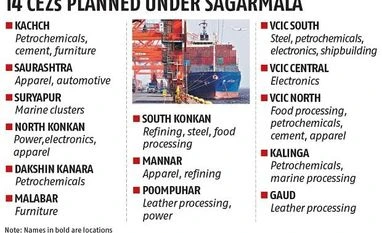
The 14 CEZs announced by the government in July 2016 under the Sagarmala programme will cover all the maritime states and Union Territories and were identified as part of the programme's National Perspective Plans. The Perspective Plans were prepared in consultation with the relevant state governments and central ministries.
The proposed CEZ sites are: Kachh, Suryapur and Saurashtra in Gujarat; North and South Konkan in Maharashtra; Dakshin Kanara in Karnataka; Malabar in Kerala; Mannar, VCIC South and Poompuhar in Tamil Nadu; VCIC Central and North in Andhra Pradesh; Kalinga in Odisha; and Gaud in West Bengal.
The Sagarmala programme has four features – port modernisation, port connectivity, port-led industrialisation and coastal community development. The CEZs fall under the third category and through them the government hopes to give an impetus to its "Make in India" initiative.