The consumer price index rose 2.5% from a year earlier, the National Bureau of Statistics said Friday, down from 2.7% gain in July and weaker than the 2.8% median forecast in a Bloomberg survey of economists.
Consumer prices in China have remained mild this year compared to the soaring costs in the US and Europe, where central banks have been hiking interest rates in an attempt to tame inflation. The People’s Bank of China has taken a divergent path, cutting interest rates last month to spur an economy hit by Covid outbreaks and an
ongoing property market slump.
Friday’s data “reflects soft domestic demand and suggests that further easing is needed to stabilize growth,” said Liu Peiqian, chief China economist at NatWest Group Plc. A slower-than-expected pickup in food prices “gives policy makers more room for easing in coming months,” she said.
China’s benchmark CSI 300 Index was up 0.7% as of 9:50 a.m. local time, while the yield on the 10-year government bond held steady at 2.63%. The onshore yuan was little changed after the data release, trading at 6.9495 per dollar.
Core CPI, which excludes the volatile food and energy costs, was unchanged at 0.8% in August, a sign of weak domestic demand in the economy as Covid outbreaks curbed spending on consumer goods and services.
What Bloomberg Economics Says...
China’s soft price data for August suggests inflation won’t be a major constraint to monetary easing anytime soon. To the contrary, anemic gains in core consumer prices and deep falls in metal costs are signs of weak demand and a recovery that’s struggling on multiple fronts. This means more policy support is needed.
Food inflation was largely driven by a pickup in pork, which climbed 22.4% in August from a year ago, after surging 20.2% in July. The government has been trying to keep inflation in check by releasing frozen pork from its massive state reserves, with the National Development and Reform Commission saying Thursday it would release some supplies as major celebrations such as the Mid-Autumn Festival and the National Day holiday draw closer.
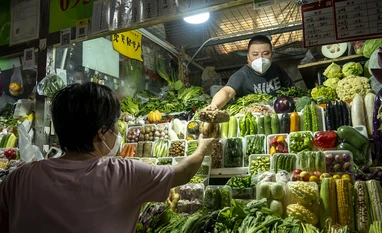
Growth in fresh vegetables prices eased to 6% from July’s 12.9%, while fresh fruits increased 16.3%. Overall food prices eased slightly to 6.1% from 6.3% in July.
A moderate amount of inflation is unlikely to inhibit the central bank from rolling out additional stimulus measures this year as needed to support growth. Earlier this month, PBOC spokeswoman Ruan Jianhong said the “mild” rise in consumer prices provided “good conditions for monetary policy adjustment.”
CPI inflation is likely to “run on top of” PPI going forward, reversing a trend that’s been happening since early last year, according to Zhou Hao, chief economist at Guotai Junan International Holdings Ltd. That suggests cost pressures “will be eased somewhat for manufacturers, as profit margins will improve,” he said.
A “relatively benign inflation profile would allow the monetary authorities to provide support to the economy in the near future,” he added.
Premier Li Keqiang said in July that as long as the increase in annual CPI stays under 3.5%, the country can “live with” an economic growth rate that is slightly higher or lower than the government’s target of around 5.5%. Economists expect gross domestic product growth to hit just 3.5% this year.


 "China inflation")