


Chinese stocks resume rout
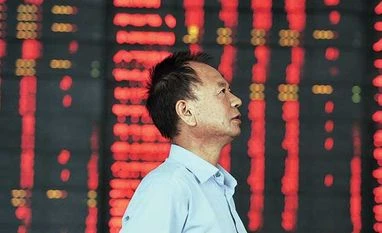)
An investor stands at a brokerage house, near an electronic board filled with red figures indicating rising prices, in Fuyang, China on Tuesday
China's stocks slumped to a two-week low, due to concerns a slowing economy and weaker currency might spur capital outflows. The Shanghai Composite Index dropped 3.4 per cent to nearly 3,664 at the close, the lowest level since August 6. About 17 per cent of mainland-listed shares remain halted. The Hang Seng China Enterprises Index sank 2.3 per cent to a 10-month low, while the Hang Seng Index closed within three points of entering a bear market.
"The market will trade between 3,500 and 3,900 in the short term, as market sentiment is still weak," said Zhang Yanbing, a Shanghai-based analyst at Zheshang Securities Co. "Whether China's stock market stabilises will depend on future economic data and further easing policies."
Speculation about the degree of government intervention in stocks has increased, as the securities regulator on Friday indicated the state would reduce buying and data showed the richest traders were cashing out. China's central bank injected the most funds in open-market operations since February, as intervention to prop up the yuan strained the supply of cash and drove a key money-market rate to a four-month high.

The 3,500 level has emerged as the latest make-or-break line for traders trying to gauge the staying power of state support. Signs of government buying have appeared at that price on the Shanghai Composite at least four times over the past six weeks. The latest example came on Wednesday, when the gauge posted an intraday rally of 6.6 percent after falling to as low as 3,558.38.
Capital outflows
The CSI 300 Index lost 3.2 per cent, closing at a six-week low. Gauges of health care, industrial and consumer companies fell more than three per cent.
Guangzhou Baiyunshan Pharmaceutical Holdings Co. retreated 10 per cent and China Shipbuilding Industry Co. lost nine per cent. Hithink Flush Information Network Co. tumbled 10 per cent. The company is facing a probe by the securities regulator and said it might be temporary delisted.
July economic data from China showed industrial output, retail sales and fixed-asset investment all trailed analyst estimates. Yuan positions at the central bank and financial institutions fell by the most on record last month, a sign capital outflows have picked up.
The government has armed a state agency with more than $400 billion to bolster share prices and told state-owned companies to buy stocks. It's seeking to prop up the market after a drop of more than 30 per cent in the Shanghai gauge threatened to undermine confidence in President Xi Jinping's ability to manage the economy.
Lacking confidence
"The market is still lacking in confidence. It's back to the downtrend after Wednesday's mild rebound," said Wu Kan, a Shanghai-based fund manager at JK Life Insurance Co. "We cannot rule out the possibility that the market will test the earlier low level of around 3,300" set on July 9, he said.
The People's Bank of China pumped a net ¥150 billion ($23 billion) into the financial system this week, data compiled by Bloomberg show. That's the most since before the Chinese New Year holiday, when seasonal demand for cash spikes. The authorities are providing another ¥170 billion through loans and an auction of deposits.
The injections come after China surprised investors by devaluing the yuan last week and shifting to a more market-oriented exchange rate.
Chinese equity valuations are still among the most expensive in the world. The median stock on mainland bourses trades at 67 times reported earnings, higher than any of the 10 largest markets. It was 68 at the peak of China's equity bubble in 2007, according to data compiled by Bloomberg.
Bear market
Margin traders reduced holdings of shares purchased with borrowed money for a second day on Wednesday, with the outstanding balance of margin debt on the Shanghai Stock Exchange falling by 0.5 percent to ¥875.4 billion.
Hong Kong's Hang Seng Index dropped two per cent, taking its decline from an April 28 high to 19.6 per cent, approaching the 20 per cent level that signifies the start of a bear market.
Cathay Pacific Airways fell 3.4 per cent, headed for its biggest two-day decline since 2011. The carrier tumbled 7.7 per cent on Wednesday after reporting lower-than-estimated first- half profit.
Galaxy Entertainment Group slid 6.1 per cent, taking a nine-day plunge to 21 per cent. The company on Wednesday said first-half net income decreased 66 per cent from a year earlier. Sands China fell for a fourth day, dropping 3.6 per cent.
Don't miss the most important news and views of the day. Get them on our Telegram channel
First Published: Aug 20 2015 | 10:33 PM IST