


New Italy quake flattens historic basilica
The national civil protection agency said there had been extensive damage to many historic buildings but no fatalities had been registered some five hours after the quake
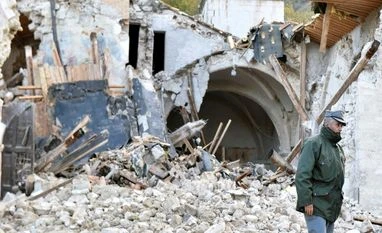 "Historic St. Benedict Basilica in Norcia destroyed in Italy earthquake")
Italy’s most powerful earthquake in 36 years struck a new blow to the country’s seismically vulnerable heart on Sunday, terrifying residents for the third time in nine weeks and flattening revered 600-year-old church, Basilica of St. Benedict in Norcia.
The national civil protection agency said there had been extensive damage to many historic buildings but no fatalities had been registered some five hours after the quake.
“I can confirm that there are no victims (deaths). Around 20 people are injured. As far as people are concerned, the situation is positive but many buildings are in a critical state in historic centres and there are problems with electricity and water supplies,” the agency’s chief, Fabrizio Curcio, said.

The quake struck at 7:40 am (1210 IST) near the small mountain town of Norcia, unleashing a shock felt in Rome, where the metro was partially shut, and even in Venice, 300 km away.
It measured 6.6 on the so-called moment magnitude scale, according to US geologists, while Italian monitors estimated it at 6.5.
It was Italy’s biggest quake since a 6.9-magnitude one struck the south of the country in 1980, leaving 3,000 people dead.
“We are going through a really tough period,” Prime Minister Matteo Renzi said, reiterating a government pledge to rebuild every damaged house and ensure that remote, quake-hit communities are not abandoned.
The earthquakes could continue in a devastating domino effect with one large quake leading to another along the central Apennine fault system, a leading seismologist warned on Sunday.
Gianluca Valensise, a seismologist at Italy’s National Institute for Geophysics and Vulcanology, told Reuters there was a “geodynamic link” between the deadly August earthquake and all those that have followed.
“An earthquake measuring 6 or larger creates stresses that are redistributed across adjacent faults and can cause them to rupture, and this is probably what we have seen since August,” Valensise said.
Don't miss the most important news and views of the day. Get them on our Telegram channel
First Published: Oct 30 2016 | 11:56 PM IST