


Are CFOs killing innovation?
Tolerance for failure is critical in motivating innovation. Chief financial officers have a large role in driving innovation at their companies, whether through creating incentives or making sure suff
)
Innovation is the key to sustainable business success in today's fast-paced, volatile and uncertain world. Companies that can nurture the creativity necessary for innovation and have a finance function that support implementation of their ideas efficiently are more likely to succeed in the long run.
Innovation is vital but it isn't easy. It can be disruptive to an existing business and uncertain in its outcomes and requires a strong appetite for risk. Some companies are good at coming up with ideas while others thrive on knowing how to commercialise innovation at scale. This makes innovation a challenging concept for companies - but the biggest risk of all arises from a failure to innovate.
There are few innovations or innovation-led organisations, that are successful without the input and influence of management accountants and the finance team. Whether shepherding new ideas from concept to business realisation or considering the risks associated with differing choices, finance can play a vital enabling role.
While CFOs are rarely expected to be the originators of a breakthrough product or technology, they are certainly expected to contribute to an environment that ensures great ideas are spotted, encouraged, financed and delivered to the market. Along the way, finance has an important role to play in ensuring that ideas are challenged and refined to ensure a stronger business case. It also needs to ensure that the trade-offs and risks associated with betting finite resources on unproven ideas are properly considered.
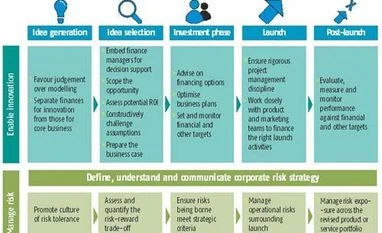
In some organisations, finance has not always been regarded as a source of help and advice on innovation. Striking the balance between an enabling culture and laying down a process to realise the potential of new ideas is a huge challenge. To get this right, Chartered Institute of Management Accountants (CIMA) has identified five broad areas where finance leaders can have a critical impact on the way companies commercialise innovative ideas.
Create an innovation-centric mindset
Successful companies put innovation at the heart of their business, fostering a culture in which ideas are allowed to flourish. That culture needs to start with leadership from the very top of the organisation. The successful companies provide a range of incentives to encourage innovation from all employees, not just those in R&D. Appliance maker Whirlpool, for example, has put every employee through a business innovation course, while also developing a cadre of so-called 'I-mentors' who are specially trained to facilitate innovative projects and help people with ideas.
By 2008, these new inputs were responsible for more than one-fifth of total revenues, with nearly 1,100 such I-mentors in place. Others take alternative approaches: both 3M and Google encourage employees to devote a proportion of their working time to projects and research outside their core responsibilities. They credit some of their most successful products to this approach. Royal Dutch Shell has a game-changer budget: a fund to which employees can apply for support for promising research projects that fall outside their daily work.
These examples suggest that finance should be involved in creating the right environment for innovation. This may entail applying a different mindset to early-stage projects, where the premature application of too many KPIs can kill an idea. In these early stages, finance needs to apply a different type of thinking, accepting that ideas need to be allowed to fully form before an evaluation process is applied.
Respect and nurture the creative process
Innovative companies understand that they need a distinct financial approach for judging and measuring innovation. One that is more flexible and tolerant of failure than that used in their operational businesses. Typically, early-stage R&D projects should be governed by a more relaxed approach to financials, for example, by ring-fencing budgets and shielding idea generation from the accounting pressures of day-to-day operations.
Corporates obviously also need to balance the competing priorities of the short-term reporting cycle - with quarterly or half-yearly investor and media scrutiny - against the long-term requirements to build a sustainable future business.
Help business partners plan the path to profits
Companies do not generally innovate for innovation's sake. They do so expecting long-term rewards. By putting discipline around the process of moving from idea to implementation, finance can help bolster the process bringing innovations to reality. Finance plays a key role in the allocation of resources and in sourcing finance, while staying focused on the costs and efficiency that are the bread and butter of financial management.
Apply the right metrics at the right stage of development
Innovation KPIs and other metrics all have a valuable role to play when managing a portfolio of innovation projects. But companies must beware of the dangers of trying to put firm metrics around initiatives that are nascent or experimental. A staged approach, which applies different criteria to the creation phase than to later commercialisation phases, is likely to be more successful. The stage gate process also allows the financial metrics to be tailored to the stage the innovation has reached. At the outset the innovation has to meet only modest criteria for its development to continue, and the funding it receives is also modest, limiting downside risk if the project is later abandoned. Early-stage criteria for project selection may include answers and accompanying analysis to basic questions about whether competing products have been identified and what advantage the new product offers over alternatives. But as it passes each 'gate' in the process, the hurdles it must meet to release the next level of funding, rise.
Each gate is an opportunity to review the project. If the results are not achieved at any stage, it is important to determine the reasons. Conversely, if outcomes are better than expected, it may be necessary to make rapid adjustments to accelerate a promising programme.
Take a balanced view on innovation risk
While minimising risks has obvious merits in running day-to-day operations, it has equally obvious shortcomings when applied to innovation, where risk is an inherent part of the process. Recalibrating attitudes to risk is therefore one of the key areas where finance professionals can help to create an environment where innovation can flourish. First, an organisation's risk appetite should be well defined and understood, and set out within its strategy. This is still surprisingly rare, according to a recent survey. It found that almost two-thirds of companies have not articulated their risk appetite in the context of their strategic plans.
So perhaps it is not surprising that analysis has shown that misjudgement of strategic risks is the greatest cause of destruction of shareholder value. Or that companies with more mature risk management practices outperform their peers financially. The use of key risk indicators can help organisations monitor their strategic risks.
Second, use risk management as a strategic tool for managing risk-reward trade-offs, across the portfolio of innovation projects and on a case by case basis. This ensures that minor or incremental innovation, which accounts for up to 90 per cent of innovation and is generally low-risk, balances the major innovations that are risky, but have the potential to transform business growth.
Third, companies need to build both tangible (hard) and intangible (soft) risks into their strategies. This requires a change in attitude, because the soft risk of not innovating, for example, is hard to quantify.
It is clear that with the right attitude, finance can become an effective co-pilot on innovation helping guide the rest of the business towards its goals. It can target and prioritise company resources both financial and human to make innovations a reality, while managing known and unknown risks.
Reproduced by permission of AICPA and CIMA from the CGMA Report titled Managing Innovation: Harnessing the power of finance, June 2013

Don't miss the most important news and views of the day. Get them on our Telegram channel
First Published: Jun 24 2013 | 12:15 AM IST