


Prakash Chauhan bets on a niche to relive success
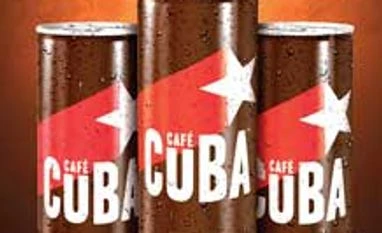
He expects Cafe Cuba to stir up the market with Rs 1,000-crore revenue in 12-18 months. But uncommon flavours are yet to find favour
)
For ten years, Parle Agro's chairman, Prakash Chauhan, the estranged younger brother of Ramesh Chauhan, the promoter of Bisleri International, and co-creator of brands Thums Up, Limca, Gold Spot, Maaza and Citra, quietly worked at bringing out a soft drink. This was even as American majors Coca-Cola and PepsiCo consolidated their position in the marketplace by pushing distribution, reach and spending top dollars on advertising and marketing.
The 67-year-old Chauhan, known to be tenacious, remained unmoved by the marketing blitzkrieg of the two giants. By his own admission, his passion for a soft drink had consumed him enough to not be distracted by what rivals were doing. "I had the option of launching a soft drink 10 years after selling Parle's carbonated portfolio to Coca-Cola in 1993. But I took my time. While the drink was ready a few years ago, our business needed to scale up sufficiently for us to launch a product like this," he says.
Chauhan's youngest daughter Nadia, who is joint-MD, Parle Agro, claims the maker of Frooti, Appy and Bailley has a turnover of Rs 2,000 crore - a seven-fold jump in 10 years -sufficient for it to consider re-entering the Rs 15,000-crore carbonated soft drink market.

The 27-year-old claims the gameplan now is to touch a turnover of Rs 5,000 crore by 2015. Cafe Cuba, the company's new coffee-flavoured soft drink, is expected to help the Mumbai-based firm, which derives its name from the north-western suburb of Vile Parle, where it is headquartered, more than double sales in two years.
Ambitious target
Thanks to its strong and differentiated flavour, the Chauhans claim Cafe Cuba is capable of creating a niche of its own. "In the first 12-18 months, we are targeting sales of Rs 1,000 crore from Cafe Cuba," says Chauhan.
While it may seem ambitious a target, the Chauhans are spending close to Rs 150 crore on ramping up production and distribution of Parle Agro. Part of the money has been utilised in increasing manufacturing capacity at 14 of the firm's existing plants to accommodate production of both plastic bottles and cans of Cafe Cuba. Part of the money is being used to set up a returnable-glass-bottle (RGB) network - an important segment for carbonated drinks. And some part has gone into increasing its distribution footprint. The Chauhans declined to give the precise break-up of the three.
But industry experts say that over 50 per cent of the investment would have gone into setting up a glass bottling facility, as it was the chink in Parle Agro's armour. "They are setting it up from scratch, which would cost money. A 600-bottles-per-minute glass unit could cost around Rs 80-90 crore to set up," says Vimal Kedia, managing director, Manjushree Technopak, a Bangalore-based packaging company.
This investment, say experts, is imperative, since almost 20 to 30 per cent of carbonated beverage sales happen via glass bottles. Chauhan, say experts, is unlikely to miss out on this opportunity, given that it will allow his firm to optimise the channel mix by pushing more products into general trade as well as hotels, restaurants and canteens that stock glass bottles. This, more importantly, will help his firm improve its bargaining power with stockists, distributors and retailers - crucial to take on Coca-Cola and PepsiCo.
Parle Agro's retail reach is nearly 800,000 outlets, which is just about 36 to 40 per cent of Coca-Cola's at 2.2 million outlets and PepsiCo's 2 million outlets.
Different strokes
This will not be the first time when a beverage player has attempted a carbonated soft drink that has a different flavour altogether. In 2004, Coca-Cola launched its much-hyped Vanilla Coke, with brand ambassador Vivek Oberoi screaming 'Wakaw' in television commercials, billboards and online ads. But the hype soon died down with consumers, fed on "strong" products such as Coke, Pepsi and Thums Up, not taking to a vanilla-flavoured fizzy drink. The product was withdrawn in 2005.
PepsiCo too experimented with flavour, launching its sugarless cola called Pepsi Max in 2010. It sank without a trace soon after. Consumers, according to industry sources, were simply unable to accept a drink devoid of sugar - a key ingredient that goes into the manufacture of fizzy drinks.
While the Chauhans are conscious they have taken a calculated risk with Cafe Cuba, they claim there is a market for a coffee-flavoured soft drink. "This is the first time any beverage player in the country has attempted something like this. We did an in-depth market survey and have also test-marketed the product extensively following which we are now ready for a commercial rollout by January-February next year," says the elder Chauhan.
To make sure they were on the right track, the Chauhans claim that 3 million Cafe Cuba cans and plastic bottles were produced as part of the test-marketing exercise, which went on for a few months this year. Now, they say, is payback time.
Don't miss the most important news and views of the day. Get them on our Telegram channel
First Published: Oct 08 2013 | 9:40 PM IST