


'Simpler KYC can help create an equity culture'
Mutual funds say more skin in the game and greater investor engagement is the way forward
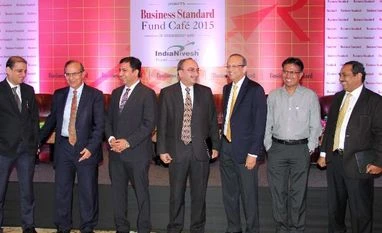)
(From left to right) Nimesh Shah, MD & CEO, ICICI Prudential AMC, Leo Puri, MD, UTI Mutual Fund, Sundeep Sikka, CEO, Reliance Mutual Fund, Dinesh Kumar Khara, MD & CEO, SBI Mutual Fund, Milind Barve, MD, HDFC Mutual Fund, Nilesh Shah, MD, Kotak Mutua
The past year has been good for the mutual fund (MF) sector, with equity folios regaining the 40 million mark and assets under management (AUM) at a record Rs 13 lakh crore. Can it continue the growth spiral?
A panel of chief executives from seven leading fund houses that got together, at the Business Standard Fund Cafe 2015, were confident the growth could be sustained. In fact, they were unanimous that assets would grow to Rs 20 lakh crore in the next three years.
"We have clearly seen the retail investor coming back after almost three years of negative flows. Last year, we saw almost 1.5 million new investor folios and eight million SIP (systematic investment plan) folios being created. More important, the number of investors from smaller cities and towns has increased," said Sundeep Sikka, chief executive officer (CEO), Reliance MF. (CRACKING THE MF CODE)
Added Leo Puri, managing director (MD), UTI MF: "In equity, we are at Rs 8-9 lakh crore. In terms of business, it is relevant and a good indicator of the health of the industry."
Investment from the Employees' Provident Fund Organisation (EPFO) would help boost assets. "EPFO will invest about Rs 5,000 crore this year. Next year, hopefully, it will be Rs 10,000 crore and Rs 15,000 crore (a year) thereafter," said Nilesh Shah, MD of Kotak MF.

The investor base could also see exponential growth. "Today, (we) have 10-15 million actual investors. If we see the number of people who file income tax returns, we would have barely scratched 25-30 per cent of the surface. If we compare that with people who ought to file their returns, we would have barely scratched 10-15 per cent. Clearly, the potential is huge," said Nilesh Shah.
The government's push to ensure savings are channelled into financial assets rather than real estate and gold is considered another positive. "The real estate market is correcting and investors have lost money in gold. On the other hand, MFs - be it equity funds or fixed income funds - have actually delivered far better returns. A positive word of mouth will pull in more investors to MFs," said Shah.
The worry, however, playing on the minds of fund houses is the incessant volatility in Indian equities in recent months. While the overall market still seems fairly priced, it has become difficult for managers to find stocks that are priced attractively. "There is a significantly higher premium for quality and a tendency sometimes to take shelter in high-quality companies because they have very strong, stable earnings. There are companies sitting at 35 PE (price to earnings) multiples, 40 PE multiples and have gone on to become 60 PE multiples," said Milind Barve, MD, HDFC MF.
Dinesh Khara, MD & CEO at SBI MF, believes it is important for fund houses to manage return expectations in times of euphoria. "Typically, it is always the rear-view mirror kind of experience which people expect to see going forward as well. AMCs (asset management companies) should engage with investors to showcase their track record but also tell them how things could change. The second area to look at is a fund's risk management capabilities. Sebi (the Securities and Exchange Board of India) is permitting a hedging mechanism which can help reduce risks," said Khara.
Pointing to the recent news flow from China and a sudden slump in commodity prices overn recent months, A Balasubramanian, CEO at Birla Sun Life MF, admitted that anticipating sudden market movements or predicting event risks was difficult even for fund managers. That said, he felt the sector had done a great job of mitigating potential risk, especially through diversification.
According to Nimesh Shah, MD&CEO, ICICI Pruential AMC, one way to deal with volatility was through asset allocation products. "These products can be structured in a way that equity allocation can be reduced when the PE ratios are very high. This can minimise negative customer experience," he said.
The sector has also been aggressively marketing the benefits of investing through SIPs, to ensure customers stay invested in volatile times. "Over the past decade or so, we saw the industry coming up with lot of exotic products. But, the majority of investor flows are coming in simple, vanilla (basic) products. SIP has been a key innovation and instrumental in giving investors a pleasant experience. The industry has been responding well to customer needs, but it is an evolving process," said Sikka.
Given the volatility, customer acquisition remains a key challenge. According to Khara, investors often have the inclination to invest but are put off by paperwork. "A simpler KYC (Know Your Customer rule check), especially for the younger generation, will help create an equity culture. If we can accept a bank KYC as valid for MFs, we will be able to get many more investors on board," he felt.
Added Nimesh Shah: "When you go to Flipkart, you do not have to fill a form before you buy. We are working with the regulator on this. If we can integrate the Aadhaar card details into the KYC process, a big bottleneck would get resolved."
The other problem was getting distributors to sell MF products, given the recent cap on upfront commission. "If a financial advisor is only an MF distributor and does have significant size or scale, it might not be lucrative for him to pursue this profession. Today's distributor has no option but to be a multi-product distributor (MFs, insurance, financing, etc), which will help him sustain operations," said Shah.
Last year, Sebi made it mandatory for each AMC to invest Rs 50 lakh or one per cent of assets, whichever was lower, in every new fund offer made by the same AMC. Some fund houses are going beyond this mandatory requirement. "Our employees made a voluntary pledge to invest in Kotak MF schemes. This pledge has now been converted into a code of conduct," said Nimesh Shah. Adding: "In our case, part of the employee bonus is automatically invested in the schemes of the company and the employee gets it after three years."
The market regulator has mandated that fund houses also put up their voting patterns on their websites. Would fund houses get more active in shareholder activism in the coming months? "I think you will see us engage much more with companies, and most boards have welcomed this engagement. It is not about activism but simply taking a stand on behalf of investors to avoid the possibility of value destruction," said Puri.
Added Khara: "Governance issues can arise in some companies, especially in the mid-cap space. Considering the kind of exposure that funds have to various corporates, their say on management issues becomes critical."
Don't miss the most important news and views of the day. Get them on our Telegram channel
First Published: Aug 12 2015 | 10:47 PM IST