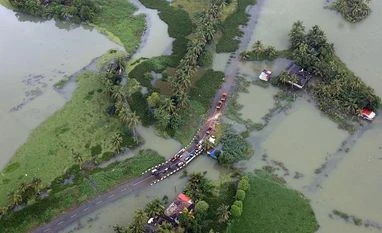
There is no doubt that Kerala, wracked by floods of a magnitude rarely seen twice in a century, needs all the help it can get. Large tracts of the state are under water and many residents have been rendered homeless. But the Centre’s decision to disallow the direct contribution to flood relief from the UAE cannot be faulted.
There are good reasons to refuse foreign governments from directly aiding Indian states. All aid is routed through the Centre for reasons that have stood the test of time. Consider, for example, the manner in which development assistance is being used by the People’s Republic of China to warp the local politics of many countries along its periphery. Could Beijing be given a free hand to contribute to states in India’s Northeast? Or could Pakistan help out the government of Jammu and Kashmir without New Delhi being involved? Clearly these would represent significant security threats. Yet, once a precedent has been set, the Union government would be hard pressed to explain why such aid and assistance must be turned down. Foreign policy is in the Union’s remit according to the Constitution, and allowing state governments to form their own bilateral aid and assistance ties is tantamount to allowing them to conduct an independent foreign policy. This cannot be considered appropriate, however dire the emergency.
In any case, India has declined aid offers from many other countries, including Thailand, Maldives and Qatar. Since 2004, as a matter of policy, India has not been accepting foreign aid for natural disasters. What this implies is that Kerala is not being singled out or discriminated against. The matter therefore boils down to the quibbling between the Centre and the state over the quantum of relief funds. That has to be urgently addressed. The total quantum of the money required is not so high that it can’t be arranged if the Centre and state governments collaborate. It is the Centre’s responsibility to put together an assistance package of the size demanded by the Kerala government, from the overall national Budget — and, if it fails to do so, it should be held accountable. After all, India has now reached an economic size such that it is in net terms no longer a recipient of aid. Thus if Kerala finds itself short of the money it needs, it reflects domestic systemic problems and has nothing whatsoever to do with the amount of foreign aid offered or rejected. It is a matter for domestic politics and domestic accountability.


 "kerala flood")