


Restricted entry: Keep tabs on devices or people?
In-flight electronics ban poses questions without offering answers
 "electronic devices, Laptops")
premium
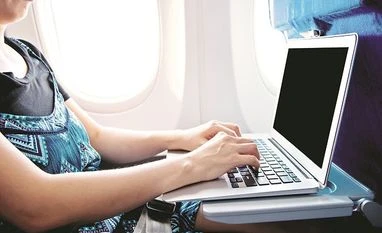
Banning electronic devices larger than a mobile phone paints affected airlines as less child and business-friendly. Photo: BLOOMBERG
AS ROYAL Jordanian’s surprise tweet about a cabin ban on electronic items on flights to the US from 21 March 2017 sank in, travellers and airlines scrambled to assess the impact of the action messily and mysteriously orchestrated by the Trump administration, eventually encompassing up to a dozen airlines from eight largely Muslim Middle Eastern countries. Britain responded in kind with restrictions imposed on six countries – Jordan, Egypt, Tunisia, Turkey, Lebanon, and Saudi Arabia – affecting in all, 15 airlines.
US airlines have not been affected by the restrictions.
While the US ban also covers Dubai, Doha, and Abu Dhabi – along with their popular powerhouse airlines, Emirates, Qatar Airways, and Etihad Airways – Britain remained reluctant to include these three airlines much favoured by value-seeking Britons headed on holidays to Southeast Asia and Australia. Indeed, their inclusion could spell economic disaster for the three national carriers, frequently criticised by less competitive US players for being coddled by state subsidies. There is rarely any mention of the hugely elevated level of service provided by these airlines, which of course, is a major traffic driver.
Banning electronic devices larger than a mobile phone (roughly 16cm x 9.3cm x 1.5cm) paints affected airlines as less child and business friendly, as laptops and iPads (packed with spreadsheets, movies or entertainment) are removed from the in-flight menu.
Royal Jordanian put it thus: “Following instructions from the concerned US departments, we kindly inform our dearest passengers departing to and arriving from the United States that carrying any electronic or electrical device on board the flight cabins is strictly prohibited… Prohibited devices, including… laptops, tablets, cameras, DVD players and electronic games… can be carried in the checked baggage only.” The airline stressed that medical and life-support equipment was not included in the ban.
This action immediately throws up a few questions. Are malicious electronic devices any safer in the cargo hold than in the passenger cabin? And are these devices the sole culprits? Bombs of varying sophistication are suspected in the case of the Russian Metrojet downing over Egypt (October 2015, supposedly with a device in an aerated drink can), and the Somalian airline that was hit by an apparent laptop explosive (February 2016). Going farther back, there was Pan Am 103 (blown up over Lockerbie, Scotland, December 1988), and Air-India 182 (brought down over the Atlantic, June 1985).
Worryingly, two egregious failed bombing attempts that caught the public eye involved US airlines and, in both cases, the would-be attackers boarded their flights in Europe, not in the allegedly murky mayhem of the Middle East, as US authorities would have us believe. In December 2001, the ‘shoe bomber’ Richard Reid was on an American Airlines flight to Miami that he boarded in Paris. Later, in December 2009, the ‘underwear bomber’ was on a Northwest flight to Detroit that he boarded in Amsterdam.
US airlines have not been affected by the restrictions.
While the US ban also covers Dubai, Doha, and Abu Dhabi – along with their popular powerhouse airlines, Emirates, Qatar Airways, and Etihad Airways – Britain remained reluctant to include these three airlines much favoured by value-seeking Britons headed on holidays to Southeast Asia and Australia. Indeed, their inclusion could spell economic disaster for the three national carriers, frequently criticised by less competitive US players for being coddled by state subsidies. There is rarely any mention of the hugely elevated level of service provided by these airlines, which of course, is a major traffic driver.
Banning electronic devices larger than a mobile phone (roughly 16cm x 9.3cm x 1.5cm) paints affected airlines as less child and business friendly, as laptops and iPads (packed with spreadsheets, movies or entertainment) are removed from the in-flight menu.
Royal Jordanian put it thus: “Following instructions from the concerned US departments, we kindly inform our dearest passengers departing to and arriving from the United States that carrying any electronic or electrical device on board the flight cabins is strictly prohibited… Prohibited devices, including… laptops, tablets, cameras, DVD players and electronic games… can be carried in the checked baggage only.” The airline stressed that medical and life-support equipment was not included in the ban.
This action immediately throws up a few questions. Are malicious electronic devices any safer in the cargo hold than in the passenger cabin? And are these devices the sole culprits? Bombs of varying sophistication are suspected in the case of the Russian Metrojet downing over Egypt (October 2015, supposedly with a device in an aerated drink can), and the Somalian airline that was hit by an apparent laptop explosive (February 2016). Going farther back, there was Pan Am 103 (blown up over Lockerbie, Scotland, December 1988), and Air-India 182 (brought down over the Atlantic, June 1985).
Worryingly, two egregious failed bombing attempts that caught the public eye involved US airlines and, in both cases, the would-be attackers boarded their flights in Europe, not in the allegedly murky mayhem of the Middle East, as US authorities would have us believe. In December 2001, the ‘shoe bomber’ Richard Reid was on an American Airlines flight to Miami that he boarded in Paris. Later, in December 2009, the ‘underwear bomber’ was on a Northwest flight to Detroit that he boarded in Amsterdam.
Banning electronic devices larger than a mobile phone paints affected airlines as less child and business-friendly. Photo: BLOOMBERG
Disclaimer: These are personal views of the writer. They do not necessarily reflect the opinion of www.business-standard.com or the Business Standard newspaper