


Shekhar Gupta: A People and their Army
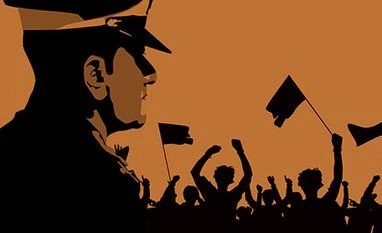
Gen Rawat-Dyer comparison shows how post-colonial scholars missed out on the finest Army of this era
 "Indian Army")
premium
Brigadier-General Reginald Dyer was British, but was an officer of the Indian Army. The 50 riflemen who opened fire at a peaceful Baisakhi gathering at Amritsar's Jallianwala Bagh, killing 396 and wounding more than a thousand, were Indian soldiers.
Within 25 years, the same Army was fighting on both sides of a small, one-sided but historic war. Subhash Chandra Bose's Indian National Army consisted of Indian prisoners of war with Axis forces. Within three years, in 1947-48 of that fratricide, the Army was at war again, this time to protect its own nation, in Kashmir.
The colonial Army initially split into two, and eventually three in 1971, with the same ethos, training and command structures. In both Pakistan and Bangladesh, the same army has held power more than once, and assassinated elected leaders. Over the decades, Pakistan's Army has so institutionalised its indirect control over power it calls the shots as elected governments come and go. Why take the opprobrium of martial law?
The Bangladeshi Army has now depoliticised after two decades of Ershad-Zia misadventures. In India, over these decades, the Army has become more apolitical, business-like. It's also become ethnically, socially and religiously diverse, stepping out of many colonial fixations like martial races and lately batmen (ok, golfing culture has grown, regrettably). Indian Army's ability to adapt and evolve with times, from Dyer to Azad Hind Fauj to a loyal institution back-stopping a democratic nation is marvellous and must be acknowledged.
Now survey how post-colonial armies have evolved since World War-II: Africa, West Asia, Latin America, Eastern Asia, and definitely the rest of South Asia. Find one sizeable army that stayed out of politics.
Post-Colonial evolution of the Army has been widely studied in India, although mostly by scholars and historians of military affairs and generally ignored by the eminences of the social sciences. The period up to the debacle of 1962 is the best documented and it is also the most vital because the Army was still Indianising – there were two categories of officers, holding the King's and the Indian Commission. Defeats tend to produce better, from-the-heart literature and the Army had a generation that brought inherited a commitment to military literature from its past masters, the British. Subsequently, our military scholarship and literature declined, with just two pieces of work, Lt.Gen. Harbakhsh Singh's War Despatches and Air Chief Marshal P.C. Lal's My Years With The IAF on the air war in 1971 standing out. There was always Stephen Cohen's The Indian Army which, read with his equally thorough The Pakistan Army is still a standard text to understand the contrasting way the two siblings, separated by a calamity as in old Bollywood films, evolved in their own ways.
Lately, there has been another set of solid publications. Four books by Punjab Chief Minister Amarinder Singh, by far the best military historian in India: on Kargil, World War I, a true classic (with Lt.Gen. Tajindar Shergill) on the 1965 war and the latest on the Battle of Saragarhi, hailed as the Sikh Regiment's Thermopylae. More importantly three recent works by non-military scholars, Yale Professor Steven Wilkinson (Army and Nation), Srinath Raghavan on how the Army changed between the two great wars (India's War) and to contrast with, Georgetown University scholar C. Christine Fair's Fighting to the End on the Pakistani Army.
I am being deliberately repetitive: I do not find on any bookshelf a substantive study on this fascinating socio-military-political institution, written by a professional Indian social scientist. It is as if the Army, as we wanted, decided to stay out of our life, and our scholars responded by leaving it alone. They demilitarised their minds – even Raghavan, a world-class scholar, is a former Army officer. Let the Army live in its cantonments. It is this intellectual secession from the military that leads to a regrettable misjudgement like the Rawat-Dyer comparison.
To understand how India succeeded in keeping its Army out of politics, Wilkinson is a must-read. He tells you of the evolution of the military thought from Cariappa to Manekshaw through four wars and onwards but also of how the system worked together to change the social and ethnic composition of the Army. To make it more diverse over the decades, shrewdly reducing the domination of one ethnicity, the Punjabis, shrugging the Colonial legacy of martial races and, ultimately, assigning recruitment quotas to states according to their population. Of course, he fishes out some nuggets like defence minister Jagjivan Ram's keenness to bring more Dalits into the Army and the letter Manekshaw wrote to Lt.Gen. S.K. Sinha to "handle it"--as a Bihari he would know how to do it.
Within 25 years, the same Army was fighting on both sides of a small, one-sided but historic war. Subhash Chandra Bose's Indian National Army consisted of Indian prisoners of war with Axis forces. Within three years, in 1947-48 of that fratricide, the Army was at war again, this time to protect its own nation, in Kashmir.
The colonial Army initially split into two, and eventually three in 1971, with the same ethos, training and command structures. In both Pakistan and Bangladesh, the same army has held power more than once, and assassinated elected leaders. Over the decades, Pakistan's Army has so institutionalised its indirect control over power it calls the shots as elected governments come and go. Why take the opprobrium of martial law?
The Bangladeshi Army has now depoliticised after two decades of Ershad-Zia misadventures. In India, over these decades, the Army has become more apolitical, business-like. It's also become ethnically, socially and religiously diverse, stepping out of many colonial fixations like martial races and lately batmen (ok, golfing culture has grown, regrettably). Indian Army's ability to adapt and evolve with times, from Dyer to Azad Hind Fauj to a loyal institution back-stopping a democratic nation is marvellous and must be acknowledged.
Now survey how post-colonial armies have evolved since World War-II: Africa, West Asia, Latin America, Eastern Asia, and definitely the rest of South Asia. Find one sizeable army that stayed out of politics.
Post-Colonial evolution of the Army has been widely studied in India, although mostly by scholars and historians of military affairs and generally ignored by the eminences of the social sciences. The period up to the debacle of 1962 is the best documented and it is also the most vital because the Army was still Indianising – there were two categories of officers, holding the King's and the Indian Commission. Defeats tend to produce better, from-the-heart literature and the Army had a generation that brought inherited a commitment to military literature from its past masters, the British. Subsequently, our military scholarship and literature declined, with just two pieces of work, Lt.Gen. Harbakhsh Singh's War Despatches and Air Chief Marshal P.C. Lal's My Years With The IAF on the air war in 1971 standing out. There was always Stephen Cohen's The Indian Army which, read with his equally thorough The Pakistan Army is still a standard text to understand the contrasting way the two siblings, separated by a calamity as in old Bollywood films, evolved in their own ways.
Lately, there has been another set of solid publications. Four books by Punjab Chief Minister Amarinder Singh, by far the best military historian in India: on Kargil, World War I, a true classic (with Lt.Gen. Tajindar Shergill) on the 1965 war and the latest on the Battle of Saragarhi, hailed as the Sikh Regiment's Thermopylae. More importantly three recent works by non-military scholars, Yale Professor Steven Wilkinson (Army and Nation), Srinath Raghavan on how the Army changed between the two great wars (India's War) and to contrast with, Georgetown University scholar C. Christine Fair's Fighting to the End on the Pakistani Army.
I am being deliberately repetitive: I do not find on any bookshelf a substantive study on this fascinating socio-military-political institution, written by a professional Indian social scientist. It is as if the Army, as we wanted, decided to stay out of our life, and our scholars responded by leaving it alone. They demilitarised their minds – even Raghavan, a world-class scholar, is a former Army officer. Let the Army live in its cantonments. It is this intellectual secession from the military that leads to a regrettable misjudgement like the Rawat-Dyer comparison.
To understand how India succeeded in keeping its Army out of politics, Wilkinson is a must-read. He tells you of the evolution of the military thought from Cariappa to Manekshaw through four wars and onwards but also of how the system worked together to change the social and ethnic composition of the Army. To make it more diverse over the decades, shrewdly reducing the domination of one ethnicity, the Punjabis, shrugging the Colonial legacy of martial races and, ultimately, assigning recruitment quotas to states according to their population. Of course, he fishes out some nuggets like defence minister Jagjivan Ram's keenness to bring more Dalits into the Army and the letter Manekshaw wrote to Lt.Gen. S.K. Sinha to "handle it"--as a Bihari he would know how to do it.
Disclaimer: These are personal views of the writer. They do not necessarily reflect the opinion of www.business-standard.com or the Business Standard newspaper