


Vyasan R: Time ripe for universal basic income
The fiscal space that has presented itself due to demonetisation is an opportunity that should be utilised
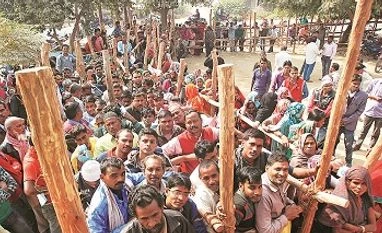 "Cashless Cue: Villagers queue to exchange and deposit currencies outside a bank on the outskirts of Allahabad. If the demonetisation exercise is the first step in the long road to a cashless economy, then transferring amounts for the UBI will be an")
Cashless Cue: Villagers queue to exchange and deposit currencies outside a bank on the outskirts of Allahabad. If the demonetisation exercise is the first step in the long road to a cashless economy, then transferring amounts for the UBI will be an
The impact of demonetisation on the Reserve Bank of India’s (RBI) balance sheet has been well understood. It is anticipated that there will be a decrease in the currency liabilities of the RBI between Rs 2,000 and Rs 2,500 billion. The exact amount may vary depending on the assumptions of the proportion of Rs 500 and Rs 1,000 currencies in circulation that will not be returned to the banking system to avoid paying tax penalties. The actions of the RBI to offset this reduction in liabilities present a wide array of possibilities. They range from giving a windfall to the government in terms of increasing dividends to a possible capitalisation of banks that are reeling under the impact of non-performing assets. Another way to compensate the reduction in liabilities in the RBI’s balance sheet is to reduce its assets by offloading government debt.
Offloading government debt would mean a proportionate increase in the fiscal legroom of the central government. Creative thinking by the government can help mitigate the negative impact of reduced money supply in the economy. Lower money supply can impact GDP growth by reduced consumption expenditure in the near term as there is a temporary liquidity crunch because of the government strictures. In the medium to long term negative wealth effects leading to lower GDP growth from the erstwhile hoarders of Rs 500 and Rs 1,000 currencies may set in. One way to neutralise the negative impacts on spending (either through the wealth effect in the medium term or through the liquidity crunch effect in the near term) is to transfer the windfall gain to the needy with a high marginal propensity to consume. This is, in other words, the right time to try out the idea of universal basic income (UBI). The government can use the fiscal space created by the demonetisation exercise to introduce a UBI in a stage-wise manner.
UBI and subsidies
The estimated budgetary requirement for providing UBI to all adults (roughly 69 per cent of the population) is in the range of 11 per cent of the GDP amounting to Rs 11,000 billion. One of the main stumbling blocks was the need to rationalise subsidies which accounted for 14.4 per cent of the total expenditure of the central government and use the savings thus generated to provide a UBI. India’s political economy landscape prevents rationalising subsidies in a vacuum. Politicians and policy-makers are presented with a Hobson’s choice on which move should come first. Reduction in subsidies, a no-no in the current political landscape, or implementation of the UBI which would entail an extra fiscal burden? The fiscal space that has presented itself due to demonetisation is an opportunity that should be utilised and it is that rare occasion when the imperatives of economic theory (to buoy up consumer demand and start on the path towards a long-term rationalisation of subsidies) and political willingness coincide perfectly. The additional fiscal space that demonetisation has presented itself should therefore be utilised for putting in place a version of the UBI that is implementable. I try and number-crunch one of the many possible permutations of the UBI below.
UBI: some numbers
Also Read

Cashless Cue: Villagers queue to exchange and deposit currencies outside a bank on the outskirts of Allahabad. Photo: Reuters
Manna from GoI
This above suggestion also ties in well with the government’s avowed policy of moving towards a cashless economy. If the present demonetisation exercise is the first step in the long road to a cashless economy, then transferring amounts for the UBI will be an assured progression in the journey. The monetary behaviour of individuals remains unchanged over very long periods of time. To actualise the move towards cashless transactions, the government has to encourage making transactions through their accounts using facilities such as RuPay, which are add-ons to the Jan Dhan accounts. Implementation of the UBI using the fiscal resources freed by demonetisation will be the manna that government provides for its needy citizens.
The author is an IAS officer.
Views are personal
Disclaimer: These are personal views of the writer. They do not necessarily reflect the opinion of www.business-standard.com or the Business Standard newspaper
Don't miss the most important news and views of the day. Get them on our Telegram channel
First Published: Nov 20 2016 | 9:39 PM IST