


Revisiting reservations?
RSS chief Mohan Bhagwat's remark on new thinking on affirmative action has put the fat in the fire
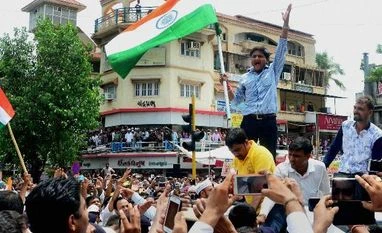 "Hardik Patel leading Patidar community members during their rally for reservation in Ahmedabad")
Hardik Patel leading Patidar community members during their rally for reservation in Ahmedabad
September 25 marked the beginning of the centenary year of the birth of Deendayal Upadhyaya, former chief of the Bharatiya Jana Sangh, political arm of the Sangh parivar. To coincide with that, Organiser and Panchajanya, publications that support the work of the parivar, recorded an interview with Rashtriya Swayamsevak Sangh (RSS) chief Mohan Bhagwat.
The editors talked about Upadhyaya's concept of Integral Humanism and in that context, Bhagwat spoke of a need to return to more accurate definitions and eliminate distortions.
"Reservation for socially backward classes is the right example in this regard. If we would have implemented this policy as envisaged by the Constitution makers, instead of doing politics over it, the present situation would not have arrived. Since inception, it has been politicised. We believe: form a committee of people genuinely concerned for the interest of the whole nation and committed for social equality, including some representatives from the society; they should decide which categories require reservation and for how long. The non-political committee, like autonomous commissions, should be the implementation authority; political authorities should supervise them for honesty and integrity," Bhagwat said to illustrate the "right" way of extending reservations.

For Bhagwat, the context was the Patel agitation launched in Gujarat at the end of August. The message of the agitation was: give us, the Patels, reservation as well, or take it away from everyone. Bhagwat's statement was instantly cannibalised, parsed and boiled down to one idea, depending on where you stood: those who had gained politically from supporting reservation said he was opposed to affirmative action for the socially disempowered; and those who felt reservations had harmed their economic advancement declared he was pro-reservation and a votary of identity politics.
It was around 6 pm on the day the interview was published and everyone was packing up to go home when Bharatiya Janata Party (BJP) General Secretary Ram Madhav got a call - he won't say from whom. Could he manage the situation? Bhagwat's remarks could hurt the BJP's chances in the Bihar election if people were allowed to continue thinking that Bhagwat, and by implication, the RSS; was against reservations. Leveraging his long association with the RSS (which makes him acutely conscious of the restrictions the organisation puts on a prompt rebuttal), and getting the formulation right in his head, he tweeted: "The RSS clarifies that Shri Bhagwatji has not made any comment on the existing reservation system."
That was the first clarification, even before the RSS had issued one. The genie could not be put back into the bottle. But, it could be made to issue a clarification. The RSS followed this by putting out steady tweets about its stand on reservations for the socially backward (it supports it); and statements by leaders ranging from Golwalkar to Bhagwat himself. Ravi Shankar Prasad, the upper caste telecom minister from Bihar, went on TV to declare unambiguously that neither the BJP nor the government had any intention of tampering with the current scheme of reservations for communities that were socially backward.
But, it was the elephant in the room. What was the BJP's stance on reservations? And, what should be India's stance?
Shorn of emotion, drama and hysteria, the Patel agitators in Gujarat ask exactly this question. What should be the basis of reservation? Should it only be social backwardness? Or should an element of economic backwardness be brought in it as well?
Lalu Prasad, who will always be seen as the man who forced India to come to terms with the political assertion of the socially backward, was unsurprisingly first off the bat. "They (the RSS) have always favoured the upper castes. We have known that and now the real agenda is out in the open," he said, adding, "We will fight ferociously against any attempt to dismantle the reservation system." This was somewhat disingenuous because the Prasad clan's claims on affirmative action have tended to leave the cupboard bare for others of the same caste groups but less wealthy.
Others had already joined the debate. In the Congress, Jitin Prasada had, in a letter to AICC general secretary for UP Madhusudan Mistry, sought a review of the party's stance on reservations. This refrain was taken up by others in the Congress. Prasada clarified he was not against reservations; he wanted it rationalised, so that the wealthy alone could not use it to their advantage.
Uneasily realising that this could lead to dangerous ground, the Gujarat government swung into action. On Friday, it announced a Rs 1,000-crore package to support students pursuing higher education. It also relaxed the age limit for government jobs from 28 to 33 years for the general category and from 33 to 38 in the reserved category.
Around the same time, came the decision of the Rajasthan government, also ruled by the BJP. On September 22, the Rajasthan Assembly passed two legislations aimed at providing reservation in educational institutions and government jobs to economically backward classes and special backward classes. The latter was aimed at pacifying the Gujjars, who have been seeking reservations since 2007. But the government also cited the recommendations of a commission appointed to identify and examine the requirements of the economically backward classes of general categories not covered by the existing reservation available to the scheduled castes, scheduled tribes and backward classes, to ensure 14 per cent reservation for this section of people.
Against the background of the Supreme Court rulings (see box), it is debatable if these moves will stand legal scrutiny. But it does bring the spotlight on something Mohan Bhagwat had, almost conversationally, flagged: Does India's affirmative action policy need revisiting?
Sociologist Dipankar Gupta says there was a time when the Patels, (or Patidars, to give them their correct caste name), used to ridicule demands for OBC reservation. But things have changed for them. "This asymmetry between political power and economic well-being is what makes Mandal so attractive to even those who had once scoffed at the idea of OBC reservations. Therefore, if a community is politically powerful but has fallen on bad times, there is every chance that Mandal will be invoked just to prove their strength. In recent years, Jats, Gujjars and even Marathas have enthusiastically played this card and may close in soon with a winning hand," he says in a signed newspaper article.
Making the same point, another sociologist, Achyut Yagnik told Business Standard: "The root cause of the agitation is the belief of the Patel youth that they are deprived for more than one reason. First, they would like entry into professional courses such as medical and engineering. They feel that because of reservation they are not getting their due even after getting higher percentage of marks at the higher secondary level. Second, Patel youth, who aspire for government jobs, feel that due to the contract system adopted by the government in departments such as education, forest, and police, along with reservation in the contractual positions too, they are not getting jobs. In the private sector also, job avenues have not expanded, which too, has contributed to their restlessness. The third reason is the decline of small and medium enterprises in Gujarat, most of which are run by the Patels, who have invested their surplus income from agriculture in these."
So, if the grievance is just economic disempowerment, why invoke social categories like caste to correct it? And if this logic is taken forward, are we now seeing a marketisation of caste? In an extraordinarily perceptive article in the Journal of Consumer Research in July 2015, Ram Manohar Vikas, Rohit Varman and Russell W Belk say a new order based on markets and consumption is disrupting the old order based on caste.
As the old moral order dissolves, so do the old status hierarchies, obligations, dispositions, and norms of sharing that held the village together for centuries. In the microcosm of these gains and losses, we may see something of the broader social and economic changes taking place throughout India and other industrializing countries.
Caste cannot be eliminated from India; not when there are people who get no other jobs simply because they were born in a caste to carry night soil on their head. But can it be better managed? And what does the BJP, both as a party and government, offer by way of fresh thinking on this? It is not entirely clear from the administrative decisions taken by the states run by it. But the truth is: new thinking is needed because the elephant won't just go away on its own.
A LOOK AT RESERVATIONS ACROSS INDIA
- Maharashtra made 16 per cent reservation for Marathas and five per cent for Muslims in government jobs and education institutions soon after the Lok Sabha elections in which it was defeated. This takes reservation to 73 per cent in the state
- A spate of reservations from 1951, soon caused total reservation to exceed 50 per cent. The Supreme Court on October 15, 1982, directed the Tamil Nadu government to constitute the second Tamil Nadu Backward Classes Commission. Citing Article16(4) of the Constitution that confers a discretionary power on the state to make reservations on appointments in favour of backward class of citizens which in its opinion, are not adequately represented in the services of the state, reservations in Tamil Nadu are legal at 69 per cent
- Rajasthan government is expected to use the same logic to justify reservations for the economically backward irrespective of caste is now touching 68 per cent
- In 2010, Karnataka, which wanted to increase reservations to 73 per cent was restricted from doing so by Supreme Court
Don't miss the most important news and views of the day. Get them on our Telegram channel
First Published: Sep 28 2015 | 12:20 AM IST