


Supreme Court waives six months wait for divorce under Hindu Marriage Act
The 1955 Hindu Marriage Act provides for a statutory cooling period of six months
 "Photo: Reuters")
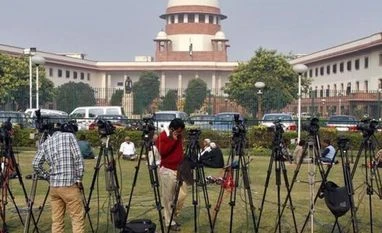
Tripods of television crew stand in front of the Indian Supreme Court building in New Delhi. Photo: Reuters
The Supreme Court on Tuesday held that the minimum cooling period of six months for granting the decree of divorce under the Hindu law can be waived by a trial court if there was no possibility of cohabitation between an estranged couple.
The 1955 Hindu Marriage Act provides for a statutory cooling period of six months between the first and the last motion for seeking divorce by mutual consent to explore the possibility of settlement and cohabitation.
"We are of the view that the period mentioned in section 13B(2) is not mandatory but directory; it will be open to the court to exercise its discretion in the facts and circumstances of each case where there is no possibility of parties resuming cohabitation and there are chances of alternative rehabilitation," a bench comprising Justices A K Goel and U U Lalit said.
Also Read

The apex court said the minimum period of six months can be relaxed by the trial court in certain situations and the estranged couple, who are seeking divorce with mutual consent, can file waiver application after a week of filing the first motion.
The top court also said that in conducting such proceedings, the trial court "can also use the medium of video conferencing and permit genuine representation of the parties through close relations, such as parents or siblings, where the parties are unable to appear in person for any just and valid reason as may satisfy the court, to advance the interest of justice".
The court noted in its verdict that the object of the cooling off period was to safeguard against a "hurried decision" if there was otherwise a possibility of differences being reconciled.
"Though every effort has to be made to save a marriage, if there are no chances of reunion and there are chances of fresh rehabilitation, the court should not be powerless in enabling the parties to have a better option," it said.
"In determining the question whether the provision is mandatory or directory, language alone is not always decisive. The court has to have the regard to the context, the subject matter and the object of the provision," it said.
The bench was dealing with a plea filed by an estranged couple which had sought waiver of the six month period on the ground that they have been living separately for the past eight years and there was no possibility of their re-union.
Topics : Supreme Court
Don't miss the most important news and views of the day. Get them on our Telegram channel
First Published: Sep 12 2017 | 9:07 PM IST