


Home / Technology / Tech News / Indian Defence has a 'Sputnik Moment' as it adopts artificial intelligence
Indian Defence has a 'Sputnik Moment' as it adopts artificial intelligence
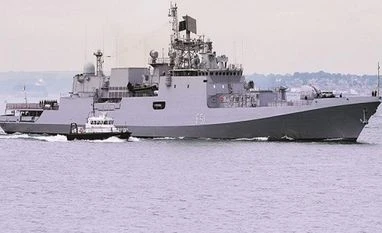
The new-generation platforms of the Indian Navy give it an edge in developing new AI technologies that are becoming increasingly popular with military and industry
 "Indian navy")
premium
7 min read Last Updated : Jun 01 2021 | 8:46 PM IST
The Indian Navy is a technology-savvy force. The new-generation platforms that it operates are equipped with cutting-edge technology. This puts it in an advantageous position to develop and absorb new AI technologies that are becoming increasingly popular with the military and industry.
The Government of India has already taken concrete steps in this direction. In 2018, having identified the potential impact of artificial intelligence (AI) and machine learning (ML) across sectors, it entrusted NITI Aayog and the Ministry of Defence with the task of establishing a roadmap for devising a national programme. This was aimed at research and development (R&D) of AI applications in the social sector and armed forces respectively, according to the research paper by Amrut Godbole, Indian Navy Fellow, at think tank Gateway House.
Consequently, in June 2018, NITI Aayog published a white paper, titled National Strategy for AI. The task force, set up by the Ministry of Defence, called Strategic Implementation of AI for National Security and Defence, submitted its recommendations. The task force identified use cases that are of strategic value, but involve prolonged R&D cycles.
The long-term goals of the Indian Navy of transforming to a 200-ship force by 2027 and its continued impetus to maintain optimal combat capability, are repeatedly put to test by diminishing capital availability and shortages in manpower, said the Gateway House paper.
“It is therefore imperative that the armed forces, and more so, the Indian Navy, look to leverage the benefits of AI and ML-based technologies for improving organisational efficiencies at various levels,” said the paper.
This paper focuses on four additional use cases, namely, inventory management, training, prescriptive maintenance, and security and surveillance, for implementation in the Indian Navy. The additional use cases identified are based on established industry capability and thus have shorter R&D cycles. These solutions, once demonstrated, can easily be scaled up to the other two forces. Industry participation in aiding skill development and delivery of proof of concept will be critical for the emergence of commercially viable and sustainable technologies.
AI use cases identified in the paper have commercial applications too. The development of these AI technologies in collaboration with industry and academia will help reverse the current trend in industry circles of first developing technology for commercial use and then suitably modifying it for military applications.
Robert O Work, a former US deputy secretary of defence, in March 2018, equated the impact of AI-based disruption in the US as its "Sputnik Moment". The paper said that India too is having a parallel “Sputnik Moment” with regard to AI, especially in the defence sector.
In 2018, the Ministry of Defence constituted a task force, Strategic Implementation of AI for National Security and Defence, to study the future of AI in defence and identify workable AI-based solutions, called use cases.
The ‘use cases’ identified by the task force will undergo an extended R&D cycle before their acceptance in service. The task force’s focus on use cases with strategic value include Lethal Autonomous Weapon Systems (LAWS), unmanned surveillance, simulated war games and training, cybersecurity, aerospace security, and intelligence and reconnaissance.
Beyond the strategic category, however, are AI use cases that are equally critical to defence operations. These are in areas such as raising efficiencies, human resource management, and training. The Gateway House paper focuses on these additional AI use cases for the Indian Navy. Specifically, it includes solutions for inventory management, training, prescriptive maintenance and security and surveillance. These not only have shorter R&D cycles but will also enable the Indian Navy to substantially improve operational efficiency and reduce revenue expenditure.
“Once implemented, the Indian Navy will emerge as a flag-bearer for the-AI based transformation envisaged for the defence sector, and also be a model for defence-private partnerships for technology development,” said the paper.
For instance, the foundation for success in combat is training. A 2018 CAG report on the state of the defence services brought out various deficiencies in training. It built on CAG Report 20 of 2017, which stated that an overwhelming 71 per cent of accidents are attributable to crew error or non-compliance with standard operating procedures, or simply, organisational failure. It is, therefore, imperative for the Indian Navy to develop newer models for training personnel, based on AI and ML.
Here, Virtual Reality (VR) intends to replace users’ existing reality (environment) with a virtual one. VR technology can provide on-demand training portability to the edge, on board ships and shore facilities.
Also, Augmented Reality or AR intends to superimpose digital or virtual reality on the existing reality (environment). Such applications will be helpful, especially in the training of personnel who handle repairs of engines, pumps and systems. It can also be used for enhancing safety and procedural awareness of the crew on board.
Maintaining the reliability of any equipment or system so that it can provide repetitive design performance is a central objective of platform or facility managers in the Indian Navy. Unexpected failures directly hit productivity, operational efficiency, and combat readiness.
The shortage of skilled manpower and the frequent transfer cycle leaves a wide gap in institutional memory. However, AI and ML-based prescriptive maintenance systems can overcome this. The paper said it would do this by shifting the onus of prediction and expertise from the human to the asset or equipment.
The Integrated Platform Management System (IPMS) on board new generation ships in the Indian Navy are already equipped with the necessary sensors. They will serve as the backbone for an AI/ML-based predictive maintenance model.
Sensor technology is increasing in sophistication. Wearable alert devices will detect and identify a variation in the noise of an individual piece of equipment in a cluster and correlate it to an off-design operation.
Also, traditionally, security and surveillance in the armed forces has been physical. This is both in terms of infrastructure (perimeter walls, barricades, hydraulic bollards and tyre killer) and human presence.
Surveillance has added closed-circuit television (CCTV) systems at vital locations. However, present solutions result in intermittent analytics, subject to human efficiency. A delayed response leads to a possible security breach.
To address this challenge, an AI/ML-based security and surveillance system will typically consist of hardware. This includes trip wires, cameras, radars, drones (aerial and underwater), and software for machine learning and data analytics.
The Gateway House paper said that AI-based cameras will revolutionise security and surveillance systems. It can recognise the face of a registered person. Advanced security cameras include voice recognition features. It allows an organisation to keep track of people entering and leaving a restricted area. The system reads the number plate of any vehicle in the covered area within a speed range of 0-200 km/hr.
Infrared features can also be used to locate hot spots and major temperature variations in the areas under surveillance. They generate a heat map that is notified to users.
The attack on the Aramco oil field in September 2019, using drones, has been a global advertisement of their use for destructive purposes. To address this challenge, the paper highlights the applications of high-resolution radar that uses advanced multi-beam technology for persistent surveillance target-tracking over an area of interest.
The Defence Research and Development Organisation (DRDO), in March 2018, had also announced the development of a low-endurance prototype for underwater surveillance. The successful trials of this drone system will provide a reliable alternative to ships anchored or berthed alongside for underwater surveillance.
Apart from high definition underwater cameras, the systems, so developed, should be capable of mounting various remote-controlled accessories. These include ultrasonic thickness-gauging sensors, cleaning brushes, mini cutters, grip-sticks and cathode potential probes. This job is currently being done by a diver who undertakes occasional inspections. The underwater drone will provide continuous surveillance.
Also, autonomous systems can assist in the discovery, control and damage control of incipient fires. Developing the human-robot interaction technology will allow a Navy firefighter to interact peer-to-peer, shoulder-to-shoulder with a humanoid robotic firefighter.
“Organisations failing to accept and leverage the advantages offered by AI/ML-based technologies for fear of data breach or misuse will lose combat competitiveness,” said the Gateway House paper. “The drawbacks of continuing with traditional, inefficient human-based operations far outweigh the risks posed by implementing (these) technologies across various use cases.”