


Hyundai Motor lines up ₹45,000 cr investment in India: 26 launches in 2030
Lining up its 2030 strategy, Hyundai said it was targeting up to 30 per cent export contribution and over 1.5-fold rise in revenue, to cross the ₹1 trillion milestone in five years
 "José Muñoz, President and Chief Executive Officer of Hyundai Motor Company")
We’re making India a global export hub, targeting up to 30 per cent export contribution: Muñoz


Listen to This Article
Automobile major Hyundai Motor India Limited (HMIL) on Wednesday announced around ₹45,000 crore worth of investment plans over five years to fuel its next phase of growth.
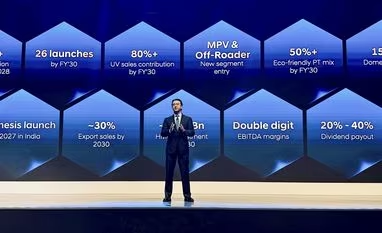
José Muñoz, president and chief executive officer (CEO) of Hyundai Motor Company, said the South Korean brand’s Indian arm was planning 26 product launches, including seven new nameplates, as it targets entry into the multi-purpose vehicle (MPV) and off-road sport utility vehicle (SUV) segments.
Lining up its 2030 strategy, Hyundai said it was targeting up to 30 per cent export contribution and over 1.5-fold rise in revenue, to cross the ₹1 trillion milestone in five years.
Addressing Hyundai’s first-ever CEO-investor meet in Mumbai, Muñoz said the firm’s EV localisation strategy would roll out in phases.
“We’re making India a global export hub, targeting up to 30 per cent export contribution. Our commitment is comprehensive: 26 product launches, including seven new nameplates, India’s first locally manufactured, dedicated electric SUV by 2027, and the launch of our luxury brand Genesis, all while treating every customer like our honoured guest,” Muñoz said.
Also Read

 "Tarun Garg")
 "Tarun Garg COO, Hyundai Motor India")
 "Jose Munoz, president and chief executive officer of Hyundai Motor Company")
 "Mahindra and Mahindra, M&M")
 "BSE, NSE, STOCK MARKETS")
“Phase 1 EV localisation strategy focuses on local assembly at our Chennai plant, with a fresh dedicated EV launch this year. We are also establishing a flexible battery plant with locally assembled battery packs starting this year. Phase 2 will focus on supply chain localisation. It is our commitment to build a self-reliant automotive ecosystem in India,” Muñoz added.
The company’s strategic road map includes India-centric product expansion, advanced manufacturing, deep localisation, and key financial guidance to support its growth trajectory through FY30.
“As we chart this growth trajectory, we are targeting a revenue milestone of ₹1 trillion by FY30, while sustaining strong double-digit Ebitda margins. We remain deeply committed to creating long-term value for our shareholders by announcing a healthy dividend payout guidance of 20-40 per cent,” said Unsoo Kim, managing director, HMIL.
Tarun Garg, whole-time director and chief operating officer of HMIL, said the company was aiming to achieve over 15 per cent domestic market share, driven by India-centric product launches. “We remain steadfast to augment our presence in the high-growth SUV segment, targeting over 80 per cent UV contribution by FY30,” said Garg.
India an export hub
Hyundai is aiming for exports to account for 30 per cent of its total production by 2030, positioning India as a key global export hub. It is eyeing around 50 per cent exports to West Asia and Africa, driven by compact sedans and SUVs, mild hybrids, and entry-level EVs. Around 40 per cent will come from Central and South America, and the remaining 10 per cent from Asia Pacific.
In 2020, India accounted for 11 per cent of Hyundai’s global sales, ranking as its fifth-largest region by volume. This increased to 15 per cent and the third-largest in FY25 and is expected to be the second-largest region by FY30.
“Our average selling price for exports was 6 per cent higher than domestic sales, which means exports are highly beneficial for profitability. The Indian automotive industry is projected to grow 5.2 per cent annually till 2030, reaching 5.6 million units.
Domestically, HMIL will grow at 7 per cent annually, significantly increasing our base, reaching 15 per cent domestic market share. This is before additional growth from the export business,” said Muñoz.
Of the 26 planned launches, four will be rolled out in the next one year.
“Today internal combustion engines (ICE) are the majority of automotive profit pools. We have a strong presence in these core markets with about 14 per cent market share in the ICE car segment and 18 per cent in the ICE SUV segment in FY25. As we look forward, EV SUVs will grow 500 per cent from 2025 to 2030. Hybrid SUVs will grow 600 per cent, hybrid cars will grow 2,300 per cent and MPV EVs by 15,000 per cent. Despite this, ICE profit will still represent half of the industry,” he added.
Muñoz later told the media that the company would not exit the entry-level segment. The entry market is developing and provides an opportunity for people to access safer mobility. “It’s in our own interests not to abandon the entry market,” he added.
Garg said the company would be among the few mass-market original equipment manufacturers in India to offer a complete range of powertrain options — ICE, CNG, EV and Hybrid technologies.
More than 50 per cent of our portfolio will be powered by cleaner and more sustainable technologies, reflecting our commitment to future-ready mobility. By FY30, our sales and service network will extend to 85 per cent of India’s districts, with rural markets expected to contribute 30 per cent of total sales, underscoring our inclusive growth strategy and deepening reach across Bharat,” Garg said.
More From This Section
 "Sanjeev Verma, CEO, Black Box")
 "IRB Infrastructure Developers")
 "Chalet Hotels, Hotels")
 "Godrej, Godrej properties")
 "The year was a mixed bag for the real estate industry as housing supply slowed down but record investments came in. Industry experts believe that demand will stabilise as sales are likely to be lower compared to 2023.")
Don't miss the most important news and views of the day. Get them on our Telegram channel
First Published: Oct 15 2025 | 1:38 PM IST