


IndiGo Q1 profit down 20.5% on airspace curbs, AI171 crash fallout
IndiGo's Q1 profit fell as geopolitical tensions, Pakistan airspace curbs, and AI171 crash drove cancellations and depressed yields despite higher passenger numbers
 "IndiGo, Bird Strike")
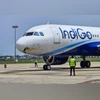
Total income for the quarter rose 6 per cent Y-o-Y to ₹21,542.6 crore. (Photo: PTI)
Listen to This Article
Low-cost carrier IndiGo on Wednesday announced that its consolidated profit dropped 20.5 per cent year-on-year (Y-o-Y) to ₹2,174.9 crore in the first quarter of financial year 2025-26 (FY26) due to airspace restrictions, geopolitical disruptions, and the impact of the AI171 crash, which led to widespread flight cancellations and depressed ticket yields.
“The quarter was marked by a series of external events. Geopolitical events, airspace restrictions, and the unfortunate accident, leading to a higher flight and passenger cancellations and moderation in yields,” said Gaurav Negi, chief financial officer, IndiGo.
Yield refers to the average fare paid per passenger per kilometre flown. Pakistan has shut its airspace for Indian carriers since April 24.
Despite these disruptions, the airline carried 12 per cent more passengers during the quarter, clocking 31 million travellers, double the industry growth of six per cent.
Also Read

 "indigo airlines, indigo")
 "BSE, stock market, sensex")
 "Will Air India crash aid IndiGo Q1 results? Check date, time, expectations")
 "equity market, stocks, share market")
 "indigo airlines, indigo")
He acknowledged that profits took a hit from broader geopolitical headwinds, although lower fuel prices offered some respite.
The airline saw a relatively strong start to the quarter, but conditions deteriorated by May and June. “While the large part of April performed well, May and June were marked by significant geopolitical headwinds, which led to significant cancellations, and did not allow normalisation of yields,” Negi said.
Total income for the quarter rose six per cent to ₹21,542.6 crore.
Operationally, IndiGo inducted eight new aircraft, while making progress on reducing reliance on wet-leased planes. “The number of grounded aircraft remains stable in the 40s. And with the reduction in the number of groundings, we have started returning damp leases (wet-leased aircraft), and have redelivered 16 damp-leased aircraft this quarter,” Negi said.
The airline is keeping its fleet plans flexible. “We remain open to inducting additional wet-leased aircraft based on the demand-and-supply situation going forward,” he added.
Chief Executive Officer Pieter Elbers said the quarter was marked by severe turbulence. The closure of many airports across northern and western India, following Operation Sindoor on May 7, forced the airline to cancel up to 170 flights a day.
Elbers said the airline has begun long-haul services to Europe, launching flights to Amsterdam and Manchester in early-July. He added that given strong demand, IndiGo will double its frequency to Amsterdam and add a fourth weekly flight to Manchester. A reciprocal codeshare with KLM will also expand the airline’s reach across Europe.
After debuting on the Delhi-Mumbai route late last year, IndiGo’s business class (called Stretch) has now been extended to flights to Bangkok, and will soon launch on routes to Singapore and Dubai. Elbers said the market response has been encouraging, with load factors improving gradually.
On the domestic front, IndiGo recently began operations from Hindon airport in Delhi and is looking to expand its network further.
The airline’s loyalty programme, launched late last year, has now amassed 3.8 million members. Elbers said this, combined with long-haul flying, a tailored premium product, and ongoing network expansion, positions IndiGo strongly to tap into India’s aviation growth story.
More From This Section
 "Mahindra and Mahindra, M&M")
 "Tata Steel")
 "Hyundai")
 "From its highs over the past month, the stock of Procter & Gamble Hygiene and Healthcare is down 7 per cent before recovering this week P&G")
 "Hyundai Q4 FY25 results, Hyundai profit decline, Hyundai model launch plan, Hyundai FY30 roadmap, HMIL export strategy, Unsoo Kim Hyundai, Hyundai EV India")
Don't miss the most important news and views of the day. Get them on our Telegram channel
First Published: Jul 30 2025 | 7:19 PM IST