


Zimbabwe knocks Australia out, first group stage elimination since 2009
Australia's only win came against Ireland as Mitchell Marsh and co. are out of the T20 World Cup before the semis for the third time in a row now.
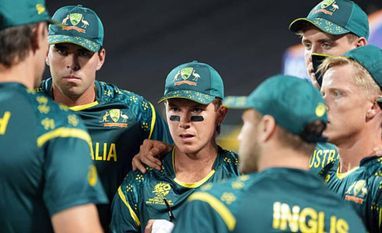 "Australia knocked out of T20 World Cup 2026")
Australia knocked out of T20 World Cup 2026
Listen to This Article
Heavyweights Australia have been knocked out of the T20 World Cup 2026 after a tournament hit with injuries, inconsistencies and no luck going in their favour. This is the first time that the Aussies have failed to go through past the group stage for the first time since 2009.
Zimbabwe proved to be kryptonite for the Aussies this year, delivering a shocking defeat and ultimately playing a key role in Australia’s tournament exit when the Ireland vs Zimbabwe match was washed out in Pallekele today
The 2021 champions bow out of the tournament with a solitary win in 3 games as they faltered to a surprise defeat to Zimbabwe and followed it up with another disappointing loss against co-hosts Sri Lanka in their group stage. Their only win came against Ireland as Mitchell Marsh and co. are out of the T20 World Cup before the semis for the third time in a row now.
Many are questioning the selectors’ choices, particularly the decision to ask Steven Smith and Matt Renshaw to run drinks rather than replace struggling starters. However, the issues run deeper than a few personnel decisions, with multiple factors contributing to Australia’s struggles.
Injuries and squad management issues
Hazlewood’s hamstring injury in November 2025 marked a turning point. Before his injury, he had been in peak T20I form, taking eight powerplay wickets in seven games at an average of 15.12. Since his absence, Australia has won only once in eight T20Is. Additionally, Tim David, Cooper Connolly, and other key players have struggled with form or fitness, leaving selectors with a limited and underperforming squad.
Batting Collapse undermines promising starts
Australia’s innings began well against Sri Lanka last night, with Mitchell Marsh and Travis Head guiding the team to 104 without loss after 8.3 overs. The approach mirrored their successful 2025 strategy, which had yielded ten wins in 11 matches. Despite a brief collapse of four wickets for 26 runs, Josh Inglis and Glenn Maxwell revived the innings to 160 for 4, with power-hitters Marcus Stoinis and Cooper Connolly still available. Yet another late collapse, six wickets for 21 runs in 24 balls, left Australia all out for 181.
Also Read


 "IRE vs ZIM live score T20 World Cup")
 "Usman Tariq, Pakistan mystery spinner")
 "Lalchand Rajput, current UAE head coach and former Zimbabwe head coach")
 "Top 10 wicket takers and run getters in T20 World Cup 2026")
Bowling Woes Exposed
Australia’s bowlers struggled yet again, taking only two wickets in the Sri Lanka chase. Nathan Ellis and Adam Zampa, previously reliable, went wicketless in consecutive matches, while injured pacers Josh Hazlewood and Pat Cummins were unavailable. The lack of penetration in the powerplay, combined with inexperienced backups like Ben Dwarshuis and Xavier Bartlett, has exposed the team’s pace-bowling depth as a critical weakness.
Selection and strategy criticisms
Decisions to prioritize the BBL finals over full warm-up series in spinning conditions and relying on a small pool of fit players have backfired. The lack of preparation in subcontinental conditions, combined with over-reliance on underperforming power-hitters, has resulted in poor execution on the field.
T20 cricket takes a back seat
Australia’s focus on domestic tournaments over international T20 preparation has highlighted a larger structural issue. While other nations prioritize global T20 events, Australia’s approach may hinder performance in upcoming World Cups, including the 2028 home edition. The team’s inability to get out of the group stage raises questions about planning, prioritization, and long-term strategy for white-ball cricket.
A wake-up call for the Aussies
The problems are multifaceted - from injuries and fitness concerns to selection missteps and lack of preparation in subcontinental conditions. While this may not trigger a full-scale review, Australia must rethink its T20 strategy to remain competitive on the world stage
More From This Section


 "Australia cricket team will be eliminated if IRE vs ZIM gets washed out")
 "T20 WC Group D points table")
Topics : Cricket News Australia cricket team
Don't miss the most important news and views of the day. Get them on our Telegram channel
First Published: Feb 17 2026 | 5:50 PM IST