


How the world cup triumph can change women's cricket landscape in India
Cricket's universal appeal ensured this moment reached every small town and village, inspiring a new generation of girls to dream beyond boundaries.
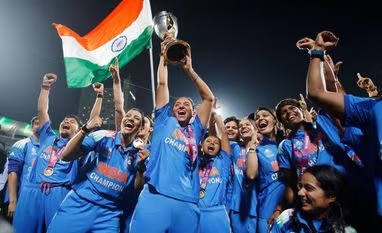 "India women's cricket team")
India women's cricket team


Listen to This Article
At Mumbai’s DY Patil Stadium, history finally smiled on Indian women’s cricket. After years of heartbreak in the 2005 and 2017 finals, Harmanpreet Kaur’s team lifted the World Cup, sealing their place in the nation’s sporting folklore. For the players who endured the pain of near misses, this victory wasn’t just a trophy, it was vindication.
The Harman Effect
When Jemimah Rodrigues and Amanjot Kaur steered India past Australia and South Africa, they didn’t just win a championship, they united a nation. Cricket’s universal appeal ensured this moment reached every small town and village, inspiring a new generation of girls to dream beyond boundaries.
This victory broke the invisible ceiling that kept women’s sport on the margins. While earlier icons had opened doors, Harman and her teammates flung them wide open.
A Historic Triumph and Its Lasting Impact on Women’s Cricket
India’s historic win in the 2025 Women’s ODI World Cup was the culmination of years of dedication, perseverance, and unparalleled talent, showing that the impossible dream of lifting the trophy could indeed be realized. Central to this achievement was the brilliance of Shafali Verma, whose performances in both the semi-final and the final left spectators and teammates in awe. India coach Amol Muzumdar also emphasised how the displays from Shafali Verma and other players could inspire a whole generation in the years to come. "From scoring crucial runs to taking important wickets and executing stunning catches, Shafali delivered a complete performance when it mattered the most, embodying the spirit, resilience, and skill that define world-class cricket." he said. The victory was also symbolic, evoking memories of India’s first men’s World Cup triumph in 1983. Reflecting on the journey from heartbreak to glory, the coach called it a defining moment for the sport, deeming it as a “Watershed moment." "The ripple effects will be felt for generations. Magical, that’s what Shafali was today. Semi-final, final, she turns up every time. Runs, wickets, catches, complete performance. Couldn’t be prouder.” This triumph promises to inspire countless young girls to pick up cricket, elevating the sport in India for years to come and creating a legacy that will influence generations.
Also Read

 "mandira bedi, cricket")
 "Indian women's cricket team")
 "India cricket team, led by Harmanpreet Kaur, won ICC Womens World Cup 2025")
 "Pratika Rawal")
 "Venky Mysore, chief executive officer (CEO) of Knight Riders Group and Red Chillies Entertainment.")
From Usha’s Sprint to Global Glory
India’s journey in women’s sports began decades ago with the legendary PT Usha, who sprinted her way into public consciousness at the 1984 Los Angeles Olympics. Her feats inspired generations to chase impossible dreams. From there, Sania Mirza and Saina Nehwal smashed their way into global arenas, while PV Sindhu turned Olympic medals into milestones of national pride.
Wrestlers like Sakshi Malik, boxers such as Mary Kom, and weightlifters like Mirabai Chanu built the foundation of India’s women’s sporting power. But it took the women’s cricket team’s World Cup triumph to ignite the country’s collective sporting imagination
The Cultural Shift
India’s sporting map is now being redrawn. Women’s leagues are emerging from Himachal to Madhya Pradesh, and academies are nurturing talent in previously untapped regions. Equal facilities, fitness programs, and fan engagement have brought women’s cricket to the same emotional space once monopolized by men’s teams.
Even Bollywood’s long-cherished dream, seeing India’s women defeat Australia on the world stage, has come true.
The New Era
India’s historic Women’s World Cup triumph is poised to transform the landscape of women’s cricket in the country. This victory could draw significantly more attention to the sport, encouraging larger crowds at matches and boosting revenue through sponsorships, ticket sales, and broadcasting rights. The success is likely to inspire young girls nationwide to take up cricket, expanding the talent pool for the future. The Women’s Premier League (WPL), which has consistently nurtured top talent for the national team, may also experience growth, with the possibility of new franchises joining the 5-team league. Increased competition and exposure will provide more players with essential game time and recognition, ultimately enhancing the depth, skill, and overall quality of the Indian women’s cricket team on the international stage. The more number of teams will eventually help more brands centered around them to generate more revenue as well indicating a win-win situation for all.
More From This Section
 "Mithali Raj and Diana Edulji")
 "India win ICC Women's World Cup 2025 on November 2")
 "IHPL Chris Gayle")
 "Indian women's cricket team")
Topics : Cricket News Indian Cricket
Don't miss the most important news and views of the day. Get them on our Telegram channel
First Published: Nov 03 2025 | 1:37 PM IST