


Scenarios for India's future: How planning can shape growth and inclusion
Scenario planning, having being successfully implemented in businesses, has tremendous potential for shaping India's future
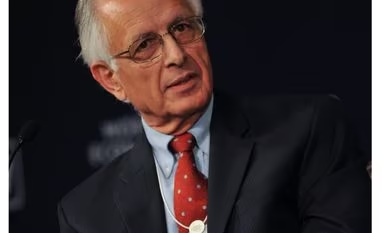 "Arun Maira")
File image of Arun Maira | Photo: Wikipedia
Listen to This Article
The US army employed a methodology, called scenario planning, to prepare for the uncertainties of the future and develop their strategies accordingly. The method was applied for business strategy by Shell Oil in the 1980s. The multinational oil companies were investing in expensive deep-sea drilling to increase their supplies. Shell’s scenario planners examined the possibility of the Soviet Union collapsing, which would open Russian gas supplies to Europe and make deep sea drilling less remunerative. Shell changed its investment strategy and saved billions of dollars.
Adam Kahane from the Shell scenarios team assisted a group of business and political leaders in South Africa to foresee scenarios of South Africa and develop a strategy for the reform of the South African state when apartheid was abolished and its white rulers handed power to native Africans. They applied the approach of generative scenario planning to focus on strategies for South Africa’s internal reforms. They compared the effects of alternative economic strategies on internal social cohesion. Whereas classical scenario planning is akin to chess-playing, with a focus on external conditions and on what other players may do, generative scenario planning is focused on what a country should change about itself to create a future its citizens aspire for.
Generative scenario planning was applied in India in 1999, 2005 and 2013. The first time by a diverse group of citizens—businessmen, politicians, economists, and civil society— concerned with the inequitable and unsustainable trajectory of India’s growth, already visible then. In 2005, it was employed by the WEF and CII. In 2013, the Planning Commission implemented generative scenario planning to supplement the preparation of the 12th Five Year Plan whose objective was ‘Faster, More Inclusive and Sustainable Growth’.
The WEF commissioned scenario planning exercises in Brazil, Russia, India, and China in 2005, because its business members were skeptical about the futures forecasted by economists for the BRICs countries. They feared that economists often get the big picture wrong. For example, in the 1980s, the economists had projected that the 21st century would be Japan’s century. China was not on their radar then and they did not foresee its unchallenged rise. Nor had they considered the imminent collapse of the Soviet Union (which Shell’s scenarists had). Social and political forces direct economic changes. Economists’ models concentrate on economic measurements. They exclude social and political forces as messy externalities. Thus, they are incomplete representations of reality.
The WEF scenarists adopted the generative scenario process in India. They produced three plausible scenarios of what India could be in 2025: Pahale India, Bolly World, and Atakta Bharat. Bolly World was their evocative description of what India’s economy was becoming then. Shining with glamour, and also lurking violence. Very entertaining for an outsider to watch. But a vulnerable situation for insiders. The other two scenarios were possibilities dependent on India’s future economic policies. The scenarists projected that persistence of ‘un-socialist’ free market reforms could cause the Indian society and polity to crack, creating an Atakta Bharat. Whereas, if reforms became more inclusive, and inequalities reduced, the growth of India’s economy would be faster and sustainable, resulting in the Pahale India scenario by 2025.

 "Mamata Banerjee, Mamata, Abhishek Banerjee, Abhishek")
 "modi, narendra modi, Nitish Kumar, Bihar CM")
 "India vs New Zealand 2nd Test live score updates")
 "Stock market")
 "India vs Germany")
The National Council of Applied Economic Research (NCAER) and Oxford Economic Forecasting calculated what India’s growth rate, poverty levels, and other economic indicators would be in the three scenarios. They projected that Bolly World would result in growth for a few more years and then internal tensions would cause growth to fall.
The utility of India’s top-down planning process, and the Planning Commission itself, was questioned in 2009—by civil society, businesspeople, and politicians. The Commission produced budgets and lengthy plan documents. However, the outcomes they projected, especially in terms of citizens’ well-being, were not achieved. There were calls to replace the Planning Commission with an ‘implementation commission’. Civil society organizations wanted economic planners to listen to the people to understand realities on the ground which the planners’ statistics were not representing accurately.
A new, participative, approach to national planning seemed necessary, engaging all stakeholders in a dialogue to determine the reforms required to make India a good, secure, and just country for everyone. Therefore, the generative scenario planning methodology was applied for the 12th Plan, albeit as a small supplement to the traditional top-down, numbers driven, planning process which continued.
The Planning Commission was abolished in 2014. Its plans, along with scenario planning strategies, were buried. A year later, the Commission was replaced by the National Institution for Transforming India (NITI Aayog). NITI is now preparing plans for India@100, projecting how large India’s GDP will be.
It is worthwhile considering the reforms recommended by the 2013 scenario process. It projected three plausible scenarios for India’s future. They were titled The Flotilla Advances, Muddling Along, and Falling Apart. The fundamental differences amongst them were in strategies for growth. The Flotilla Advances was based on:
- Inclusion through faster growth of livelihoods instead of more handouts and subsidies
- Sustainability through community-based solutions instead of large projects
- More localized governance instead of centralized control
Growth, poverty, and government deficits in the three scenarios were estimated by NCAER and C-STEP, a leading think tank. The Indian economy will always be affected by uncertain global conditions. Therefore, differences between projected growth rates with different strategies for internal reforms are pointers to the best strategy for India regardless of external conditions. NCAER projected that growth in the Flotilla Advances scenario would be 9.3% per annum. With Muddling Along, it would be 6.5%, while Falling Apart predicted 5.0%. Therefore, the reforms recommended for The Flotilla Advances scenario, mentioned before, were the way to go.
India’s reformers seem to be muddling along hoping that minimum government regulation, free trade, and more GDP will create more incomes for Indian citizens, and equitably too to maintain social cohesion. Neo-liberal economics is not working anywhere, and inequalities are increasing in rich countries too. Populist movements from Left and Right are rising against the muddled middle even in the West.
The government must take heed and change its strategy to hasten inclusion and sustainability at the bottom for achieving its dreams of India@100. India’s diversity and demographics can be India’s strengths, provided we adopt the right policies. Growth strategies must be guided by society, less pure economics; with more listening, less numbers; and more open-minded dialogue, less diktat.
The writer is a former member of Planning Commission
Disclaimer: These are the personal opinions of the writer. They do not reflect the views of www.business-standard.com or the Business Standard newspaper
More From This Section
 "Rizwan Soomar")
 "Lt Gen Harinder Singh")
 "pulses")
 "tomato")
 "Counting the cost of Bihar's liquor prohibition on state's revenue, alcohol ban")
Topics : planning commission Niti Aayog US Army economy
Don't miss the most important news and views of the day. Get them on our Telegram channel
First Published: Oct 24 2024 | 2:54 PM IST