


Brent crude may cross $110 if Hormuz oil flow halves: Goldman Sachs
But Kotak Institutional Equities believes market concerns are driving oil prices and points to sufficient OPEC+ spare capacity and well-supplied global inventories
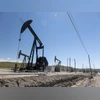 "Crude Oil, Brent Crude, Oil")
For India, an estimated 10 per cent increase in crude prices may not have much of an impact on the economy where fundamentals remain robust.


Listen to This Article
Goldman Sachs estimates Brent crude prices could temporarily peak to $110 per barrel if oil flows through the critical Strait of Hormuz were halved for a month and remained down by 10 per cent for the following 11 months. In that case, crude prices will settle on an average of $95 per barrel in the fourth quarter of 2025, the bank said in a note on Monday.
Oil prices oscillated on Monday, touching a five-month high before erasing most gains as oil and gas transit continued on tankers from West Asia after US airstrikes against Iran at the weekend.
Brent crude futures were up 16 cents, or 0.2 per cent, at $77.17 a barrel by 1307 GMT. US West Texas Intermediate crude rose 14 cents, or 0.2 per cent, to touch $73.98.
In a more severe scenario where Iranian output remains suppressed, Brent would still peak at $90 but then stabilise at $70–80 per barrel in 2026, as global inventories shrink and spare capacity drops. The latest forecast comes days after Citigroup warned oil could cross $90/bbl if the strait is shut.
Also Read

 "CIO Marco Argenti and Co-chairman and India head Gunjan Samtani, Goldman Sachs")
 "Biocon")
 "Goldman Sachs")
 "stock market trading")
 "Bajaj Finance")
However, Kotak Institutional Equities believes that, given the significant spare capacity of 6 million barrels per day (bpd) with the OPEC+ bloc, oil prices are set to come down soon. “Also, at higher than $70/bbl, the US could see further increase in production. We do not expect oil prices to remain elevated for long and maintain our oil price assumption of $70/bbl for FY2026/27E,” it said in a note on Monday.
Brent crude prices have risen 13 per cent since the conflict began on June 13, while WTI has gained around 10 per cent. Brent oil futures rose to a five-month high of $78/bbl on Monday, before falling to $75.4/bbl at the time of writing this report.
For India, an estimated 10 per cent increase in crude prices may not have much of an impact on the economy where fundamentals remain robust, but a prolonged effect may cause harm, Madan Sabnavis, chief economist at Bank of Baroda, said. “But if it is over $100 for a prolonged period it would mean virtually a 25 per cent increase over the base case assumption and can have a major impact on these variables,” he said.
At the beginning of the year, the assumption was that oil would be around $80, and hence anything more than this would raise a red flag, he stressed. The impact on GDP will be driven primarily by how inflation behaves and affects consumption, Sabnavis said.
Citing data from prediction market Polymarket, Goldman Sachs noted that markets now price in a 52 per cent probability of Iran closing the strait in 2025, though it emphasised that liquidity on such platforms remains limited. In an unprecedented step, Iran’s Parliament voted on Sunday to allow emergency measures to block the narrow, strategic waterway, state media reported. However, the final decision rests with the country’s Supreme National Security Council.
“With 20 million barrels per day of oil and 83–84 metric tonnes per year of liquefied natural gas (LNG), the strait accounts for 27 per cent and 20 per cent of global oil and LNG trade, respectively. It is unlikely that it will be impacted for long. Any short-term impact can lead to a further spike in oil prices,” Kotak Institutional Equities pointed out.
Arguing that the recent oil price spike is primarily driven by market worries, it noted that before the conflict, oil markets were well-supplied and the planned reversal of voluntary cuts by the OPEC+ bloc was an overhang.
While risks have increased for shipping in the strait, so far there is no impact on supplies, it said. Industry portals tracking tanker movement showed many have altered their course or backed out from the strait on Monday. This was also corroborated by maritime tracking data from the Automatic Identification System.
According to Goldman Sachs estimates, a six-month-long cut in Iranian oil supply by 1.75 million bpd, followed by a gradual recovery, could drive Brent prices to $90 per barrel before declining into the $60 range by 2026.
Despite international sanctions, China remains Iran’s largest oil customer, accounting for 80–90 per cent of exports. In 2024 and early 2025, Iran’s crude exports averaged between 1.38 million and 1.7 million bpd. In March 2025, exports reportedly surged to 1.71–1.8 million bpd amid fears of tighter American sanctions, according to global energy trackers.
Kotak said Iranian oil production has been impacted and currently stands at 3.5 million bpd, while exports are at 1.7 million bpd.
It is also not in Iran's interest to close the Gulf at a time when the country has been racing to get its oil out. Bloomberg reported last week that Iran has exported an average of 2.33 million barrels per day since June 13, fearing strikes on key oil infrastructure. Large amounts of crude have been brought to Kharg Island, Iran’s key oil export terminal in the northern Persian Gulf.
More From This Section
 "FDI, INVESTMENT, investment, foreign investment, foreign direct investment, FPI, dollar inflow, GROWTH, MARKETS, FUNDS, SHARES, DEMAND, GROWTH, mutual fund, fund, stocks")
 "MoSPI, Survey")
 "Energy, Solar energy, Wind Energy")
 "PMI, PMI INDIA")
 "capex")
Don't miss the most important news and views of the day. Get them on our Telegram channel
First Published: Jun 23 2025 | 8:03 PM IST