


India, UK dismantle trade walls with landmark deal amid global tensions
Comprehensive trade deal signed, allowing duty-free entry to 99% of Indian exports
 "Narendra Modi, Keir Starmer")
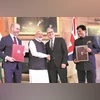
PM Narendra Modi and his British counterpart Keir Starmer are joined by Commerce and Industry Minister Piyush Goyal and UK Secretary of State for Business and Trade Jonathan Reynolds, for the signing of the Comprehensive Economic and Trade Agreement at Chequers


Listen to This Article
India and the United Kingdom (UK) on Thursday signed a modern and comprehensive trade agreement, marking a major milestone in their bilateral relationship at a time of rising geopolitical polarisation and trade wars. Under the agreement, 99 per cent of Indian exports will enter the UK duty-free, while 90 per cent of UK goods will gain market access in India with zero tariffs.
The deal, known as the Comprehensive Economic and Trade Agreement (CETA), was signed by Union Commerce and Industry Minister Piyush Goyal and his British counterpart Jonathan Reynolds, 42 months after negotiations began in January 2022. The signing took place in the presence of Prime Minister Narendra Modi and his British counterpart Keir Starmer at Chequers, the official countryside retreat of the British PM, in the Chiltern Hills of Buckinghamshire.
“This agreement is more than just an economic partnership; it is a blueprint for shared prosperity. On the one hand, it paves the way for enhanced market access in the UK for Indian textiles, footwear, gems and jewellery, seafood, and engineering goods…. On the other hand, UK-made products such as medical devices and aerospace components will become more accessible and affordable for Indian consumers and industries,” Modi said during the joint press statement in the UK.
The agreement will come into effect once ratified by both countries. While the Union Cabinet in India has approved the deal, it still requires approval from the UK Parliament.
This is the most comprehensive trade agreement that India has signed with any major developed country. Both sides aim to double bilateral trade by 2030 from the current level of nearly $56 billion.
Also Read

 "Britain's Prime Minister Keir Starmer and Prime Minister Narendra Modi")
 "Modi, Narendra Modi, Keir Starmer")
 "Bangladesh import ban, Indian textile industry, ITF, CMAI, Indian retailers, domestic sourcing, apparel imports, import duty, MSMEs, textile manufacturing")
 "Modi, Narendra Modi, Keir Starmer, Keir, Starmer, UK")
CETA will reduce India’s applied trade-weighted average tariff on goods imports from the UK from 15 per cent to 3 per cent, according to the UK government.
However, the agreement does not address how to deal with the UK’s Carbon Border Adjustment Mechanism when it comes into force in January 2027, despite India having raised concerns.
India has granted tariff concessions on alcohol and automobiles -- key demands from the UK -- though in a staggered manner. Tariffs on whisky will be reduced from 150 per cent to 40 per cent over 10 years. For cars, where tariffs currently stand as high as 110 per cent, rates will fall to 10 per cent but within a quota. India will also eliminate or gradually phase out duties on consumer goods including soaps, perfumes, shaving creams and nail polish.
However, the deal does not extend concessions to electric, hybrid and hydrogen-powered vehicles for the first five years. Tariff cuts have also excluded products such as apples, cheese, whey, gold bars, and smartphones, with India seeking to protect sensitive domestic sectors. Britain, in turn, has excluded meat, rice, sugar and eggs from tariff liberalisation.
A standalone Double Contributions Convention (DCC) was also signed alongside the CETA. The treaty will prevent double payment of social security contributions -- roughly 20 per cent -- for a period of three years, benefiting an estimated 75,000 Indian professionals working in the UK.
As part of the deal, India has committed to granting UK firms access to its vast government procurement market. British companies will be able to bid for around 40,000 tenders annually, with a total value of at least £38 billion. UK-origin goods with just 20 per cent domestic content will be treated as “Class II” local suppliers under India’s Public Procurement Order, a category previously reserved for Indian suppliers with 20–50 per cent local content.
Experts said the move signals a shift away from using public procurement as a lever for domestic industrial development. “The 20 per cent local content rule allows UK firms to use up to 80 per cent inputs from third countries -- such as China or the European Union -- while still receiving preferential treatment, effectively diluting the benefits that programs like ‘Make in India’ and Atmanirbhar Bharat were designed to protect,” according to a report released by Delhi-based think tank GTRI.
More From This Section
 "Prime Minister Narendra Modi and his British counterpart Keir Starmer during a business showcase event at Chequers, near Aylesbury, in England on Thursday. (Photo: AP/PTI)")
 "RBI, Reserve Bank of India")
 "Donald Trump, Trump")
 "Modi, Narendra Modi, Keir Starmer, Keir, Starmer, UK")
Don't miss the most important news and views of the day. Get them on our Telegram channel
First Published: Jul 25 2025 | 12:18 AM IST