


India-UK trade deal: Smooth road ahead as luxury cars set to get cheaper
Under the FTA, tariffs on automotive imports will come down by 50 per cent over 10 years (out of quota)
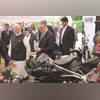 "Prime Minister Narendra Modi and his British counterpart Keir Starmer during a business showcase event at Chequers, near Aylesbury, in England on Thursday. (Photo: AP/PTI)")
Prime Minister Narendra Modi and his British counterpart Keir Starmer during a business showcase event at Chequers, near Aylesbury, in England on Thursday. (Photo: AP/PTI)
Listen to This Article
The India-United Kingdom free-trade agreement (FTA) is likely to boost market access for high-end luxury cars owing to lower tariffs.
Under the FTA, tariffs on automotive imports will come down by 50 per cent over 10 years (out of quota).
JLR is likely to be the biggest beneficiary of this move. Players like Aston Martin (which sold fewer than 25 cars in India in 2024, according to market sources), Rolls Royce, and McLaren too are likely to benefit from the reduced import duty.
Players like Jaguar Land Rover (JLR) make 60 per cent of the cars they sell in India locally as completely knocked down (CKD) units and it is on track to start local assembly at its Tamil Nadu plant next year. It makes the Range Rover, Range Rover Sport, Velar, and Evoque in India (Pune plant). CKD units attract a 15 per cent basic customs duty.
Possibilities remain on assembling JLR’s Defender model in India, given the fact that the car is manufactured at the manufacturer’s Slovakia plant, which is outside the purview of the India-UK FTA. The quota and the duty structure vary with the type of engine, and therefore industry insiders say these British luxury cars may be cheaper by 50 per cent or more. The industry is still studying the fine print of the deal. McLaren has sold around 50 cars in India since 2022 while Rolls Royce is estimated to have sold around 60 cars in 2023 (the latest data is not available).
Also Read

 "Modi, Narendra Modi, Keir Starmer")
 "Bangladesh import ban, Indian textile industry, ITF, CMAI, Indian retailers, domestic sourcing, apparel imports, import duty, MSMEs, textile manufacturing")
 "Britain's Prime Minister Keir Starmer and Prime Minister Narendra Modi")
 "David Lammy")
 "Modi, Narendra Modi")
“We welcome this FTA, which over time will deliver reduced tariff access to the Indian car market for JLR’s luxury vehicles,” a JLR spokesperson said in a statement, adding that India was an important market for the company’s British-built products and represented significant growth opportunities.
In a separate query regarding a change in the pricing of imported products, a UK-based spokesperson said: “No decisions have been made.”
In a recent interview Martin Limpert, global managing director for Range Rover, had said the Defender was a “very successful” car in the Indian market, and hence it was “natural” for them to look at local production. At present, a few high-value sport vehicles of JLR are imported as completely built units (CBUs) and those will stand to benefit.
Players that sell both CKD and CBU models will stand to benefit.
Domestic carmakers like Mahindra & Mahindra and Maruti Suzuki that have European ambitions too stand to benefit. Maruti sells the eVitara in the UK.
Anish Shah, chief executive officer and managing director, Mahindra group, said: “We believe deeply in the power of such cross-border partnerships to unlock economic potential, create high-quality jobs, and accelerate progress in future-facing sectors from green mobility and clean energy to digital technologies and advanced manufacturing.” As Indian industry becomes increasingly global, “we look forward to contributing meaningfully to this next chapter of UK-India cooperation”.
The Automotive Component Manufacturers Association of India (ACMA) welcomed the deal and hoped it fostered greater market access, technology partnerships, and value chain integration between the Indian and British automotive industries.
The deal is expected to benefit the Indian auto-component sector through enhanced opportunities for export, streamlined regulatory processes, particularly in key areas such as electric mobility, precision engineering, and lightweight materials, ACMA President Shradha Suri Marwah said in a statement.
More From This Section
 "RBI, Reserve Bank of India")
 "RBI, Reserve Bank of India")
 "Modi, Narendra Modi, Keir Starmer, Keir, Starmer, UK")
Don't miss the most important news and views of the day. Get them on our Telegram channel
First Published: Jul 24 2025 | 8:32 PM IST