


India says bilateral trade talks with US seeing 'positive progress'
India and US officials report positive progress in their trade talks, focusing on a multi-sector Bilateral Trade Agreement; roadmap is in place to conclude the deal in the near future
 "PM Modi, Donald Trump")
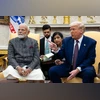
Prime Minister Narendra Modi and US President Donald Trump (Image: Bloomberg)
Listen to This Article
India and the US have made “positive progress” in the latest round of discussions on the proposed Bilateral Trade Agreement, the Ministry of Commerce and Industry said in a statement on Tuesday.
Representatives from India’s Department of Commerce and the Office of the US Trade Representative met in Washington, DC from April 23 to 25, following earlier talks held in March in New Delhi.
The meetings in Washington covered a broad spectrum of issues including both tariff and non-tariff matters, the ministry said. Officials had “fruitful discussions” and explored a roadmap for concluding the first tranche of a “mutually beneficial, multi-sector” trade agreement by Fall 2025 (September-November 2025), the ministry said.
It further said that talks also focused on identifying “opportunities for early mutual wins". These steps are seen as part of a larger effort to deepen economic cooperation and strengthen supply chain integration between the two countries.
Also Read

 "India-US")
 "Oil refinery")
 "India US side letters, India US trade deal, India US non tariff barriers, India US bilateral trade agreement, side letters trade agreements, India US trade negotiations, resolving NTBs India US, India US free trade talks, non tariff barriers India US")
 "India USA")
 "Kash Patel")
While most expert-level discussions have so far taken place virtually, the ministry announced that “in-person Sectoral engagements are planned from end May” to build further consensus. These developments follow the Leaders’ Statement from February 2025, which called for enhanced India-US economic ties through greater integration via the Bilateral Trade Agreement.
'India likely to secure first trade deal'
Last week, US Treasury Secretary Scott Bessent had indicated that India is likely to become the first nation to conclude a bilateral trade agreement designed to prevent the imposition of US President Donald Trump’s reciprocal tariffs.
Speaking at a media roundtable held in conjunction with the World Bank and International Monetary Fund’s annual meetings in Washington, Bessent noted that talks with India are close to wrapping up. He credited the progress to India’s comparatively open approach to trade.
“India also has fewer non-tariff trade barriers, obviously, no currency manipulation, very, very little government subsidies, so that reaching a deal with the Indians is much easier,” Bessent said, according to the New York Post.
Under current US policy, Indian exports face a 10 per cent baseline tariff, with an additional 26 per cent reciprocal tariff proposed but placed on hold for 90 days. That suspension ends on July 8. The proposed hike is part of Trump’s wider push to encourage trading partners to reduce trade barriers and address the US trade deficit.
More From This Section
 "cement, cement sector")
 "Sunil Barthwal, commerce secretary")
 "Nirmala Sitharaman, Nirmala")

 "Scott Bessent , Trump's Treasury secretary pick")
Don't miss the most important news and views of the day. Get them on our Telegram channel
First Published: Apr 29 2025 | 4:49 PM IST