


US trade panel flags India's high tariffs ahead of April 2 'Liberation Day'
The 2025 National Trade Estimate (NTE) report, released on Monday, details how India's tariff and non-tariff policies remain among the most restrictive in major global economies
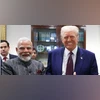 "Prime Minister Narendra Modi with US President Donald Trump")
Prime Minister Narendra Modi with US President Donald Trump. (Photo: X/@NarendraModi)
Listen to This Article
India continues to impose steep tariffs and a range of regulatory barriers on imports from the United States, particularly in sectors such as agriculture, pharmaceuticals, medical devices, and digital services, according to the latest assessment by the Office of the United States Trade Representative (USTR).
The 2025 National Trade Estimate (NTE) report, released on Monday, details how India’s tariff and non-tariff policies remain among the most restrictive in major global economies.
The report comes ahead of US President Donald Trump’s reciprocal tariffs, set to come into effect on April 2—a day he refers to as “Liberation Day.” Trump, who has described India as the “tariff king” for imposing high levies on US products, expressed confidence that New Delhi would “significantly cut tariffs” before the April 2 deadline.
India’s tariffs and non-tariff barriers
The report notes that India’s average applied Most-Favoured-Nation (MFN) tariff rate is 17 per cent overall, but rises to an average of 39 per cent on agricultural products. For non-agricultural goods, the average applied tariff is 13.5 per cent. These rates are significantly higher than those of other large economies and well above the global average.
India’s World Trade Organisation (WTO) bound tariff rates on agricultural products are also among the highest in the world, averaging 113.1 per cent and ranging as high as 300 per cent.
Also Read

 "BofA Securities expects gold prices to hit $3500 an ounce mark in 18 months on US tariff, demand")
 "Iran's Supreme Leader Ayatollah Ali Khamenei, Donald Trump")
 "John F Kennedy")
 "Donald Trump, Trump")
 "Donald Trump, Trump")
The report states that tariff changes in India are often made without prior notice or stakeholder consultation, creating unpredictability for exporters.
For US exporters, India’s tariff barriers are compounded by non-tariff measures, such import bans, restrictions, licensing requirements on certain goods, mandatory Quality Control Orders (QCOs), customs barriers, price control on medical devices, and mandatory domestic testing and certification requirements for equipment. The report also flags concerns over burdensome customs valuation practices, arbitrary regulatory changes, and excessive documentation.
Agriculture
In the agriculture sector, the report describes India’s minimum support price (MSP) programme as one of the most production- and trade-distorting forms of agricultural support. The MSP programme covers 25 agricultural products, with rice and wheat being the most prominent.
By setting price floors before planting seasons, the MSP distorts planting decisions, leads to overproduction, restricts import demand, and artificially enhances India’s export competitiveness.
US industry groups have also raised concerns over India’s sanitary and phytosanitary (SPS) barriers. These include a zero-tolerance policy for certain pests, mandatory methyl bromide fumigation, and slow risk assessment procedures.
According to the report, such requirements often lack scientific justification and disproportionately affect US agricultural exports, including almonds, walnuts, grains, and dairy products. Import quotas and licensing restrictions further reduce access to India’s food market.
Pharmaceutical sector
The NTE report also highlights persistent trade barriers in the pharmaceutical and medical devices sectors. India maintains price caps on essential medical devices such as coronary stents and knee implants, affecting US manufacturers’ profits and product availability.
In April 2024, India also banned imports of refurbished medical equipment, including items sent abroad for repair or maintenance under warranty.
The report notes that India lacks a patent linkage mechanism that would prevent regulatory approval of generic drugs that may infringe valid patents. US pharmaceutical firms continue to face long delays in patent processing, limited protection of clinical trial data, and enforcement challenges.
Digital trade
India’s digital trade and e-commerce regulations have drawn criticism in the USTR report. While India removed its two per cent digital services tax in August 2024 after bilateral negotiations, the report states that a six per cent equalisation levy on online advertising and digital services provided by non-resident firms remains in place.
This levy increases operational costs for US digital service providers.
India has since announced that the six per cent levy—often dubbed the “Google tax”—will be removed from April 1, 2025.
However, data localisation rules remain. These mandate that financial and personal data be stored within India’s borders. Cross-border data flow restrictions and limitations on cloud services continue to challenge foreign firms.
Banking, insurance and financial services
In banking, the report says India’s system is dominated by state-owned banks, which account for around 60 per cent of market share and 67 per cent of branches. Foreign banks face ownership caps—74 per cent for private banks and 20 per cent for public banks—and opaque rules on branch expansion.
In the insurance sector, India maintains a sovereign guarantee on Life Insurance Corporation (LIC) policies, which the report claims creates an unlevel playing field.
While FDI limits were raised from 49 per cent to 74 per cent in 2021, and are expected to increase to 100 per cent, foreign insurers still face board composition requirements and higher solvency norms.
Foreign reinsurers also face unequal treatment, with India requiring first-order preference for domestic reinsurers, the report states. In e-commerce, foreign-owned platforms are barred from selling directly to Indian consumers and can only function as neutral marketplaces. Inventory control restrictions prevent them from owning or managing stock sold on their platforms.
In sectors like banking, telecom, and legal services, local presence and ownership requirements persist.
Infrastructure and government procurement
The report also highlights India’s restrictive government procurement policies. As India is not a signatory to the WTO’s Government Procurement Agreement (GPA), foreign firms face limited access to public tenders.
India prioritises domestic suppliers in procurement for infrastructure, transport, and defence. Defence contracts also come with offset obligations, which are often amended without prior notice—posing compliance issues for US companies.
Intellectual property rights
India remains on the USTR’s 'Priority Watch List' due to long delays in patent and trademark processing, unclear trade secret protection, and lax enforcement against piracy and counterfeiting.
While India has made some progress—such as launching a dedicated IP division in the Delhi High Court and expanding awareness initiatives—regulatory gaps remain.
Bilateral engagement continues
The USTR report acknowledges that bilateral talks through the US-India Trade Policy Forum (TPF) continue. Issues such as digital trade, IP reform, agricultural access, and services trade are being discussed.
However, the report notes that many of the longstanding trade barriers identified in previous years remain unresolved.
More From This Section
 "Indian refiners, oil refiners")
 "religious tourism India, spiritual tourism growth, Ayodhya tourism boom, Ram Temple tourism impact, religious tourism revenue India, spiritual tourism employment, Ministry of Tourism data 2022, India pilgrimage tourism, faith-based travel India, tour")
 "Labourer, farmers, ECONOMY, INFLATION")
 "Donald Trump, Trump")
 "Donald Trump, Trump")
Topics : Donald Trump BS Web Reports Trump tariffs US trade tariff US India relations India trade policy
Don't miss the most important news and views of the day. Get them on our Telegram channel
First Published: Apr 01 2025 | 12:47 PM IST