


India fast-tracks 5th gen AMCA fighter jet amid rising security concerns
At present, the Indian Air Force relies on its fleet of 4.5-generation fighters, with the Dassault Rafale being the most advanced in service
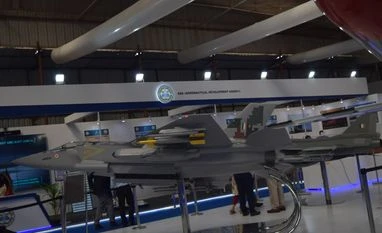 "AMCA")
Model of India's planned fifth-generation stealth fighter jet Advanced Medium Combat Aircraft (AMCA). Image credit: Shutterstock
Listen to This Article
India is set to accelerate the development and induction of ambitious fifth-generation stealth fighter jet, the Advanced Medium Combat Aircraft (AMCA). A top-level committee, led by Defence Secretary Rajesh Kumar Singh, is working to finalise a comprehensive strategy and a business model for the project, aiming to shrink timelines and enhance production efficiency, according to a report by The Times of India.
The urgency to expedite the AMCA project comes as regional security concerns grow. Earlier reports have indicated that Pakistan is in talks to acquire at least 40 J-35A fifth-generation stealth fighters from China, which has also begun showcasing prototypes of sixth-generation aircraft. Additionally, China has already deployed its Chengdu J-20 stealth fighters at air bases near India’s borders, such as Hotan and Shigatse.
Push for AMCA development
The committee overseeing the Advanced Medium Combat Aircraft (AMCA) project includes key figures such as IAF Vice-Chief Air Marshal S P Dharkar, Defence Production Secretary Sanjeev Kumar, and senior officials from the Defence Research and Development Organisation (DRDO) and the Aeronautical Development Agency (ADA). Their report is expected next month and will outline how best to transition the AMCA from concept to production in the shortest possible time frame.
One major focus is on the aircraft’s engine development. India plans to create an indigenous 110-kilonewton thrust-class engine for the 25-tonne AMCA, potentially with technological collaboration from global aerospace firms such as General Electric (US), Safran (France), and Rolls-Royce (UK).
This new committee was formed after an earlier defence review, also led by the defence secretary, presented a roadmap for strengthening the Indian Air Force’s (IAF) capabilities. That report, submitted to Defence Minister Rajnath Singh on March 3, highlighted the urgent need to address operational gaps in a time-bound manner.
Also Read

 "Operation Sindoor")
 "Air Marshal AK Bharti")
 "Su 30MKI, Sukhoi, IAF")
Delays and fighter jet shortfall
India’s fighter fleet is currently under severe strain. The IAF operates just 30 squadrons — well below the sanctioned strength of 42.5 — and at least eight more squadrons are set to retire over the next decade. At the beginning of the year, the Parliamentary Standing Committee on Defence also raised concerns over the slow pace of modernisation.
The AMCA project, which received approval from the Cabinet Committee on Security (CCS) in March 2024, is still in its early stages. While full-scale engineering development of five AMCA prototypes is underway at an estimated cost of Rs 15,000 crore, the aircraft is not expected to enter production before 2035.
Currently, the IAF relies on its fleet of 4.5-generation fighters, with the Dassault Rafale being the most advanced in service. The long-pending Light Combat Aircraft (LCA) Tejas Mk-2 project, meant to replace ageing Mirage 2000 and MiG-29 fighters, also faces delays.
To address the dwindling numbers, India is inducting 180 Tejas Mk-1A fighters, costing around Rs 1.2 trillion, along with plans for 108 Tejas Mk-2 jets. Additionally, the government is pushing forward the stalled project to manufacture 114 multi-role fighter aircraft (MRFA) in partnership with foreign firms.
AMCA programme
The AMCA is a single-seat, twin-engine, all-weather fifth-generation stealth multirole combat aircraft being developed for the Indian Air Force and Navy.
The IAF currently plans to induct seven AMCA squadrons (126 aircraft) in two phases. The first two squadrons will use General Electric’s F414 engines, producing 98 kilonewtons of thrust, while the remaining five will be equipped with the indigenous 110-kilonewton engine. The AMCA is set to feature cutting-edge technologies, including AI-powered electronic pilot systems, net-centric warfare capabilities, advanced sensor fusion, and stealth-enhancing features like an internal weapons bay and serpentine air intakes.
However, accelerating its development will be a major challenge. The defence sector is now seeking increased private sector participation to streamline production and reduce delays.
More From This Section
 "Rajnath Singh, Tulsi Gabbard")
 "Ajit Doval, Ajit, National Security Advisor")
 "Raisina dialogue")
 "Upendra Dwivedi, Upendra, Dwivedi")
 "LTTE Sri Lanka")
Don't miss the most important news and views of the day. Get them on our Telegram channel
First Published: Mar 17 2025 | 1:47 PM IST