


Narendra Modi, Vladimir Putin chart path to $100 billion trade in 5 years
Deals on labour mobility, plan for 2nd Russia-backed N-plant
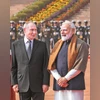 "PM Narendra Modi with Russian President Vladimir Putin at Rashtrapati Bhavan, on Friday Photo: PTI")
PM Narendra Modi with Russian President Vladimir Putin at Rashtrapati Bhavan, on Friday | Photo: PTI
Listen to This Article
Russian President Vladimir Putin wrapped up his 27-hour India visit on Friday after much bonhomie with Prime Minister Narendra Modi through several ceremonies and summit-level talks, as the world watched. The day after sharing hugs at the Palam airport tarmac, travelling in the same car and dining together at the PM’s residence over lengthy conversation, the two leaders discussed business across sectors on day two, that also packed in a high-powered session with industry honchos, a ceremonial dinner at Rashtrapati Bhavan and a visit to Rajghat.
After their summit-level talks, India and Russia unveiled a strategic economic roadmap through 2030 aimed at lifting bilateral trade to $100 billion within five years. Moscow pledged to remove non-tariff barriers and regulatory hurdles to boost Indian exports.
The two sides also signed agreements on labour mobility, opening further the door for Russian construction, engineering and IT sectors to hire semi-skilled and skilled Indian workers, along with pacts on fertiliser supply, training Indian seafarers in polar waters and cooperation in shipbuilding. Notably, they also discussed finalising a second site in India for a Russia-backed nuclear power plant (NPP).
Both leaders pushed for early conclusion of the India–Eurasian Economic Union free-trade agreement and a bilateral investment treaty. They also highlighted connectivity projects including the International North-South Transport Corridor, the Northern Sea Route and the Chennai-Vladivostok link.
Modi compared the India-Russia friendship to a “Dhruv Tara,” or guiding star, saying ties have remained steady for eight decades despite global upheavals. He credited Putin for steering the relationship with leadership and vision over the past 25 years. On Ukraine, Modi reiterated India’s consistent call for peace and support for all efforts toward a lasting resolution, saying India “has always been, and will always be ready to contribute.”
Also Read

 "Ship, maritime")
 "Alexey Likhachev, director-general, Rosatom")
 "agrochemical")
 "Russian President Putin, PM Modi")
 "India Russia Trade")
The joint statement omitted any reference to the conflict. Indian officials later said Putin briefed Modi on recent developments.
Putin, in turn, underscored “close working dialogue” with the Indian Prime Minister, pointing to frequent phone conversations and monitoring of bilateral ties “meticulously”. He said trade rose 12 per cent last year to around $64 billion and has held firm this year, with 96 per cent of exchanges conducted in “our national currencies”.
Putin announced plans for an Indian pharmaceutical company to build an anti-tumour drug plant in Russia’s Kaluga region, later confirmed by Interfax, which reported an agreement between India’s BDR Pharmaceuticals, Russia’s JSC Pharmasyntez and the regional government.
The Russian leader reaffirmed support for completing the remaining reactors at the Kudankulam Nuclear Power Plant and called for expanding cooperation into non-energy nuclear applications, including medicine and agriculture. He reiterated Russia’s willingness to help India develop small modular reactor technology.
The joint statement underscored the “importance of further discussion” on India’s second Russia-assisted nuclear plant site, saying New Delhi would work toward formal allotment in line with earlier agreements. Both sides committed to accelerating technical and commercial talks on Russian-designed VVER reactors, joint research and development of NPPs, and localisation of nuclear equipment and fuel assemblies for large-capacity plants.
On energy trade, Putin said Russia remains a “reliable supplier” of oil, gas and coal and stands ready to ensure uninterrupted shipments to fuel India’s fast-growing economy.
The summit unfolded against the backdrop of Washington’s punitive tariff on India and sanctions regime, reflected in the joint communiqué. While describing defence cooperation as a “pillar” of India-Russia ties, the document, after the 23rd Annual Summit between the leaders of the two countries, focused heavily on expanding trade, boosting Indian exports, deepening industrial collaboration and forging new technology and investment partnerships, particularly in advanced high-tech sectors.
To reach the $100 billion trade target, both sides emphasised the need to clear tariff and non-tariff barriers, ease logistics bottlenecks, improve connectivity, ensure smoother payment mechanisms and resolve insurance-related issues. Modi and Putin also addressed a business conference attended by leading executives.
The two countries agreed to continue developing bilateral settlement systems using national currencies, and to keep working toward interoperability between national payment systems, financial messaging platforms and central bank digital currency systems.
Modi highlighted the importance of cooperation in “critical minerals” to secure diversified global supply chains. He also announced a free 30-day e-Tourist Visa and a 30-day group visa for Russian travellers.
No defence pacts were unveiled, consistent with previous summits, but the joint statement noted Russia’s support for India’s push for defence self-reliance. It said the partnership is shifting toward joint R&D, co-development and co-production of advanced military technologies. Ahead of the summit, Russia had offered joint production of Su-57 fighter jets.
Both sides agreed to promote joint manufacturing in India of spare parts and components for Russian-origin defence systems under the Make-in-India programme, including through technology transfer and joint ventures serving Indian armed forces and exports to friendly third countries.
Putin arrived in New Delhi on Thursday evening, where Modi broke protocol to receive him at the airport. The two leaders then travelled together to the Prime Minister’s residence for a private dinner.
Putin is learnt to have extended an invitation to Modi, who reiterated that he’s on the side of peace, for the 2026 summit in Russia.
A political controversy erupted during the day after Opposition the Congress said Leaders of Opposition Mallikarjun Kharge and Rahul Gandhi have not been invited to the banquet for Putin at Rashtrapati Bhavan, and took a swipe at its own MP Shashi Tharoor for accepting the invite.
Tharoor in his reaction said: “I dont know the basis (of invitation); this is all done by the government, by the protocol by the Rashtrapati Bhawan… All I can say I am honoured to have been invited.”
More From This Section
 "Modi, Narendra Modi, Vladimir Putin, putin")
 "India US trade, US import tariffs 2025, reciprocal tariffs India, Indian exporters US, apparel export India, 90-day tariff pause, US India trade relations, export challenges tailor-made goods, US tariff impact India, Indo-US apparel trade")
 "Russian President Vladimir Putin walks past guards of honour during a ceremonial reception prior to his meetings with Indian officials in New Delhi, India, December 5, 2025 | REUTERS")
 "Modi-Putin")
Topics : Narendra Modi Vladimir Putin India-Russia ties
Don't miss the most important news and views of the day. Get them on our Telegram channel
First Published: Dec 06 2025 | 12:03 AM IST