


SCO can become a guide to inclusive world order: PM Narendra Modi
India refuses to endorse declaration supporting China's ambitious BRI
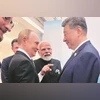 "(From left) Russian President Vladimir Putin, Prime Minister Narendra Modi, and Chinese President Xi Jinping, in China's Tianjin on Monday")
(From left) Russian President Vladimir Putin, Prime Minister Narendra Modi, and Chinese President Xi Jinping, in China’s Tianjin on Monday
Listen to This Article
The member states of the Shanghai Cooperation Organisation (SCO) agreed to a Chinese proposal to set up a new development bank, and in their joint declaration, issued after the summit concluded on Monday, opposed unilateral coercive measures and vowed to facilitate trade within the group.
In his two speeches at the summit, Chinese President Xi Jinping called for the bloc to oppose “bullying practices”, which was a veiled swipe at the US, and said the grouping has grown into the world’s largest regional organisation. He said the SCO’s “international influence and appeal are increasing day by day”.
Prime Minister Narendra Modi, in his address, said the SCO “can play a guiding role in promoting multilateralism and an inclusive world order”. New Delhi has over the years been less than enthused about the SCO, of which Pakistan is a member country. India, however, refused to endorse a declaration that supported China’s ambitious Belt and Road Initiative (BRI), which eight other member states did.
The PM’s statement on SCO’s role in helping multilateralism also comes in the context of the plummeting India-US ties over tariffs and New Delhi’s recent efforts at recalibrating its relations with Beijing, and reinforcing its friendship with Russia. The bonhomie between Modi, Xi and Russian President Vladimir Putin, which the western media interpreted as a message to US President Donald Trump, was on display at the venue of the SCO summit, Tianjin, with the three getting into a huddle before the start of the session in the morning. Later, Putin and Modi travelled in the former’s armoured limousine and conversed for almost 45-minutes in the vehicle while their respective delegations waited to start formal bilateral talks.
In a nod to India’s concerns on terrorism, the group strongly condemned the Pahalgam terror attack that took place on April 22 and concurred with New Delhi’s position that “double standards” in the fight against terrorism are unacceptable.
Also Read

 "Russia flag")
 "S Jaishankar, Jaishankar, Xi Jinping")
 "S Jaishankar, Jaishankar")
 "Ajit Doval")
 "Unified Payments Interface, UPI")
In his address, the PM thanked member countries for their strong solidarity in the wake of the Pahalgam terror attack. He emphasised that there should be no double standards in dealing with terrorism and urged the group to hold countries that perpetrate and support cross-border terrorism accountable.
Modi said the Pahalgam attack was not only an assault on the conscience of India, but also an open challenge to every nation, and every individual who believes in humanity. Modi said, “In such circumstances, it is natural to ask: Can the open support for terrorism by certain countries ever be acceptable to us?”
On June 26, the SCO defence ministers’ meeting in Tianjin couldn’t reach a consensus over a draft joint declaration after Defence Minister Rajnath Singh said it had omitted the Pahalgam terror attack and had not explicitly addressed India’s concerns over Pakistan-backed cross-border terrorism.
Modi said India seeks greater action within the SCO under three pillars — security, connectivity, and opportunity. He said India strongly supported projects such as Chabahar port and International North-South Transport Corridor. In a reference to China’s BRI, which passes through Pakistan-occupied-Kashmir (PoK), Modi said effort towards connectivity must uphold the principles of sovereignty and territorial integrity of countries.
This was the group’s biggest gathering since it was founded in 2001 and signified Beijing’s growing influence in world affairs, and the emergence of the SCO as a forum for discussion on regional and international issues beyond its initial remit of jointly combating terrorism, separatism, and extremism.
More From This Section
 "Modi, Narendra Modi, Vladimir Putin, putin")
 "S Jaishankar, Jaishankar")
 "Russian President Vladimir Putin and Prime Minister Narendra Modi at SCO Summit")
 "SCO Summit, SCO, Modi, Narendra Modi")
 "Modi, Narendra Modi, Xi Jinping")
Don't miss the most important news and views of the day. Get them on our Telegram channel
First Published: Sep 01 2025 | 9:56 PM IST