


Tejas Mk1As unlikely to come with full capabilities by March: Sources
Defence sources say HAL has sought relaxation of certain IAF requirements to meet the previously agreed March 2026 deadline for the start of deliveries
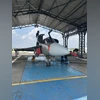 "A LCA Tejas Mark-1A combat aircraft at HAL's facility in Nashik, Maharashtra. Photo credit: Bhaswar Kumar")
A LCA Tejas Mark-1A combat aircraft at HAL’s facility in Nashik, Maharashtra. Photo credit: Bhaswar Kumar
Listen to This Article
Hindustan Aeronautics Limited (HAL) is unlikely to deliver the first of the 180 Light Combat Aircraft (LCA) Tejas Mark-1A (Mk1A) jets on order in March with all the agreed capabilities in place for the Indian Air Force (IAF), with deliveries instead likely to slip to between May and July if the aircraft are to meet the full set of operational and safety requirements, defence sources told Business Standard on condition of anonymity.
Previously, HAL officials had said deliveries of the Mk1A to the IAF would begin by the end of the 2025–26 financial year (FY26), a little over two years behind the original schedule.
“There are Air Staff Quality Requirements (ASQR) laid out for the Mk1A jets that HAL had agreed to meet. However, the company is seeking some relaxation in these capabilities in order to deliver the first five jets by March,” said one of the sources. “Otherwise, the start of deliveries could slip to May with fewer concessions, or even to June or July if all the ASQR capabilities are to be met,” they added.
ASQRs are specific, documented standards, qualifications, and performance metrics that equipment must meet to fulfil operational requirements.
Stating that the IAF will review the Mk1A project in the near future to assess whether its requirements have been met to warrant acceptance of deliveries, one of the sources said: “There is a list of issues highlighted by the IAF, including those related to operational matters and safety, that need to be addressed before the service can accept delivery of the jets.”
Also Read

 "defence budget, national security")
 "AMCA")
 "Why did HAL share price fall today?")
 "Defence-related stocks crack in intra-day trade on Budget despite higher allocation. BEML, GRSE among top losers on Sunday.")
 "Rafale, Aircraft")
The sources explained that one key operational issue was the proper functioning of the radar in conjunction with other systems, such as the electronic warfare suite.
They also pointed out that even within the two squadrons of the initial Mk1 Tejas variant operationalised by the IAF, two trainer aircraft have yet to meet the service’s requirements and therefore remain undelivered. “The Mk1 variant exists so that the IAF’s requirements could be met by HAL over a reasonable period of time. Yet, even 10 years on, not all the issues highlighted by the IAF have been resolved, which has delayed acceptance of delivery of the two trainers,” one of them said.
Initial Operational Clearance (IOC) for the Mk1 aircraft was granted in 2013, with IOC-standard jets inducted into the IAF in July 2016. The aircraft achieved Final Operational Clearance in February 2019, following the addition of key capabilities to the IOC configuration.
Earlier in the day, a statement by HAL said that five LCA Mk1A aircraft were “fully ready for delivery, incorporating major contracted capabilities in accordance with the agreed specifications”.
The company added that an additional nine aircraft have already been built and flown, and will be made ready for delivery once their F404-IN20 engines are received from American manufacturer GE Aerospace.
HAL has received five engines from GE to date. “The supply position from GE is positive, and the future delivery outlook aligns with HAL’s delivery plans,” it said.
All design and development issues identified are being addressed in an “expedited manner”, and the company is in “active discussions with the IAF to deliver the aircraft at the earliest”, HAL said.
HAL missed the original February 2024 deadline to begin Mk1A deliveries, primarily due to delays in the arrival of engines from GE. Subsequently, delays in weapons and systems integration have also affected the project.
Deliveries of the first tranche of 83 Mk1A jets — contracted for Rs 36,400 crore in February 2021 — were originally scheduled to be completed by February 2028.
In September, HAL received a follow-on order for a second tranche comprising 97 Mk1A aircraft at a cost exceeding Rs 62,370 crore. Deliveries under this contract are expected to commence in 2027–28 and conclude over six years.
The retirement of the last two MiG-21 Bison squadrons in September 2025 has reduced the IAF’s combat strength to 29 active fighter squadrons — the lowest level in 60 years — against a sanctioned strength of 42. This has left the force searching for options to shore up its numbers, particularly as it has yet to receive a single Tejas Mk1A aircraft.
The improved Mk1A variant is an indigenously designed, developed, and manufactured 4.5-generation fighter aircraft equipped with an active electronically scanned array radar, beyond-visual-range missiles, an electronic warfare suite, and air-to-air refuelling capability.
More From This Section
 "S Jaishankar, Jaishankar")
 "ship, boat, vessel")
 "A LCA Tejas Mark-1A combat aircraft at HAL's facility in Nashik, Maharashtra. Photo credit: Bhaswar Kumar")
 "Ministry of External Affairs (MEA) spokesperson Randhir Jaiswal")
 "Yogi Adityanath, yogi, UP CM")
Don't miss the most important news and views of the day. Get them on our Telegram channel
First Published: Feb 05 2026 | 10:08 PM IST