


HAL won't build AMCA; competition between Tata, L&T and Kalyani now: Source
Final decision on developer and builder of India's first stealth fighter prototypes due in about a month at the soonest
 "AMCA")
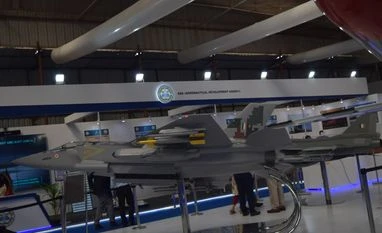
The ₹15,000 crore AMCA prototype programme will be the most consequential defence project that private players will work on | Image credit: Shutterstock
Listen to This Article
State-run Hindustan Aeronautics Limited’s (HAL’s) monopoly is set to be broken, as it will not be building the prototypes of India’s first indigenous stealth combat aircraft — the Advanced Medium Combat Aircraft (AMCA) — with three other contenders — the Tata Group and two consortia, led by the Kalyani Group and Larsen & Toubro (L&T), respectively — selected as the qualified entities that will now compete for the programme, a defence source aware of the development told Business Standard.
“HAL did not qualify to be the development-cum-production partner (DcPP), specifically under one of the criteria listed in the expression of interest (EoI) issued to shortlist entities capable of building the AMCA prototypes,” said the source, without elaborating on the criterion.
“Three contenders — Tata, L&T and Kalyani — that responded to the EoI have met the technical criteria. Now it is a matter of which one emerges as the lowest bidder, or L1,” added the source. The final decision on who will be the DcPP should be ready in about a month’s time at the soonest, if all goes to plan. The DcPP will also be the natural choice for executing the series production of the stealth jet. An emailed query sent to HAL elicited no response. HAL’s ₹2.52 trillion order book has proved to be a challenge, with one of the criteria in the AMCA EoI stipulating that companies would receive zero marks out of 100 if their order book was three times their turnover. HAL’s order book is over eight times its FY25 turnover of ₹30,105 crore.
HAL is India’s largest defence firm by revenue, order book and market capitalisation. Apart from decades of licence manufacturing foreign-designed platforms like the MiG-21 and Su-30MKI, it is also producing the light combat aircraft Tejas and handling regular repair and overhaul orders. It has also designed and manufactured multiple military helicopter variants.
The ₹15,000 crore AMCA prototype programme will be the most consequential defence project that private players will work on to date in terms of the complexity of the platform. It is also viewed as an opportunity to set up a second combat aircraft production line in the country, thereby ending HAL’s monopoly.
Also Read

 "Why did HAL share price fall today?")
 "Defence-related stocks crack in intra-day trade on Budget despite higher allocation. BEML, GRSE among top losers on Sunday.")
 "pinaka rocket launcher")
 "Stocks to buy ahead of Budget 2026: BEL among top analysts bets in agri, defence sectors.")
Once the prototypes complete testing and certification, the series production could represent the largest defence deal that any private-sector player will have clinched. While an estimate of the deal value cannot be ascertained at the moment, as an indication of how large it could be, note that the order for the 180 indigenous Tejas Mark-1A fighter jets with HAL is valued at over ₹98,000 crore. The contract for AMCA series production will be valued higher, given that it is a generation more advanced than the Tejas — being a fifth-generation jet designed to evade radar compared with the more conventional 4+ generation Tejas.
The first flight of the prototype is expected by the end of 2028 or 2029, a defence source had earlier told Business Standard. Series production is projected to begin around 2035, with the Indian Air Force (IAF) likely to induct seven squadrons, totalling 126 jets.
In May 2025, the Ministry of Defence (MoD) approved an execution model granting both private and public Indian defence firms equal opportunity to compete for the AMCA programme — whether independently, through joint ventures (JVs), or as consortia. The AMCA’s design agency, the Aeronautical Development Agency (ADA) — a department of the Defence Research and Development Organisation (DRDO) — issued the EoI in June 2025 to shortlist entities capable of developing a structural test specimen, five prototypes, and supporting their testing and certification.
Tata Advanced Systems Ltd (TASL), the Tata Group’s aerospace and defence arm, has responded to the AMCA EoI independently. Bharat Forge Ltd, part of the Kalyani Group, is leading a consortium with defence public sector undertaking (DPSU) BEML Ltd and private-sector defence electronics firm Data Patterns (India) Ltd. L&T is heading another consortium with DPSU Bharat Electronics Ltd (BEL). In November 2025, the L&T-BEL consortium also brought in global aerospace parts supplier Dynamatic Technologies Ltd as a partner.
HAL had entered as the lead of a consortium with two smaller private firms, including Vem Technologies Pvt Ltd.
Three other consortia had also been in the running: Adani Defence & Aerospace in the lead with private precision engineering company MTAR Technologies; a tie-up between engineering solutions provider Goodluck India Ltd, defence firm Axiscades Technologies Ltd, and government-controlled BrahMos Aerospace Thiruvananthapuram Ltd; and another tie-up comprising ICOMM Tele Ltd — a group company of Megha Engineering & Infrastructures Ltd — and precision metal components manufacturer PTC Industries Ltd.
More From This Section
 "s jaishankar, marco rubio")
 "S Jaishankar, Jaishankar")
 "Prime Minister Narendra Modi meeting the US President Donald Trump, at the delegation level talks at White House, in Washington DC.")
 "Gyanendra Pratap Singh, Director General CRPF")
 "Security, Pulwama Security, Army, soldier")
Don't miss the most important news and views of the day. Get them on our Telegram channel
First Published: Feb 04 2026 | 9:32 AM IST