


Theatre commands 'ultimate goal': Navy Chief on military integration
Warning that technology is accelerating the trend of grey zone activities, the Navy Chief said innocuous fishing vessels could also carry out major offensive actions in the near future
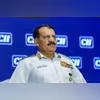 "Dinesh K Tripathi, Dinesh, Chief of the Naval Staff")
Admiral Tripathi said that the Navy is propelling ahead with the goal of having unified planning, a common (battlespace) picture, and integrated operations (Photo: PTI)
Listen to This Article
Chief of the Naval Staff (CNS) Admiral Dinesh K Tripathi on Wednesday batted for the theatre commands reform as the long-term goal, while emphasising that the Indian Navy was undertaking significant efforts towards enhancing jointness and integration between the three armed forces.
Speaking on the second and final day of the inaugural tri-service seminar on war, warfare, and warfighting — RAN Samwad-2025 — at the Army War College in Madhya Pradesh, the Navy Chief said: “We are committed to synergising our command, control, communications, and combat capability with the Indian Army and Indian Air Force (IAF). Full Stop. Period.” Highlighting that integration begins at the human level, Admiral Tripathi said the Navy has focused its attention on maximising interaction and cross-pollination across all levels among the three branches. “Today, I have an Army Aide-de-Camp (ADC) with me. And, my friend, the Air Chief, has a Naval Flag Lieutenant with him.”
Describing theatrisation as the “ultimate goal”, Admiral Tripathi said that the Navy is propelling ahead with the goal of having unified planning, a common (battlespace) picture, and integrated operations. “While gaining skills, competence, and teamwork forges cohesion, it is the leadership that transforms this into decisive outcomes. Accordingly, we are investing in leadership building and the ability to lead more qualified men and women who are managing more intelligent machines — operating under increased tempo of operations, compressed timelines, and in an information-dense environment.”
The Navy Chief’s remarks came a day after Chief of the Air Staff (CAS) Air Chief Marshal A P Singh, in a fireside chat, cautioned against hurriedly implementing the proposed theatrisation initiative and introducing new organisational structures that could lead to disruption.
Also Read

 "steel, steel industry")
 "Rajnath Singh, Defence Minister")
 "Indian naval ship Tabar during India France naval exercise, Indian navy")
 "Anil Chauhan, Anil, CDS")
The Navy Chief also underscored that in all these endeavours, the focus area is on building teams that are resilient, with adaptability and fortitude woven into the fabric of the service. “Technology is rendering the maritime battlespace increasingly complex, dynamic, and unpredictable. The future readiness of the Indian Navy will not be defined by technology alone, but by our ability to harness technology and human potential concurrently. The Navy is committed to instilling technology into our DNA so as to be a combat-ready, credible, cohesive, and future-ready force.”
The Navy Chief also explained that recent conflicts across the globe have highlighted a critical change in the nature of warfare — the blurring of lines between peace and conflict. “This ambiguity exists on land and in the air, but we believe that it is most profound in the maritime domain. The seas have always been called global commons, but today they are becoming the front line of grey zone activities, and technology is accelerating this trend.”
Admiral Tripathi added that technology has equipped grey zone actors with tools to apply pressure and disturb order at sea without triggering hostilities. “Fishing fleets fitted with satellite communication and long-range sensors now act as extensions of national strategy, remaining at sea for months while relaying positional and surveillance intelligence in real time. Similarly, research and survey vessels, ostensibly engaged in scientific pursuits, increasingly carry sophisticated sonar and electronic systems capable of mapping the seabed and gathering hydrographic intelligence, which are of obvious military value.”
The Navy Chief also cautioned that technology has advanced to the point where small autonomous boats can now launch advanced missiles. “It is conceivable that seemingly innocuous fishing vessels could carry out major offensive actions in the near future. Such platforms embody the ambiguity of intent — civilian in appearance, military in function.”
Theatre commands were conceptualised to overhaul India’s existing defence deployment structure by integrating the Army, Air Force, and Navy into one architecture. Each of the proposed theatre commands would look after the security challenges in a specified geographical territory under an operational commander. While the final contours of the theatrisation process are not known, it could involve the establishment of two integrated theatre commands to counter Pakistan and China, along with a third maritime theatre command.
More From This Section
 "Tawi, Tawi River, River")
 "MEA spokesperson Randhir Jaiswal")
 "Sitiveni Rabuka, Fiji PM")
 "China Taiwan")
 "Donald Trump, Trump")
Don't miss the most important news and views of the day. Get them on our Telegram channel
First Published: Aug 27 2025 | 3:04 PM IST