


Namibia to ease visas for 33 nations from April 1-why is India excluded?
Namibia said the visa regime is based on the principle of reciprocity
 "Namibia")
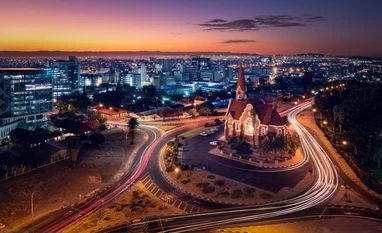
Aerial view of Windhoek, Namibia, featuring the Christ Church (Christuskirche), a German Lutheran church combining Neo-Gothic and Art Nouveau styles, built in 1907. Photo: Shutterstock
Listen to This Article
Come April 1, Namibia will introduce visas on arrival for international investors and tourists from 33 countries as part of efforts to attract foreign capital. The move is intended to reduce bureaucratic hurdles and encourage business and leisure travel. India, however, has been excluded from this visa relaxation.
“This will not only save valuable time but also reduce congestion at our borders, ensuring a smoother and more comfortable arrival process. Travellers will no longer have to wait in long queues to complete their visa applications at ports of entry, and they can simply apply online prior to departure,” said Dr Albert Kawana, the Minister of Home Affairs, Immigration, Safety and Security, on Monday.
Why Indians excluded from visa relaxation?
Kawana said the visa regime is based on the principle of reciprocity.
“Namibia remains open to engaging with nations that are willing to establish reciprocal visa agreements, promoting stronger diplomatic and economic ties,” he said.
Also Read

 "Breaking news template")
 "US President Donald Trump")
 "Paytm")
 "Rohit Sharma, Shama Mohamed")
 "PMI")
For countries that do not qualify for visas on arrival, the application process remains unchanged. These travellers must apply in advance via the Ministry’s online platform and await approval before entering Namibia.
The visa fee for Indians wishing to visit Namibia is set at N$1,600 (about Rs 7,500).
Namibia recorded a sharp increase in international tourist arrivals in 2023, reaching 863,872, up from 461,027 in 2022. The top ten tourist markets included South Africa, Angola, Germany, Zambia, Botswana, Zimbabwe, United States, United Kingdom, France, and Netherlands. India was not among them.
“Namibia’s breathtaking scenery and unique experiences remain under the radar for Indian travellers, and the reasons are varied. For starters, travel decisions in India are heavily influenced by word of mouth—recommendations from friends and family play a huge role. However, Namibia rarely features in these conversations, leading to a lack of awareness about what the destination has to offer. Compounding this is the fact that Namibia is both inaccessible and expensive: no direct flights and long travel times make it a logistical challenge, while the overall costs—from flights to on-ground expenses—are comparable to Europe. Faced with these barriers, it’s understandable that many Indian travellers opt for more familiar and budget-friendly destinations instead,” said Mohak Nahta, founder and CEO of Atlys, speaking to Business Standard.
“Direct flights between India and Namibia are rarely available at present. Most routes require at least one stopover and can take around 40 to 50 hours, which is significantly longer than travelling to other popular international destinations,” he said.
“While the visa process may not be overly complicated if planned properly, travellers must still submit a series of documents and wait for approval,” he added.
Nahta said raising awareness of Namibia’s attractions and streamlining the visa application process could help draw more Indian visitors.
Meanwhile, South Africa, which is geographically very close to Namibia, eased visa rules for visitors from India and China in 2024 to attract tourists from the world’s two most populated nations, who had been deterred by red tape. In 2019, more than 95,000 travellers from India visited South Africa. By 2023, this number had recovered to over 79,700, marking a 43% increase compared to 2022.
Between January and September 2024, South Africa received over 57,900 visitors from India.
According to Tripadvisor, an online travel booking portal, Namibia is known for several things, ranging from its unique landscapes to its rich cultural history. Here are some of the key aspects it's famous for:
Natural attractions
Namib Desert – One of the world's oldest deserts, home to the towering red dunes of Sossusvlei.
Etosha National Park – A major wildlife reserve with elephants, lions, rhinos, and vast salt pans.
Skeleton Coast – A remote and misty coastline dotted with shipwrecks and seal colonies.
Fish River Canyon – Africa’s largest canyon, often compared to the Grand Canyon.
Wildlife and conservation
Largest population of free-roaming cheetahs in the world.
Home to desert-adapted elephants and black rhinos, surviving in harsh conditions.
Community-driven conservation, with large private game reserves and eco-tourism projects.
Culture and history
San rock art at Twyfelfontein, dating back thousands of years.
Diverse ethnic groups, including the Himba people, known for their traditional way of life.
Colonial heritage, with German influence seen in Windhoek’s architecture and cuisine.
Adventure and tourism
Dune 45 – A famous climbable sand dune in the Namib Desert.
Swakopmund – A coastal town popular for adventure sports like sandboarding and skydiving.
Self-drive safaris, making it a top destination for road trips.
Economy and natural resources
Rich in diamonds and uranium, making mining a key industry.
Growing tourism sector, with luxury lodges and safari experiences.
Fishing industry, with Walvis Bay as a major port.
More From This Section
 "caste wealth analysis, upper caste, sc, st")
 "Income Tax")
 "Donald Trump, Trump")
 "H-1B Visa")
 "home insurance")
Topics : BS Web Reports Namibia
Don't miss the most important news and views of the day. Get them on our Telegram channel
First Published: Mar 05 2025 | 12:28 PM IST