


No, China isn't getting 600,000 US student visas; Trump move is a clampdown
Trump's draft proposals on student visa point to espionage and fraud risks linked to Chinese nationals, but the rules would also hit Indian students, who now form the largest group in US universities
 "US visa, US students")
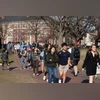
A diverse group of college students walk across the campus of UNC Chapel Hill. Photo: Shutterstock
Listen to This Article
From calling it insulting to tell foreign students not to come, to tightening visa norms again – US President Donald Trump has swung back to proposing restrictions on international students, including those from India and China. The draft regulation, seen by Business Standard on Wednesday, forms part of the Administration’s broader crackdown on immigration in Trump’s second term, where Chinese nationals have been a frequent target.
This move comes just days after Trump said he would consider doubling the number of Chinese students allowed into the US, a remark that triggered anger from his “Make America Great Again” supporters.
“It’s very insulting to say students can’t come here,” Trump said during a Cabinet meeting on Tuesday. “I like that their students come here. I like that other countries’ students come here.”
He added: “And you know what would happen if they didn’t? Our college system would go to hell very quickly. And it wouldn’t be the top colleges, so it’d be colleges that struggle on the bottom. And you take out 300,000 or 600,000 students out of the system.”
The White House on Thursday clarified that US President Donald Trump is not increasing the number of student visas for Chinese nationals, countering recent speculation over a supposed expansion in student entries. “President Trump isn’t proposing an increase in student visas for Chinese students. The 600,000 number refers to two years’ worth of visas. It’s simply a continuation of existing policy,” reported Fox News, citing a White House spokesperson.
Also Read

 "New York, USA")
 "US visa social media directive, US visa rules Indian students, Indian students US visa screening, F1 visa decline India, Indian non-immigrant visa trends, US visa approvals India FY25, Indian students US study 2025, F1 J1 M1 visa types India, US visa")
 "US visa")
Fixed visa durations proposed
Meanwhile, the proposed rule would replace the current “duration of status” system for F, J and I visas with fixed periods of stay.
• F visas for students and J visas for cultural exchange participants would be capped at four years.
• I visas for foreign journalists would be limited to 240 days.
• Extensions would require a fresh application beyond these limits.
At present, “duration of status” allows students to stay for the length of their course, periods of authorised training, and breaks outside the US. Journalists are permitted for the full term of their employment duties.
Chinese nationals singled out
The proposal devotes particular attention to Chinese nationals, citing espionage and visa fraud. US Citizenship and Immigration Services referenced past cases:
• In 2020, Yanqing Ye, a J-1 visa holder at Boston University, was charged with visa fraud and acting as an agent of a foreign government. Prosecutors said she hid her service at a Chinese military academy and passed assignments back to the People’s Liberation Army.
• That same year, a Chinese researcher at the University of California, San Francisco, alleged to be a PLA officer, was detained at Los Angeles International Airport while trying to return to China. Investigators said he concealed military ties on his visa application.
• In 2025, a J-1 research scholar at the University of Michigan was arrested for smuggling, false statements and visa fraud. The FBI alleged she carried a dangerous fungus, received Chinese government funding, and maintained allegiance to the Communist Party.
The FBI has previously told Congress that China uses “nontraditional collectors” such as students, professors and researchers to gather knowledge across American universities and labs.
Convictions referenced in the proposals were:
• Zhongsan Liu, a Chinese government official, was convicted of conspiracy for fraudulently obtaining US research scholar visas to recruit American scientists.
• Ji Chaoqun, a Chinese student in Illinois, was sentenced in 2023 to eight years in prison for spying for Beijing.
• Weiyun (Kelly) Huang, a Chinese businesswoman, was sentenced in 2020 to 37 months in prison for operating sham employment firms that provided fake work authorisations to foreign students.
Impact on Indian students
While the national security rationale largely centred on China, the new rules would extend to all countries. That leaves Indian students among those most exposed.
In 2024, over 420,000 Indian students were enrolled in the US, accounting for 27 per cent of all international students, according to the “SEVIS by the Numbers 2024” report from US Immigration and Customs Enforcement. The Institute of International Education’s Open Doors 2024 report confirmed India overtook China as the top source of foreign students in 2023–24.
More From This Section
 "green card, h1b visa")
 "London, UK")
 "American neighbour")
 "Argentina")
Don't miss the most important news and views of the day. Get them on our Telegram channel
First Published: Aug 29 2025 | 5:46 PM IST