


Shubhanshu Shukla back on Earth, India's deep space dreams get wings
After 18 days in space, Shubhanshu Shukla becomes first Indian to visit ISS, boosting India's Gaganyaan mission and space goals including a Moon landing by 2040
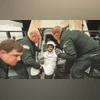 "Astronaut Shubhanshu Shukla emerges from Dragon Capsule after splashdown in the Pacific Ocean off San Diego on Tuesday. He spent 18 days on the ISS | Photo: PTI")
Astronaut Shubhanshu Shukla emerges from Dragon Capsule after splashdown in the Pacific Ocean off San Diego on Tuesday. He spent 18 days on the ISS | Photo: PTI
Listen to This Article
For nearly three weeks, Group Captain Shubhanshu Shukla orbited Earth aboard the International Space Station, becoming the first Indian ever to step inside the floating science lab 400 kilometres above the surface. On Tuesday, he returned home — or at least, to the Pacific Ocean off the coast of San Diego — after a journey that spanned 18 days, more than 310 orbits, and roughly 13 million kilometres in space.
The re-entry was textbook. SpaceX’s Dragon capsule, which carried Shukla and his three Axiom Mission 4 (Ax-4) crewmates, splashed down at 3.02 pm India time. After undocking from the ISS at 4.50 pm the day before, the return trip lasted just over 22 hours. Recovery boats were dispatched quickly. By 4 pm, the crew had emerged from the capsule, blinking into Earth’s gravity once again. Medical teams moved in next, checking vitals and calibrating the toll — and triumph— of spaceflight.
For India, the mission was historic. Shukla is only the second Indian to ever travel to space, following Rakesh Sharma’s pioneering journey in April 1984 aboard a Soviet spacecraft. But more than four decades later, India’s aspirations are strikingly different: Bigger, bolder, and far more collaborative. The Ax-4 was a joint operation involving Indian Space Research Organisation (Isro), National Aeronautics and Space Administration (Nasa), US startup Axiom Space, and the commercial flight infrastructure of Elon Musk’s SpaceX. It also comes as a precursor to Gaganyaan, India’s own crewed spaceflight project, slated for launch in 2027. And beyond that, the ambitions grow higher still: A space station of its own by 2035; a Moon mission, with an Indian astronaut aboard an Indian spacecraft, by 2040.
Also Read

 "Shubhanshu Shukla")
 "ISRO")
 "Ax-4 Pilot Shubhanshu Shukla (left) and Mission Specialist Tibor Kapu enjoying views of Earth from the cupola | Photo:AX-4 MISSION")
 "Axiom 4 mission, Ax-4 mission, Ax4 mission, Axiom, Axiom Space, Axiom 4, Ax4, Ax-4, Shubhanshu Shukla")
“From space, today’s India looks ambitious. It looks fearless. It looks confident. It looks proud,” Shukla had said in a message from orbit, a day before leaving for Earth. “And so, aaj ka Bharat abhi bhi sare jahan se acha dikhta hai (today’s India still looks better than the rest of the world).”
The pride was echoed back on Earth. “I join the nation in welcoming Group Captain Shubhanshu Shukla as he returns to Earth from his historic mission to Space. As India’s first astronaut to have visited the International Space Station, he has inspired a billion dreams through his dedication, courage and pioneering spirit,” Prime Minister Narendra Modi posted on X. “It marks another milestone towards our own Human Space Flight Mission— Gaganyaan,” he added.
India reportedly spent about ₹500 crore on the Ax-4 participation, and the return on investment was more than symbolic.
During the mission, the four astronauts conducted some 60 experiments, seven of which were developed by Indian institutions.
For Axiom Space -- which is building its own commercial space station -- this was its fourth crewed mission. For India, it was a test flight in more ways than one.
Shukla, who was commissioned into the Indian Air Force in 2006, has logged more than 2,000 hours in the cockpit, flying aircraft such as the Su-30 MKI, MiG-29, Jaguar, and Dornier-228. He is also an alumnus of the Indian Institute of Science, Bengaluru — a background that perfectly straddles India’s military, academic, and technological spheres. In other words, the right kind of astronaut for a moment like this.
The country’s space-tech sector is watching closely. “Such collaborative approaches will enable India to significantly expand its share of the global space economy beyond the current 2 per cent,” said Pawan Kumar Chandana, co-founder of Skyroot Aerospace. “It provides our private space-tech companies with the confidence to pursue more ambitious ventures.”
The excitement isn’t just about one astronaut’s journey, but what it symbolises: A nation building not just satellites, but poised for full-scale crewed missions and deep space explorations.
“This achievement is a stepping stone,” summed up A K Bhatt, Director General of the Indian Space Association. “It will not only support Isro but also give impetus to both global and Indian private space industries. This success marks a significant stride towards realising India’s vision for outer space exploration.”
More From This Section
 "Delhi High Court")
 "yamaha, yamaha bike launch, hybrid, yamaha fz")
 "Bomb Threat, Delhi Police")
 "Shubhanshu Shukla (front row; second from right) with crew members of the Axiom Mission 4, and other astronauts on ISS. Shukla started his return journey on Monday, after 18 days aboard ISS | Photo: PTI")
 "Shubhanshu Shukla")
Topics : ISRO Gaganyaan mission NASA
Don't miss the most important news and views of the day. Get them on our Telegram channel
First Published: Jul 15 2025 | 6:43 PM IST