


China defies global 'AI scare trade' as investors chase winners
In China, the mood is far more upbeat. Instead of worrying about disruption, investors are chasing perceived winners, drawn by AI's growth prospects
 "China, Knowledge Atlas Technology JSC Ltd")
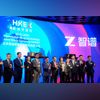
The Knowledge Atlas Technology JSC Ltd, better known as Zhipu, listing ceremony at the Hong Kong Stock Exchange | Image: Bloomberg
Listen to This Article
By Abhishek Vishnoi
US markets are gripped by the “AI scare trade,” with investors selling software firms and wealth managers on concern that rapid advances in artificial intelligence will erode established business models.
In China, the mood is far more upbeat. Instead of worrying about disruption, investors are chasing perceived winners, drawn by AI’s growth prospects and its potential to drive cost savings for end users.
Local firms that have released new models or upgraded existing ones are investor favorites. MiniMax Group Inc. and Knowledge Atlas Technology JSC Ltd. — better known as Zhipu — are the most notable examples, with their stock price more than doubling in February. Bullish ratings from Wall Street banks including Morgan Stanley are fueling the optimism as pure AI plays lure investors away from traditional Internet giants.
“China has been relatively insulated from the AI scare trade because the market is still focused on what AI can aid rather than what it can take away from incumbents,” said Charu Chanana, chief investment strategist at Saxo Markets in Singapore. “In the US, there’s anxiety about rich profit pools getting competed away, while China is still about penetration.”
Also Read

 "India AI Impact Summit, AI Summit")
 "AI Summit, India AI Impact Summit 2026, Modi, Narendra Modi")
 "K Krithivasan, managing director and chief executive officer (MD & CEO), Tata Consultancy Services (TCS)")
 "Artificial intelligence, AI")
 "Union Minister for Electronics and IT Ashwini Vaishnaw (second from right) with US Ambassador to India Sergio Gor (centre), and others in New Delhi on Friday | Photo: PTI")
One key reason for the divergence in investor focus is China’s relatively insulated competitive landscape, where regulatory constraints and geopolitical tensions limit foreign participation by AI-related companies.
“The divergence between China market participants and global investors reflects how structurally distinct China’s AI landscape is,” said Gary Tan, a portfolio manager at Allspring Global Investments in Singapore. Foreign large language models “have limited access to the domestic market, giving local model makers a clear run.”
MiniMax and Zhipu are winning favor with investors also because of a dearth of listed global companies that build LLMs. Both stocks debuted in Hong Kong in January and Zhipu shares have since climbed 524%, while MiniMax stock is up 488%. OpenAI Inc. and Anthropic, considered pioneers in this space, are unlisted.
Other recently debuted Chinese AI-related stocks have also done well in the upswing. Among chip designers, Shanghai Biren Technology Co. shares are up more than 80% since their Jan. 2 listing, while Montage Technology Co.’s stock has surged more than 98% since it started trading on Feb. 9.
The Chinese firms are also riding a halo effect, with fresh private funding rounds for the two pioneers pointing to ever-rising valuations — OpenAI is close to raising more than $100 billion in new funds at a valuation that could exceed $850 billion, while Anthropic earlier this month raised $30 billion at a $380 billion valuation.
New models and the fundraising numbers have helped drive a re-rating, analysts at Jefferies Financial Group Inc., including Edison Lee, wrote in a Feb. 13 note. “There is upside to China AI valuations.”
Some market watchers caution that the re-rating may prove difficult to sustain if earnings growth fails to keep pace with investor optimism. There is also concern that in focusing on AI champions, investors may be overlooking a more uncomfortable reality: disruption risks that could have implications for a variety of sectors, and thereby hurt corporate earnings across the broader market.
‘Reignited Interest’
For now though, each new AI development is being viewed by China investors as a catalyst not only for the developers but also for the users of the new tools. The recent rollout of a video-making app by TikTok owner ByteDance sparked a rally in film and media stocks.
Zhipu recently released the latest iteration of its LLM, GLM-5. That surpassed a rival offering from Moonshot AI unveiled just weeks ago to claim the top spot among open-source models worldwide on benchmarking site Artificial Analysis. That is the highest ranking a Chinese AI lab has ever achieved, according to the Jefferies note.
Some of the excitement is linked to DeepSeek, the company that kicked off a global frenzy over China’s fast-rising AI industry. The firm is expected to release its next-generation model soon, which could boost the entire sector.
There’s also expectation that the cost competitiveness of Chinese AI models, such as those developed by DeepSeek, could accelerate user adoption.
Morgan Stanley, Jefferies and UBS Group AG have initiated coverage of MiniMax with buy-equivalent ratings. Morgan Stanley projects the firm’s revenue could reach around $700 million by 2027, implying as much as a tenfold increase over the next two years.
“Recent China AI model releases have reignited interest in foundation model leaders, and the Morgan Stanley initiation on MiniMax with very aggressive revenue forecasts has reinforced that narrative,” said Billy Leung, an investment strategist at Global X Management. “Money is rotating into pure AI names, while diversified platforms like Alibaba and Tencent are seeing some profit taking.”
More From This Section
 "Susan rice, netflix, Donald Trump")
 "Netflix")
 "JPMorgan Chase & Co")
 "Afghanistan flag, Pakistan flag, Afghanistan-Pakistan")
 "US flag, USA")
Topics : China AI technology artifical intelligence
Don't miss the most important news and views of the day. Get them on our Telegram channel
First Published: Feb 22 2026 | 7:29 AM IST