


Why the world can't stop buying Chinese robots despite trade war
Despite skyrocketing trade tariffs, Chinese tech companies are selling more robots around the world by offering cheaper, smarter, and faster products
 "Chinese robo cafe")
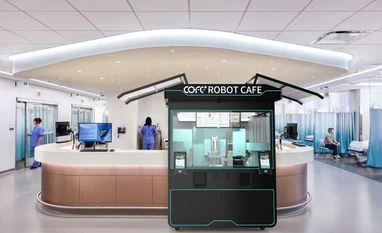
The 5.5th generation COFE+ Robot barista is multi-functional and allows taste customisation
Listen to This Article
Chinese tech companies are selling robots around the world, even with the ongoing trade war. At the Canton Fair in Guangzhou, one of the country’s biggest trade shows, buyers are lining up to see robot cafes, cleaning machines, and smart prosthetic limbs, reported The South China Morning Post.
One popular display shows two robotic arms making lattes at an automated cafe. In just the first two days of the event, the machine has already brought in 8 million yuan (US$1.1 million) in orders.
The robot cafe is made by Dolphin Robot Technology. Founder Han Zhaolin said they didn’t expect such a big response. “To our surprise, the enthusiasm from buyers this year has been overwhelming,” Han said. “Buyers from Vietnam to the Middle East showed a strong willingness to purchase on site.”
Even though the US and China have raised tariffs on each other’s products by more than 120 per cent, Han said it hasn’t hurt sales. Their robot cafe, now in its fifth generation, has nearly 100 patents and faces little competition globally.
“We aren’t bearing the tariff, nor are we lowering our prices, because US customers have rigid demand,” he said. “There’s nothing like this produced in the US, Germany or Japan, and similar products from South Korea cost twice as much.”
Also Read

 "White House")
 "China Flag, China")
 "Steel, steel coils, steel plant")
 "Aito M5 EV, EV car")
 "satellite rocket space")
Robots stay strong despite tariffs
Han’s story is part of a bigger trend at the fair. Many Chinese smart products are still doing well in global markets, even during the trade war.
That’s because most of their parts are made in China, so they don’t get hit by extra taxes. Also, they are usually cheaper and faster to produce than similar products in other countries.
Smart bionic limbs enter US market
Another Zhejiang-based company of China, Zhejiang Qiangnao Technology, is working to bring its high-tech bionic arms and legs to the US. These smart limbs are powered by software that learns from the brain.
“Our company’s smart bionic legs and hands … are only one-fifth to one-seventh the cost of similar Western products,” Pan Siyu, a company representative, told The South China Morning Post.
The products already have approval from the US Food and Drug Administration (FDA) and are included in the US medical insurance system. They cost about $50,000, which is still affordable for the market. But Pan said that could change if tariffs go up again.
“It all depends on how high the tariffs go … US policies change frequently. We can’t predict how our products will be classified next,” Pan added.
Award-winning robot cleans skyscrapers
Lingdu Intelligent Tech Development, a company based in Guangzhou, won the top prize at the Canton Fair with its skyscraper-cleaning robot. The robot can wash buildings as tall as 500 metres, doesn’t need water pipes or wires, and can hold tight even in hurricane-level winds.
“There are very few competitors in the market,” said Chen Sihong, sales director at Lingdu. “Other products still require external water pipes and wires, and can only reach about 60 metres.”
The robot is already sold in over 20 countries, and international demand is high. Buyers from the Middle East are especially interested because of the cost savings.
“Cleaning services are expensive in foreign countries. Cleaning the exterior wall of a building cost about $2 per square metre, while using our robot costs just 2 yuan ($0.27),” Chen said.
“The investment will be paid off with just one or two buildings cleaned. Plus, the robot can operate 24/7 and has a lifespan of up to eight years,” Chen mentioned.
Robot cafe saves space and cuts costs
The robot cafe from Dolphin Robot is small—just 2.5 square metres—but powerful. It can make more than 50 types of drinks, like coffee, milk tea, matcha, and chocolate. Each drink takes just 50 seconds, and can be adjusted by size, sweetness, temperature, and strength.
The machine also saves a lot of money. It can be controlled using a smartphone, fixes 90 per cent of its own issues, and can run for 10 years without needing staff.
“A single smartphone can remotely manage the entire robot cafe,” Han said. “It can self-repair 90 per cent of malfunctions, operate continuously for 10 years without the need to hire anyone, and the monthly electricity cost is only 300 to 500 yuan – less than 5,000 yuan a year.”
“In contrast, a typical cafe in the US pays over 10,000 yuan per month just for electricity.”
Han also believes the trade war is actually helping interest in Chinese technology.
“It’s not a bad thing,” he said. “It makes many foreign buyers more interested and more willing to try China’s new generation of tech products. That’s one of my biggest takeaways from this year’s Canton Fair.”
More From This Section
 "US China, US China flag")
 "Pope Francis, St Peter's Basilica")
 "Donald Trump, Trump")
 "Donald Trump")
 "The Harvard University campus in Cambridge")
Don't miss the most important news and views of the day. Get them on our Telegram channel
First Published: Apr 24 2025 | 12:24 PM IST