


Fed leaves rates unchanged, signals cautious outlook as US economy improves
The Federal Open Market Committee voted 10-2 Wednesday to hold the benchmark federal funds rate in a range of 3.5%-3.75%
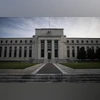 "US Federal Reserve, Fed")
Credit: Bloomberg
Listen to This Article
Amara Omeokwe
Federal Reserve officials left interest rates unchanged and pointed to improvements in the US economy as they signaled a more cautious approach to potential future adjustments.
The Federal Open Market Committee voted 10-2 Wednesday to hold the benchmark federal funds rate in a range of 3.5%-3.75%. Governors Christopher Waller and Stephen Miran dissented in favor of a quarter-point reduction.
In a post-meeting statement, policymakers said “job gains have remained low, and the unemployment rate has shown some signs of stabilization.” Officials also dropped language pointing to increased downside risks to employment that had appeared in the three previous statements.
The upgraded assessment of the labor market is likely to hold expectations for a near-term rate cut at bay, despite escalating pressure from the Trump administration. Heading into the meeting, investors saw another cut as unlikely until at least June.
Also Read

 "Jerome Powell")
 "trade war, global trade")
 "The US Supreme Court in Washington, DC")
 "Donald Trump")
 "Trump")
Bond yields were largely unchanged with 10-year yields steady at about 4.25%. The dollar edged lower from the day’s high, which came after Treasury Secretary Scott Bessent touted a strong-dollar policy earlier. The S&P 500 was also little changed on the day.
In remarks to reporters after the meeting, Fed Chair Jerome Powell further talked up a “clear improvement” in what’s expected for the US economy in the year ahead.
“The outlook for economic activity has improved, clearly improved since the last meeting, and that should matter for labor demand and for employment over time,” he said.
The Fed chief reiterated that the labor market has shown signs of stabilizing, but added, “I wouldn’t go too far with that,” noting there were also signs of continued cooling.
He demurred when asked what it may take for the committee to cut again.
“We’re not trying to articulate a test when to next cut or whether to cut at the next meeting,” he said. “What we’re saying is we’re well positioned as we make decisions meeting-by-meeting, looking at the incoming data, evolving outlook and all that.”
Wednesday’s decision was widely expected after policymakers lowered interest rates at three consecutive meetings in the closing months of 2025. Based on rate projections issued in December, most officials see the Fed cutting again later this year. But given concerns over still-elevated inflation and signs of stability in the labour market, several policymakers recently indicated they saw no immediate need for an additional reduction.
Policymakers, in their statement, marked up their view of the economy, describing the pace of growth as “solid.” Since October they had said the economy was expanding at a “moderate pace.” They also dropped a reference to inflation having moved up.
On inflation, Powell said the overall story was “modestly positive,” despite his estimate that the Fed’s favored gauge of core price increases will likely end 2025 at 3%, a full percentage point above target.
But, he added, “most of the overshoot was in goods prices, which we think is related to tariffs, and ultimately, we think those will not result in inflation, as opposed to a one-time price increase.”
Political Backdrop
In the opening portion of his press conference, Powell avoided answering most questions about the extraordinary political backdrop overshadowing the central bank, including questions about the Department of Justice’s criminal investigation into the Fed chief.
The DOJ earlier this month issued subpoenas to the Fed, prompting Powell to issue an unusually forceful response, accusing the administration of using the investigation as a form of intimidation.
Without commenting directly on pressure from the Trump administration over rates, Powell repeated his defense of central bank independence.
“The point of independence is not to protect policymakers,” he said. “It’s just an institutional arrangement that has served the people well.”
Asked whether he’d made a decision on whether to remain on the Fed’s Board of Governors after his term as chair expires in May, Powell said no, and declined to say when he may decide.
Powell did comment on his decision to attend a Supreme Court hearing last week over President Donald Trump’s attempt to fire Fed Governor Lisa Cook.
“That case is perhaps the most important legal case in the Fed’s 113-year history,” Powell said. “I thought it might be hard to explain why I didn’t attend.”
Comforting Data
Officials have broadly coalesced around the view that Fed policy is well-positioned for now, offering them time to assess incoming information on inflation and the labor market.
That represents a shift from recent months in which disagreements over the economic outlook led to a spirited debate about the appropriate path for rates. Some called firmly for cuts to support a labor market they viewed as fragile. Others urged caution, citing inflation as the more pressing concern.
Fresh economic data have offered some comfort for both camps. While hiring remains anemic, layoffs have also stayed low and, in December, the unemployment rate ticked lower, suggesting the labor market might be stabilising.
Figures on consumer prices for December, meanwhile, showed underlying inflation was softer than anticipated. Still, distortions to price measurements from last year’s government shutdown won’t fully unwind until this spring, meaning Fed officials may view the data with limited confidence.
Several policymakers have argued that 175 basis points of Fed rate cuts in the last 16 months have brought policy much closer to the so-called neutral level that neither stimulates nor restrains the economy, further reducing the urgency for more cuts.
An exception is Miran, who’s on unpaid leave as a top White House economic adviser. He estimates the central bank’s benchmark rate remains well above a neutral setting and says the Fed should slash it by 150 basis points this year.
Waller, who is among Trump’s top candidates to replace Powell when his term as chair expires in May, has repeatedly raised concerns about labor market fragility, but more recently signaled the Fed need not rush to lower rates again.
More From This Section
 "Puma")
 "Vietnam flag")
 "Keir Starmer, Keir, Starmer, UK")
 "Google AI Overviews")
 "Nouri al-Maliki")
Topics : US Federal Reserve
Don't miss the most important news and views of the day. Get them on our Telegram channel
First Published: Jan 29 2026 | 3:05 AM IST