


'Without corn, there is no country': Why Mexico has banned GM corn planting
Mexico has amended its Constitution to recognise native corn as part of its national identity and has banned genetically modified (GM) seed cultivation to protect biodiversity and cultural heritage
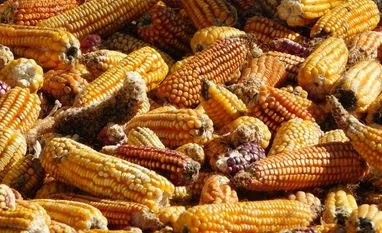 "Mexican corn, Mexico, Mexico GM corn")
Mexico has taken a decisive step to protect its agricultural heritage by amending its Constitution to recognise native corn as an element of national identity and banning the planting of genetically modified (GM) seeds. (Photo: Wikimedia commons)
Listen to This Article
Mexico has taken a decisive step to protect its agricultural heritage by amending its Constitution to recognise native corn as an element of national identity and banning the planting of genetically modified (GM) seeds. The move, approved by Congress and state legislatures this week, solidifies Mexico’s commitment to preserving maize biodiversity and has sparked fresh debate over trade and sovereignty.
Corn: A symbol of Mexican identity
Corn is deeply embedded in Mexico’s cultural and historical fabric. The phrase Sin maíz, no hay país—“Without corn, there is no country”—reflects its significance not only as a dietary staple but also as a national symbol.
The crop originated in Mexico nearly 9,000 years ago when Mesoamerican farmers domesticated teosinte, a wild grass. Since then, corn has remained central to Mexican life, appearing in everything from ancient Aztec carvings of the maize deity Centeotl to the works of modern artists like Diego Rivera and Frida Kahlo.
Today, the average Mexican consumes up to two pounds of corn daily, in the form of tortillas, tamales, pozole, and other traditional foods.
Also Read

 "Nayab Singh Saini")
 "immigration")
 "Police, Delhi Police")
 "Rajnath SIngh")
 "task scam")
“This isn’t just about protecting biodiversity,” President Claudia Sheinbaum recently stated. “Corn is the foundation of our culture and our sovereignty. It ties us to our origins and the resilience of Indigenous peoples.”
Economic and trade implications
The constitutional reform follows an earlier attempt to phase out GM corn imports, which was struck down in December by a US-Mexico-Canada Agreement (USMCA) trade panel.
US corn farmers—who export nearly $5 billion worth of GM corn to Mexico annually, primarily for livestock feed—lobbied against the restrictions.
While Mexico complied with the ruling, the new amendment focuses on domestic agriculture, banning GM seed cultivation rather than GM corn imports.
Activists have long warned that illegal plantings and cross-pollination are contaminating Mexico’s native maize. Some ancestral maize varieties have already disappeared due to the spread of engineered traits.
The dispute is particularly complex given Mexico’s evolving role as both an importer and exporter of corn. Though Mexico relies heavily on US corn imports, it also exports substantial quantities of its own corn, primarily to Latin America and select international markets.
Shifts in Mexican corn trade
Mexico was a corn exporter until the 1980s, but the North American Free Trade Agreement (NAFTA) in 1994 reshaped the industry. With federal subsidies, US farmers flooded the Mexican market with cheap corn, making it difficult for small-scale Mexican farmers to compete.
Corn imports surged from 3.1 million metric tonnes in the early 1990s to nearly 23.4 million metric tonnes today.
The decline of Mexico’s domestic corn industry forced many farmers to shift to subsistence agriculture or migrate in search of work. The latest constitutional amendment is seen by many as an attempt to reclaim agricultural independence and restore balance in the corn sector.
Despite its reliance on US corn imports, Mexico has been expanding its export markets in recent years. In 2023, Peru emerged as the largest destination for Mexican corn, with imports valued at $14.8 million.
Other top buyers included:
• Guatemala ($12.9 million)
• Ecuador ($12.7 million)
• United States ($10.9 million)
• El Salvador ($5.73 million)
• Cuba ($5.41 million)
Trade with Costa Rica and the United Kingdom was relatively smaller, with imports worth $191,000 and $100,000, respectively.
GM corn and health concerns
Beyond economic concerns, the ban on GM corn cultivation has been framed as a public health and environmental issue.
Maria Elena Alvarez-Buylla, a molecular genetics researcher at the National Autonomous University of Mexico, has published studies suggesting that GM corn and associated herbicides pose risks to human health.
She claims that 90 per cent of tortilla samples in several Mexican cities contained traces of GM corn, raising concerns about its long-term effects.
The US agricultural industry, however, strongly disputes these claims.
Trade tensions with the US
The corn battle is the latest in a series of trade tensions between the US and Mexico.
President Donald Trump has imposed tariffs on Mexican exports, escalating economic friction. Critics argue that US trade policy is contradictory—demanding respect for free trade agreements while imposing protectionist measures when convenient.
Despite US pressure, the Mexican government insists that public support for banning GM seed cultivation remains strong.
At its core, the issue is not only about trade but about national identity.
With the constitutional reform now awaiting President Sheinbaum’s signature, Mexico has drawn a line in the sand: its corn, its culture, its rules.
More From This Section
 "Sunita Williams and Barry Wilmore")
 "NATO")
 "Joe Biden, autopen")
 "Donald Trump, Trump")
 "Mark Zuckerberg")
Topics : BS Web Reports US mexico Mexico Maize
Don't miss the most important news and views of the day. Get them on our Telegram channel
First Published: Mar 17 2025 | 8:47 PM IST