


Joel Mokyr, Philippe Aghion, Peter Howitt win Nobel Prize in Economics
Mokyr won half the prize for identifying factors behind sustained growth via technological progress, while Aghion & Howitt shared the other half for their theory of growth through creative destruction
 "Nobel Prize in Economics 2025")
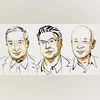
2025 Nobel Prize in Economic winners: Joel Mokyr (left), Philippe Aghion (middle) and Peter Howitt (right). (Photo: X/@NobelPrize)
Listen to This Article
The 2025 Nobel Prize in Economic Sciences has been awarded to Joel Mokyr, Philippe Aghion, and Peter Howitt for their work on “innovation-driven economic growth”, the Nobel Committee said on Monday.
Mokyr, a professor at Northwestern University in the US, received half of the prize for identifying the prerequisites of sustained growth through technological progress. The other half, was jointly conferred to French economist Aghion of Collège de France, and Howitt of Brown University for developing the theory of sustained growth through creative destruction.
“Over the last two centuries, for the first time in history, the world has seen sustained economic growth. This has lifted vast numbers of people out of poverty and laid the foundation of our prosperity. This year’s laureates in economic sciences... explain how innovation provides the impetus for further progress,” said The Royal Swedish Academy of Sciences, which is responsible for selecting Nobel laureates in physics, chemistry and economic sciences.
The economics prize is formally known as the Sveriges Riksbank Prize in Economic Sciences and is presented along with other Nobel Prizes on December 10 in Stockholm, Sweden.
Also Read

 "Nobel Prize")
 "Tata Capital")
 "transfer pricing provisions, associated enterprise definition, draft Income Tax Bill 2025, beneficial ownership tax rule, intra-group transactions India, house property income taxation, pre-construction interest deduction, Income Tax Act associated e")
 "Ujjivan Small Finance Bank news, Ujjivan SFB stock price today, Ujjivan SFB share target 2025, Ujjivan bank universal license update, Small finance banks in India 2025, Best small finance bank stocks India, Universal banking license India, RBI univer")
 "trade talk, India, US")
BREAKING NEWS The Royal Swedish Academy of Sciences has decided to award the 2025 Sveriges Riksbank Prize in Economic Sciences in Memory of Alfred Nobel to Joel Mokyr, Philippe Aghion and Peter Howitt “for having explained innovation-driven economic growth” with one half to Mokyr… pic.twitter.com/ZRKq0Nz4g7
— The Nobel Prize (@NobelPrize) October 13, 2025
Contribution of Joel Mokyr
Economic historian Mokyr, the committee said, “Used historical sources as one means to uncover the causes of sustained growth becoming the new normal.” He stressed that in order for innovations to succeed one another in a self-generating process, it is not enough to know that something works, but understanding the scientific reasons why it works is also essential.
Before the industrial revolution, such explanations were often missing, making it difficult to build on new discoveries and inventions, the committee said.
Contribution of Aghion & Howitt
Meanwhile, Aghion and Howitt developed a mathematical model of ‘creative destruction’, describing it as a process in which new and better products enter the market, causing companies selling older products to lose out, the committee said.
They argued that creative destruction creates conflicts that must be managed in a constructive manner. Otherwise, established companies and interest groups threatened by change can hinder innovation.
John Hassler, chair of the Committee for the prize, said, “The laureates’ work shows that economic growth cannot be taken for granted. We must uphold the mechanisms that underly creative destruction, so that we do not fall back into stagnation,”
Last year, the Nobel Prize in Economic Sciences was awarded to US-based scholars Simon Johnson, James Robinson, and Daron Acemoglu for their research examining how colonisation and the establishment of public institutions help explain why some countries have remained trapped in poverty for decades.
More From This Section
 "Crime, Prison, Law, Arrest, Punishment")
 "Donald Trump")
 "china, china flag, Politburo")
 "Donald Trump, Trump")

Topics : Nobel Prize Nobel Prize in Economics Nobel prize for Economics Economics Nobel prize BS Web Reports
Don't miss the most important news and views of the day. Get them on our Telegram channel
First Published: Oct 13 2025 | 3:34 PM IST